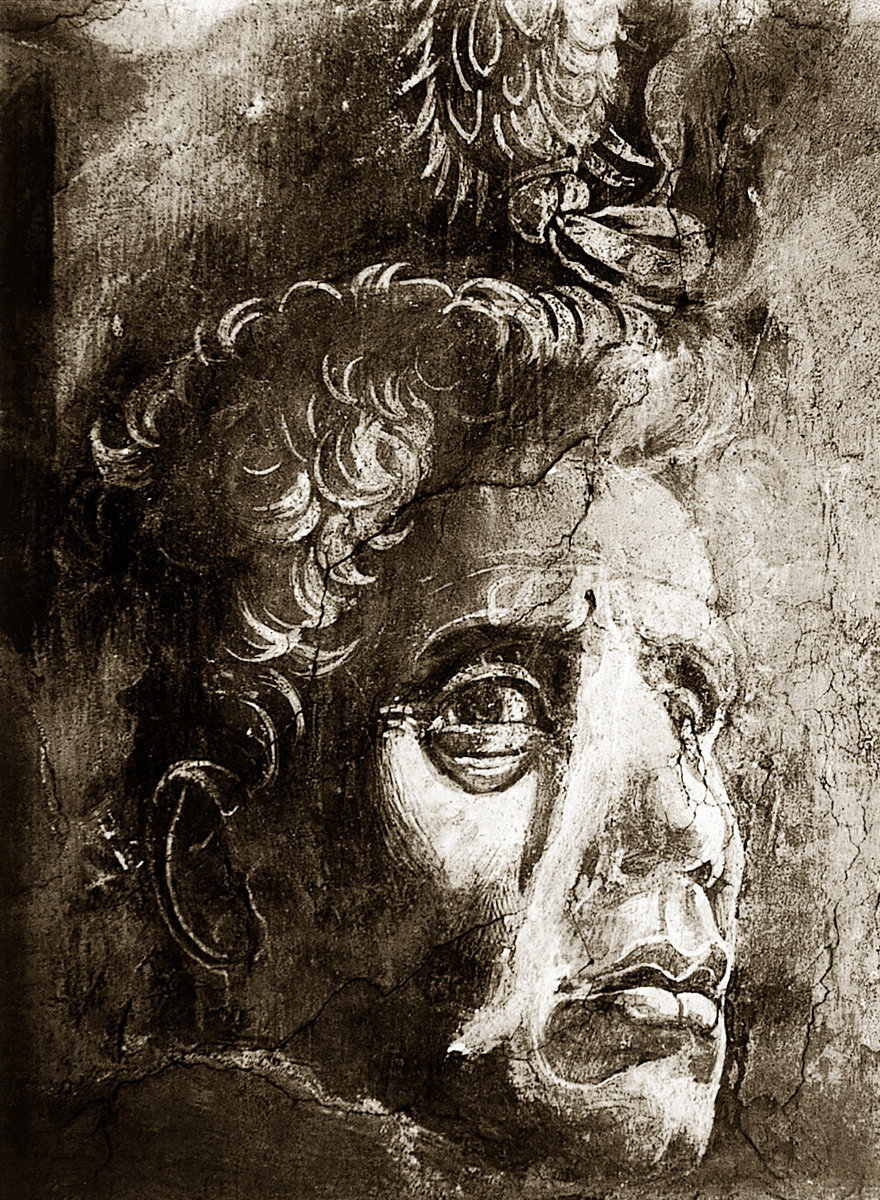
14. Self-Portrait (destroyed), c. 1448-1457.
Fresco. Ovetari Chapel, Church of the Eremitani, Padua.
Since Antonio degli Ovetari and his wife Imperatrice had friends and associates who were learned and scholarly citizens of Padua, it is not surprising they would wish to have paintings done in the new Renaissance style, with strong classical overtones. And indeed, although some older, more conservative artists from Venice were for a brief time intended to share in the project (they eventually painted only some lesser parts of the chapel), it was the new generation of Renaissance painters who were destined to paint the great narrative scenes. The patrons perhaps turned first to the locally famous Squarcione, who then passed along the work largely to his talented student Mantegna. Other painters were involved as well. Another pupil of Squarcione, Niccolò Pizzolo, was now a practicing painter and sculptor, and he got a large part of the commission. Pizzolo died in a sword fight at the age of thirty-three, before he could paint anything but a few figures around the perimeter and on the vault of the chapel; he also made the sculptured altar showing the Madonna and Saints, its wiry figures inspired by the style of Donatello.
Pizzolo was about ten years older than Mantegna, and he must have impressed upon the young artist the importance of studying the new Tuscan Renaissance manner, which he had so thoroughly imbibed. Indeed, the Ovetari Chapel is a microcosm of the pattern of change which brought about the change toward the new style in art. Older masters did not respond favourably to the Tuscan Renaissance style, but the younger generation, including Mantegna and Pizzolo, took the lead in ushering the novel manner in to their local setting. This shift occurred in city after city during the fifteenth century – including Ferrara, Milan, Venice, Urbino – as the central Italian style was adopted, interpreted, and varied by a wide range of artists. Compared to Mantegna and Pizzolo, even the work of Squarcione was rather conservative and unadventurous (cf. Fig. 6); it was the master’s training and open attitude to the study of various styles that was progressive. The Ovetari Chapel was a showpiece of artistic revolution, and Mantegna, thanks partly due to the early death of Pizzolo, was responsible for the greatest part of the work.
The Ovetari Chapel was almost completely destroyed during an aerial raid in 1944 when a cluster of bombs meant for the nearby railroad yards fell wide of the mark. Fortunately, colour illustrations of the works were taken shortly before the destruction. Some of the works were removed from the wall for restoration before the raid, notably Mantegna’s Assumption of the Virgin (Fig. 19) and his Martyrdom of Saint Christopher (Fig. 7); these survive and have been reinstalled in the chapel, giving us an idea of Mantegna’s great achievement.
Some of the more extraordinary works of art of the fifteenth century resulted from the application of Renaissance ideals of lively and detailed narrative to the illustration of fantastic medieval accounts of saints. Most of Mantegna’s scenes in the Ovetari Chapel were drawn from the Golden Legend of Jacobus de Voragine, a thirteenth-century Dominican priest from northern Italy. His colourful stories of the lives of saints are often lacking in historical authenticity or Biblical authority, but for centuries they moved and inspired the faithful to worship Christian martyrs and heroes. In Mantegna’s time, despite new secular trends in culture, the religious fervour of the Middle Ages had not passed. Men and women still saw visions, went on long pilgrimages, believed in miracles, and feared the intervention of the devil in human affairs. The frescoes of the Ovetari Chapel were painted for people who still passionately believed in the power of God and even in the veracity of the most far-fetched Christian legends. On the left wall of the Ovetari Chapel Mantegna represented scenes from the life of Saint James the Greater. Niccolò Pizzolo was originally to have painted part of the left wall, but his slowness and his early death meant Mantegna ended up painting this wall, working off and on between 1449 and 1455 (Fig. 16).