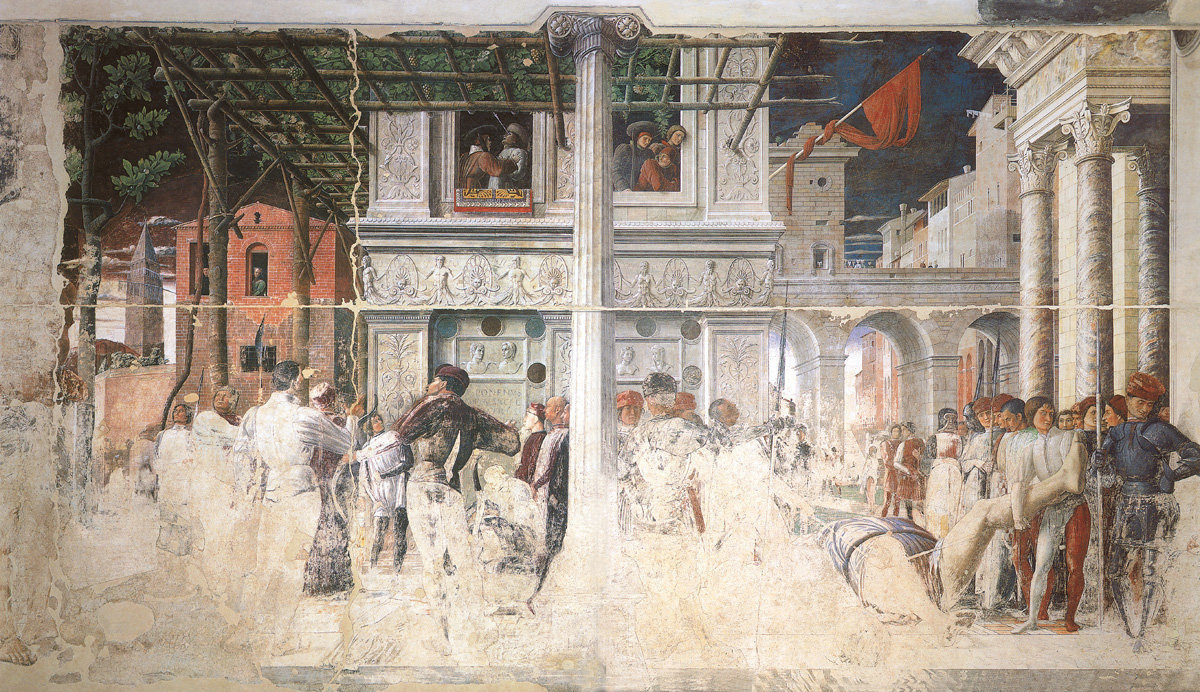
7. Martyrdom of St Christopher, c. 1448-1457.
Fresco. Ovetari Chapel, Church of the Eremitani, Padua.
An important development in intellectual culture of the early fifteenth century was the remarkable rise in humanistic learning. Today there are several meanings and connotations for the word “humanist.” In the context of Renaissance history, a humanist is one whose chief field of study was literature, especially that of classical Greece and Rome. Some ancient literature was known throughout the Middle Ages, but it was studied largely for its value as way of improving one’s grammar, logic, and vocabulary, though its underlying paganism caused it to be held in suspicion. In the fourteenth- and, increasingly, the fifteenth century classical writings were avidly being sought by scholars and wealthy patrons. The Florentine humanist Poggio Bracciolini (d. 1454) scoured the libraries in medieval monasteries in Switzerland and rediscovered manuscripts of works by Cicero and Tertullian; valuable texts which had been left rotting in piles of parchment, neglected and unknown for centuries. The scholar Niccolò Niccoli (d. 1437) rediscovered several classical texts, and he formed his own small collection of Roman statuary and cameos. By the time of Mantegna’s birth, the revival of classical literature and ideals was in full swing, the interest in antiquity fuelled by a tenacious and passionate group of humanists. The interest in classical culture spread quickly to a larger public in fifteenth-century Italy, well beyond the narrow ranks of humanist scholars. A whole new secular world opened that had hitherto been largely ignored, and people of all ages and social backgrounds came to embrace this great rediscovery. As a painter, Mantegna would cater to the demands of a public thirsting for art, both sacred and secular, which imitated the distant but laudable civilisations of classical antiquity.
The northern Italian city of Padua (Fig. 5), where Mantegna would begin his artistic career, had been the ancient Roman city of Patavium and in the fifteenth century as today still contained some classical ruins. In addition to these physical remains of Roman civilisation, it was a city redolent with the spirit of antiquity because of the intellectual interests there in ancient literature. Padua was one of the main centres in Renaissance Italy of humanist scholarship; its university was the chief institution of higher learning in the Venetian Republic (to which Padua was subjected in 1405 and thereafter), and a number of professors were leaders of their fields in the study of ancient Greek and Latin literature.