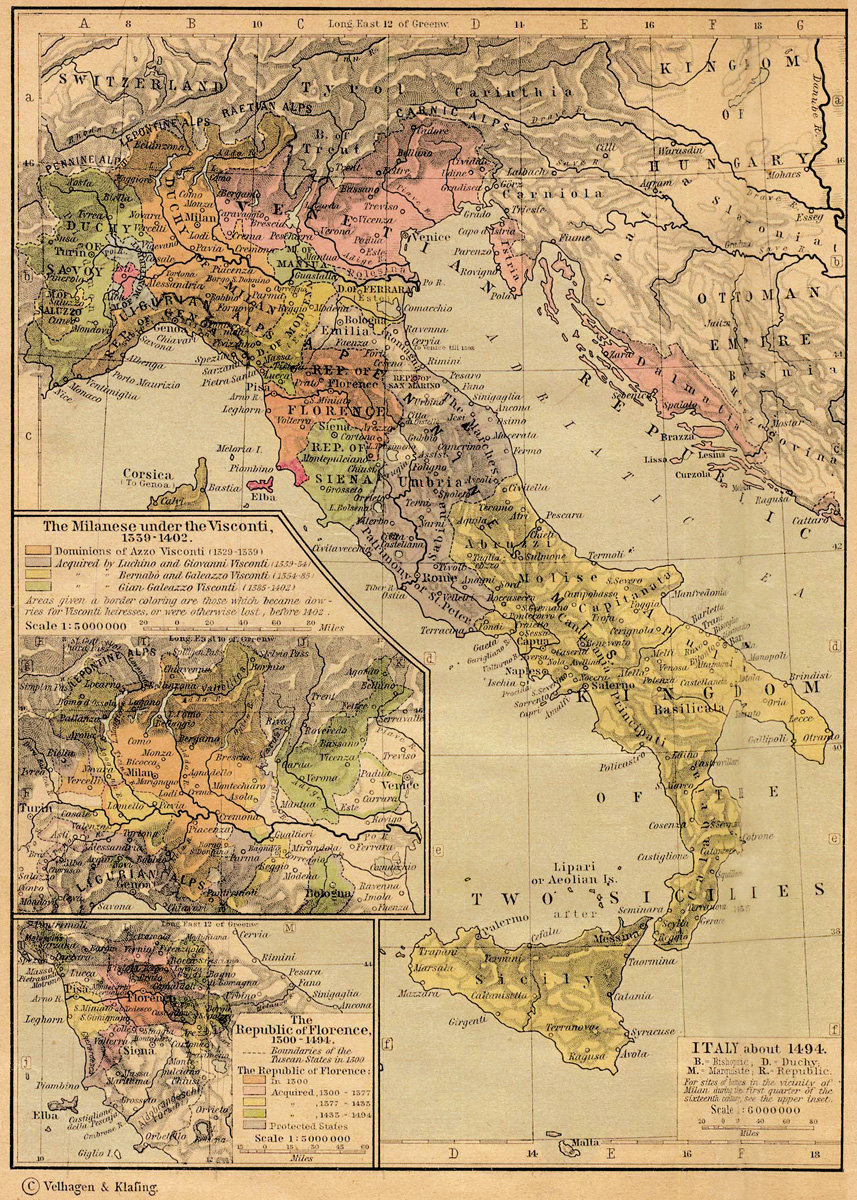
5. Map of Italy, c. 1450.
The University of Texas Libraries, Austin.
The Debut of a Prodigy: Mantegna’s Early years in Padua
Andrea Mantegna lived during a time of social and cultural change in Italy. The continuity of institutions – government, church, family – masks the social and cultural changes which occurred in Italy over several centuries leading up to Mantegna’s time. By the Quattrocento, in place of static, agrarian society there had developed flourishing, urban economies based on trade and small manufacturing. Fifteenth-century Italy had become evermore dominated by bankers, manufacturers, traders and lawyers rather than landholders. A dynamic social structure resulted from this shift toward mercantile, city life, leading to more head-to-head competition between individuals and families, and one had to get along in a constantly changing world which promised few people automatic status or continued prosperity. This shift was readily apparent in larger urban centres such as Florence and Venice, but was also felt in smaller cities and city-states where political control remained held by a single family, who had to operate in the framework of a dynamic balance of political power and had to survive in a fragmented world.
This competitive and changing atmosphere gave rise to a new, pragmatic attitude among Italians. People came more and more to observe, measure, describe, and admire the world around them; a new culture took root based increasingly on science, commerce, and exploration. Indeed, this worldly attitude would lead to the discovery of new lands and peoples in Africa, Asia, and the Americas. The nineteenth-century historian Jacob Burckhardt aptly called the Renaissance the era of the “rediscovery of the world and of man.” This entailed broad intellectual changes, and affected all aspects of the sciences and the humanities. Italians became more keenly interested in what we would call psychology, analysis of family life and societal roles, and an incipient fascination with anthropological issues. There was even a new realistic approach taken in the social science of political philosophy; we recognise the pragmatic and sometimes cynical advice on statecraft of Niccolò Machiavelli as a sign of the times, a tough-minded response to the vicissitudes of ever-changing fortune. The new naturalism encompassed a growing focus on the personal experience, and this gave rise to a new kind of individualism. Renaissance literature, letters, and other records indicate a level of self-reflection and self-consciousness not seen since antiquity.
Fifteenth-century artists such as Mantegna responded to the growing interest in the real world with an increasing naturalism in their paintings and sculpture. The development of convincing perspective, the representation of cityscape and landscape views, and the growth of portraiture all progressed during the fifteenth century. Many painters consciously sought to imitate Nature, although some artists still indulged in unnatural effects and fantastic idealism in their art. Mantegna belonged to a group of artists known among contemporaries for their striking realism.
In addition to this ever-increasing engagement with material existence, another major aspect of the new, comprehensive investigation of the secular world was the rediscovery of antiquity, especially ancient Roman civilisation, which had left in Italy so many monuments and surviving literary texts in its wake. There developed an almost obsessive preoccupation in early Quattrocento Italy with all things classical: statues, poetry, inscriptions, and coins were collected, treasured, and studied, and ancient buildings were admired as never before since the time of the collapse of the Roman Empire nearly a thousand years before. These two focal points of Renaissance culture – a fascination with the real world (both human and natural) and a powerful attraction to classical art and civilisation – formed the central focal points of Andrea Mantegna’s art.
During the Middle Ages there remained only a lukewarm interest in the visual arts of Greek and Roman antiquity. Ancient Roman art was only known to a minor extent even in Italy, and there was little inclination to excavate the remains of a fallen, pagan civilisation. An incident that occurred in the central Italian city of Siena in the 1340s will serve to indicate the ambivalent attitude held toward the classical past in medieval Italy. A marble statue of the Roman goddess Venus was unearthed by chance and was placed in the central square of the city. The public was interested at first, and at least one painter even drew copies of it. But after a while the Sienese became worried, and some claimed it would bring disaster on the city if they continued to pay attention to this nude, heathen idol. The Sienese, who were at war with the Florentines at the time, smashed the sculpture into bits and crossed over one night into Florentine territory to bury the fragments, believing their enemies would come to suffer misfortune just by having these pieces in their lands!
This superstitious attitude changed rapidly in the early years of the fifteenth century. How different it was in the year of Mantegna’s death when the Laocoön was rediscovered near Rome. This ancient Greek sculpture, representing a high priest of Troy and his sons being strangled by a serpent sent by a punishing god, was universally admired when it was dug out of the ground in 1506. It was brought to the city in a grand parade as flowers were strewn in its path and church bells tolled, despite the pagan subject matter and the nudity of the figures. The Italian people had come to worship all things classical, and Mantegna – with his vividly painted representations of the ancient world – was an active player in the rebirth of Greek and Roman culture which has come to be called the Renaissance.