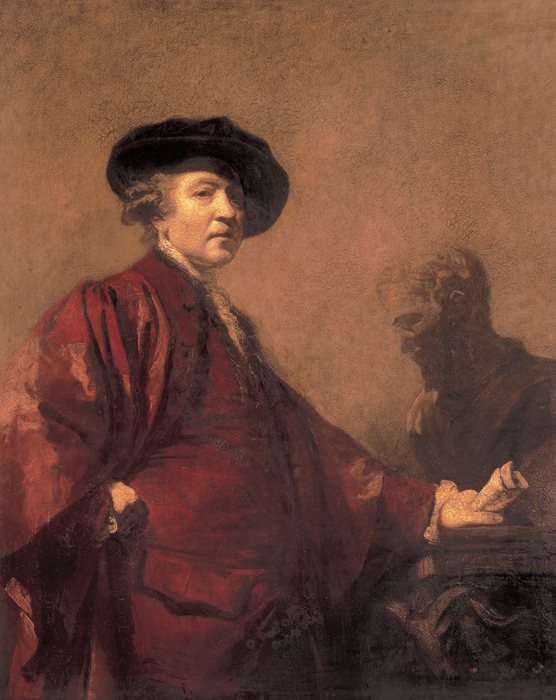
Sir Joshua Reynolds, Self-portrait in his Robes as a Doctor of Civil Law of Oxford University, 1773-80, Oil on canvas, 127 x 101.6 cm, Royal Academy of Arts, London
THE ROYAL ACADEMY
Farington was the means through which Constable entered the Academy Schools. He called on Farington for the first time in February 1799, with a letter of introduction from the author Priscilla Wakefield. The many friends they had in common, such as Beaumont and Dr John Fisher, the King’s chaplain (later Bishop of Salisbury), guaranteed Constable a warm reception. Farington told him that “he must prepare a figure” as a demonstration of his competence, and having done so, he was admitted as a probationer to the Royal Academy Schools and properly registered in the following year.
Constable’s earliest experiences in London, as he confided them to Dunthorne, were rather mixed. He rejoiced in the collections of Old Master paintings to which he now had access, and even told his friend that “I find my time will be more taken up in seeing than in painting.” But it was productive research, and he regularly made new discoveries: “I have the loan of a sweet little picture by Jacob Ruysdael to copy,” he wrote. “Since I have been in town I have seen some remarkably fine ones by him, indeed I never saw him before.”
As with Claude, Constable still thought it worthwhile copying from Ruysdael long after his apprenticeship years. He also managed to supplement his father’s modest allowance by producing drawings that were sold by J. T. Smith at reasonable prices. His personal and social life were less satisfactory. He was often homesick, once confessing to Dunthorne that “This fine weather almost makes me melancholy; it recalls so forcibly every scene we have visited and drawn together.” And if the account he gave of his typical day can be relied upon, he had little in the way of recreation, and perhaps few friends of his own age. For about eighteen months Constable’s closest friend in London was Ramsay Richard Reinagle, his exact contemporary, but a far more accomplished and wordly figure. They shared lodgings, jointly purchased a Ruysdael and Reinagle stayed with Constable’s family in Suffolk. Eventually the relationship soured: he found Reinagle’s attitude towards art cynical and exploitative, and although Constable was prone at times to adopt a tone of lofty moral superiority, Reinagle was undoubtedly dishonest.
In 1848, long after Constable’s death, Reinagle created a scandal by purchasing a landscape and exhibiting it at the Royal Academy as his own work. If he had little in common with his fellow students, some of the academicians themselves were friendly and encouraging. Besides Farington (whom he later referred to his master), he received kindly advice from the President, Benjamin West. When Constable suffered an early rejection at the Academy’s exhibition, West told him, “Don’t be disheartened, young man, we shall hear of you again; you must have loved nature very much before you could have painted this.” And he went on to offer a practical lesson in chiaroscuro. Constable’s early work was unremarkable, but West, like Farington, must have found a spark of promise, for in 1802 he persuaded Constable to refuse an offer of secure employment as a military drawing master. Unless he had real faith in the young man’s potential, it would have been cruel and irresponsible advice.
The rejection of this post, so thoughtfully arranged for him by Dr Fisher, marked a watershed in Constable’s early career. It forced him to commit himself: “Had I accepted the situation offered,” he told Dunthorne, “it would have been a death-blow to all my prospects of perfection in the art I love.” There had been occasions when Farington found him weak-willed and wanting in application, but in May 1802, he claimed to “have thought more seriously of my profession than at any other time of my life.” He reviewed his previous work, visited Beaumont’s collection to draw upon the example of the Old Masters, and returned with a deep conviction of the truth of Sir Joshua Reynolds’ observation, that “there is no easy way of becoming a good painter”. The Royal Academy was thoroughly imbued with the doctrines and posthumous influence of Sir Joshua Reynolds, its first president, and Constable was no exception. When making brief notes for his lectures in the 1830s, he wrote:
All Art in Europe
roused into life by
Sir Joshua Reynolds
in England
Constable may be forgiven for overstating his case. Prior to the foundation of the Royal Academy and Reynolds’ presidency, England was renowned only for its lack of great painters and struggled, in the words of the Redgrave brothers “against an old prejudice — namely, that art is neither congenial to our soil nor to our nature, and cannot flourish among us”. Reynolds’s career gave the lie to all such insinuations because he enjoyed European fame, both for his paintings and his writings. The Discourses, his published lectures to the students of the Royal Academy, provided (among other things) a sound and elegant resumé of European academic theory; they also raised the morale of young English painters. Constable celebrates Reynolds’s formative role in the development of a British school of painting in The Cenotaph of 1836. The Discourses were on the list of recommended reading supplied by John Cranch in 1796, but he also offered some words of warning: be cautious it does not bias you against Familiar nature, life and manners, which constitute as proper and as genuine a department of imitative art as the sublime or the beautiful. The Discourses are a work of unquestionable genius, and of the highest order of literature; but they go, if I may so express it, to establish an aristocracy in painting: they betray, and I believe have betrayed, many students into a contempt of everything but grandeur and Michael Angelo: the force and the splendid eloquence with which the precepts are inculcated, makes us forget that the truth of Teniers, and the wit and moral purposes of Hogarth, have been, and for ever will be, at least as useful, and diffuse at least as much pleasure, as the mere sublimities of Julio Romano and Raphael.
Cranch was outspoken in his criticisms of Reynolds, but he drew attention to themes within the Discourses that might easily have intimidated or discouraged a young landscape painter. The notion that there was a hierarchy of subject matter (or an aristocracy, as Cranch put it) was fundamental to academic teaching until well into the nineteenth century. Historical paintings were granted a higher status than portraits, whilst portraiture in turn was considered a more dignified form than landscape.