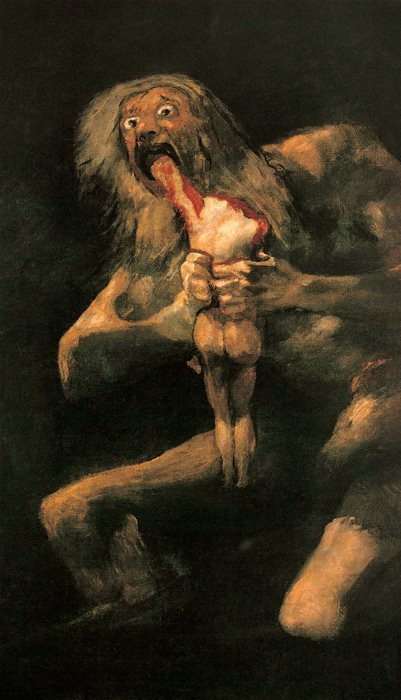
Francisco de Goya (1746-1828), Saturn devouring one of his sons, 1821-1823.
mural transferred to canvas, 143.5 x 81.4 cm.
Museo del Prado, Madrid.
Introduction
It is perhaps unsurprising that Salvador Dalí has proven to be one of the most popular artists of the twentieth century, for his finest works explore universal and timeless states of mind, and most of his pictures were painted with a mastery of traditional representation that has proven rare in our time. For many people, that acute realism alone would have sufficed to attract them to Dalí’s work, and it has certainly served to mask any gradual lessening of quality in his art. Moreover, Dalí was also probably the greatest artistic self-publicist in a century in which (as Igor Stravinsky commented in 1970), publicity gradually became ‘about all that is left of the arts’. In this respect he was in a class of his own for much of his lifetime, as was his brilliant wife and co-publicist, Gala.
Yet Dalí’s immense popularity is also rather ironic, for his work – in its finest phase, at least – constitutes an attack on the social, sexual and cultural morés of the very society that feted him. The notion that an artist should be culturally subversive has proven central to modernist art practice, and it was certainly essential to Surrealism, which aimed to subvert the supposedly rational basis of society itself. In time, Dalí’s subversiveness softened, and by the mid-1940s André Breton, the leading spokesman for Surrealism, was perhaps justifiably dismissing the painter as a mere showman and betrayer of Surrealist intentions. But although there was a sea-change in Dalí’s art after about 1940, his earlier work certainly retains its ability to bewilder, shock and intrigue, while also dealing inventively with the nature of reality and appearances. Similarly, Dalí’s behaviour as an artist after about 1940 throws light on the basically superficial culture that sustained him, and this too seems worth touching upon, if only for what it can tell us about the man behind the myths that Salvador Dalí projected about himself.
Salvador Felipe Jacinto Dalí i Domènech was born on 11 May 1904 in Figueres, a small town in the Catalan province of Gerona, northern Spain, the son of Salvador Dalí i Cusi and Felipa Domènech. Dalí senior was the public notary of Figueres and, as such, an important and widely respected local official. He was a very forceful man, and it was rumoured that he had been responsible for the death of Dalí’s elder brother, also named Salvador, who had been born in 1901 and who died in 1903; officially the death was caused by catarrh and gastroenteritis but according to Dalí, his older brother died of meningitis that had possibly been brought on by a blow to the head. Certainly that death left Dalí’s parents with an inescapable sense of anguish, and the young Dalí was always aware of the demise simply because both parents constantly projected his lost brother onto him, every day making comparisons between the two boys, dressing the younger Salvador in his deceased brother’s clothes, giving him the same toys to play with, and generally treating him as the reincarnation of his departed brother, rather than as a person in his own right.