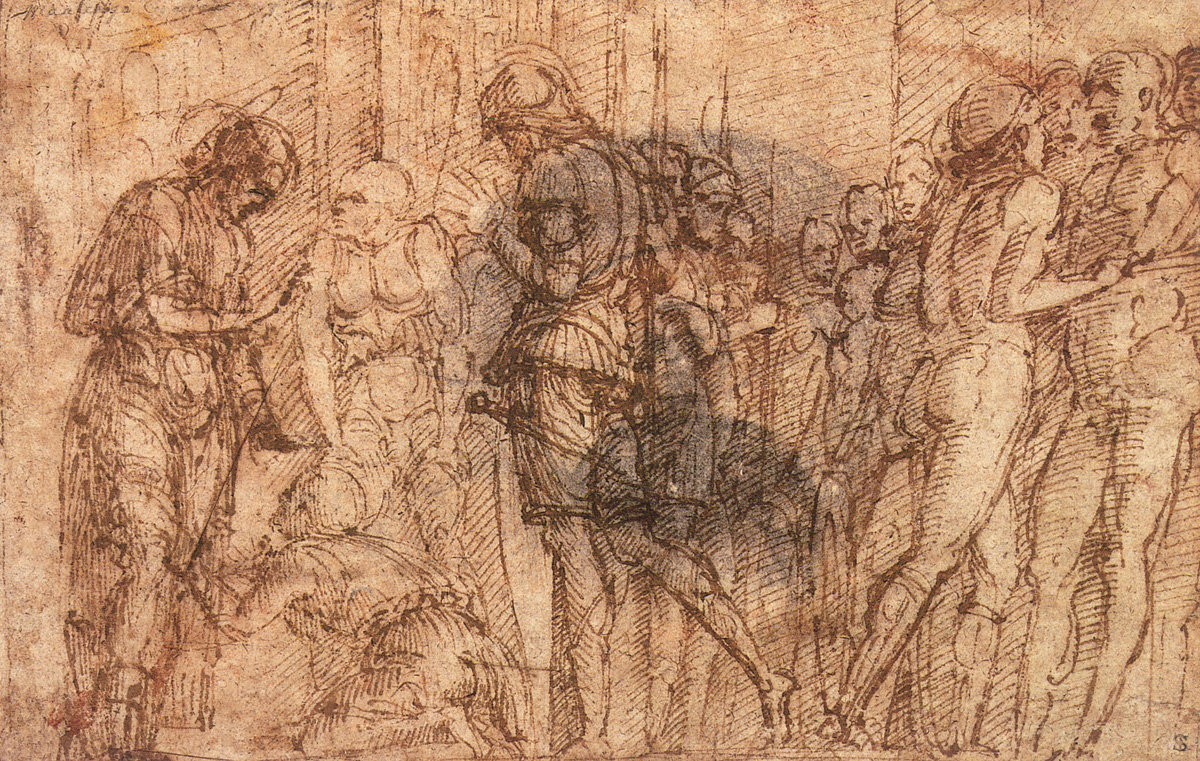
12. Preparatory drawing for the St James Led to Execution, c. 1448-1457.
Pen and ink and black chalk on paper, 15.5 x 23.4 cm. British Museum, London.
One of the characteristic exponents of the late Gothic style was Stefano da Zevio, whose Madonna and Child with God the Father in a Garden serves as an example of this graceful, decorative style: with its flowery background, elegant, ethereal figures, inexpressive faces, and delicate lighting running like quicksilver across the surfaces, it is characteristic of the traditional medieval fashion that was beginning to be replaced by the new tough and worldly manner which came to prevail in the early fifteenth century. In contrast to such a work, Mantegna would have been able to study Florentine Renaissance works in Venice, such as the saints by Andrea del Castagno in San Zaccaria, which convey a blunt, naturalistic, and monumental ideal of the human figure. Some bronze reliefs and freestanding figures by the Florentine sculptor Donatello were designed for the Paduan church of Sant’Antonio soon after 1443. These reliefs show the kind of deep space and dramatic narrative Mantegna would later echo in his own art. Donatello was mostly in Padua for the eleven years prior to 1453, and Mantegna is likely to have known him personally. Inspiration from Florentine art helped to propel art in northern Italy, including Mantegna’s, away from dreamy legacy of the late Middle Ages towards a brittle, dry, and more classicised style.
Blessed with a progressive training in the craft of painting and enviable talents, Mantegna was ready to start his professional career at an early age. In 1448, Mantegna painted an altarpiece in Padua for the high altar of the church of Santa Sophia. He was only seventeen years old, and even so this work was received with critical acclaim. Unfortunately this altarpiece is now lost. His next great commission came when he began, at the age of eighteen or so, to paint murals in a chapel in the Church of the Eremitani in Padua. The frescoes were commissioned by Antonio degli Ovetari, a member of a wealthy and established family of Padua.
After he died in 1448, his wife, Imperatrice, used the funds left in his will to have the project brought to completion. The chapel, a small section of the much larger church, was to be filled with frescoes depicting the lives of Saints James and Christopher. It is impossible to separate the religious from the secular motives of patrons of such grand projects, but clearly there was – in addition to the religious devotion of Antonio – a desire on his part to bring glory to himself and his whole family by causing such a great artwork to come into being. Indeed, murals in private chapels were essentially public monuments, symbols of the refinement and devotion of the local citizens; visitors to Padua from other parts of Italy and the rest of Europe would come to see the great frescoed walls of the Eremitani church. Today the family chapels of Italy form living museums, legacies of the religious spirit of the age as well as evidence of the personal pride of the patrons.