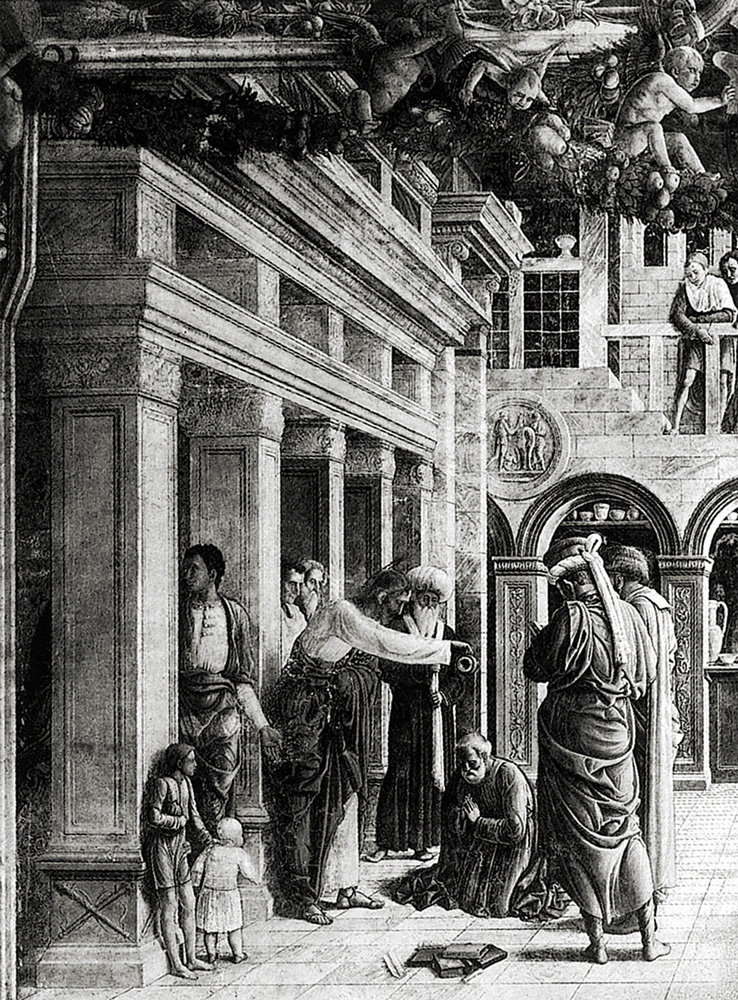
8. St James Baptising Hermogenes (destroyed), c. 1448-1457.
Fresco. Ovetari Chapel, Church of the Eremitani, Padua.
Many of the humanists in Padua were passionate recorders of ancient inscriptions, and throughout his life Mantegna maintained a strong interest in classical Roman lettering. Some humanists became admirers and counsellors of Mantegna, including the artist’s friend Ulisse degli Aleotti and the scholar Giovanni Marcanova, the latter a professor at the University of Padua. Mantegna maintained friendly relations throughout his life with learned advisers, and his early conversion to the spirit of classical revivalism was owed in large part to the humanistic atmosphere in Padua, where patrons as well as local scholars shared a taste for Greek and Roman culture.
The world of humanist scholars and classically minded patrons was an elite realm. Mantegna’s parents, who were of humble stock and living in a provincial village, certainly knew little of this exciting literary revival or of the new Renaissance artistic style. Mantegna’s father was a country carpenter from Isola di Cartura, a small town a few miles outside of Padua. Andrea spent some of his early years herding cattle near the family’s village, yet he must have shown some early interest or talent in drawing, for by 1442, probably at about the age of ten or eleven (the standard age at the time to begin an apprenticeship), Andrea’s father took him to the thriving city of Padua to a certain master painter named Francesco Squarcione (c. 1394-1468) and asked he give the boy room and board and teach him to be a professional painter.
Francesco Squarcione is not exactly a household name today, but he was an important figure in Italian painting of the period. The records of his professional activity as an artist and teacher constitute some of the most colourful episodes of Renaissance art history. Squarcione started his career as a tailor and embroiderer, and only turned to painting later on in life. The extent of his own artistic output is in dispute, but it is generally agreed that at least two of his paintings have survived, a small altarpiece (Fig. 6) and a panel painting of the Madonna and Child. These works, although carried out with a lively sense of design and an attention to detail, demonstrate he was a competent but not extraordinary painter.
Yet his workshop, which he kept filled with apprentices and pupils over the years, was a novel institution. Although guild regulations classified his school as a workshop, Squarcione called it a studium, or what we might call an art studio. It was arguably the first professional art school in Italy and in Europe. Beginning in 1431 and continuing until his death in 1468, Squarcione trained over 130 young artists in his school, among them Andrea Mantegna.