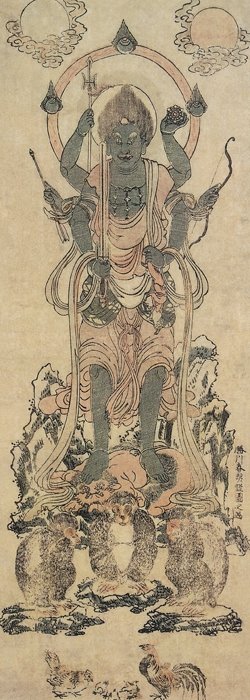
Blue Kongō (Seimen Kongō), 1780-1790.
Nishiki-e, 37.3 x 13.7 cm.
Honolulu Academy of Arts,
donation of James A. Michener, Honolulu.
I. Life of Hokusai
Hokusai was born in 1760 (October or November according to some, March according to others). He was born in Edo in the Honjô neighbourhood, close to the Sumida River and to the countryside, a neighbourhood to which the painter was much attached. He even signed his drawings, for a time, “the peasant from Katsushika”, Katsushika being the provincial district where the Honjô neighbourhood is located. According to the will left by his granddaughter, Shiraï Tati, he was the third son of Kawamura Itiroyemon, who, under the name Bunsei, would have been an artist of the new profession. Near the age of four, Hokusai, whose first name was Tokitaro, was adopted by Nakajima Isse, mirror designer for the Tokugawa royal family.
Hokusai, while still a child, became the assistant to a great bookseller in Edo, where while contemplating illustrated books, he carried out his duties as assistant so lazily and disdainfully that he was fired. Paging through the bookseller’s illustrated books and life in images for long months developed the young man’s taste and passion for drawing. Around 1773-74, he worked for a woodcutter, and in 1775, under the name Tetsuro, he engraved the last six pages of a novel by Santchô. Thus, he became a woodcutter, which he continued until the age of eighteen.
In 1778, Hokusai, then named Tetsuzo, abandoned his profession as a woodcutter. He was no longer willing to be the interpreter, the translator of another’s talent. He was taken by the desire to invent, to compose, and to give a personal form to his creations. He had the ambition to become a painter. He entered, at the age of eighteen, the studio of Katsukawa Shunshō, where his budding talent earned him the name of Katsukawa Shunrō. There, he painted actors and theatre sets in the style of Tsutzumi Torin and produced many loose-leaf drawings, called kyōka surimono. The master allowed him to sign, under this name, his compositions representing a series of actors, in the upright format of the drawings of actors by Shunshō, his master. At this time, the young Shunrō began to show a bit of the great sketch artist who would become the great Hokusai. With perseverance and relentless work, he continued to draw and to produce, until 1786, compositions bearing the signature of Katsukawa Shunrō, or simply, Shunrō.
In 1789, the young painter, at twenty-nine years old, was forced to leave Katsukawa’s studio under peculiar circumstances. As a matter of fact, Hokusai would keep the odd habit of perpetually moving and of never living more than one or two months in the same place. This departure took place under the following circumstances: Hokusai had painted a poster of a stamp merchant. The merchant was so happy with the poster that he had it richly framed and placed in front of his shop. One day, one of his fellow students at the studio, who had studied there longer than he, passed the shop. He thought the poster was bad and tore it down to save the honour of the Shunshō studio. A dispute ensued between the elder and the younger student, following which Hokusai left the studio, resolving to work only from his own inspiration and to become a painter independent of the schools that preceded him. In this country where artists seem to change names almost as often as clothes, he abandoned the signature of Katsukawa to take that of Mugura, which means shrub, telling the public that the painter bearing this new name did not belong to any studio. Completely shaking off the yoke of the Katsukawa style, the drawings signed Mugura are freer and adopt a personal perspective.
Hokusai married twice, but the names of his two wives are unknown. It is also not known whether or not his separation from them was due to death or divorce. It is certain that the painter lived alone after the age of fifty-two or fifty-three. By his first wife, Hokusai had a son and two daughters. His first son, Tominosuke, took over the house of the mirror designer Nakajima Isse and led a disorderly life, causing his father many problems. His daughter Omiyo became the wife of the painter Yanagawa Shighenobu. She died shortly after her divorce and after having given birth to a grandson who was a source of tribulation for his grandfather. His second daughter Otetsu was a truly gifted painter who died very young. By his second wife, Hokusai also had a son and two daughters. His second son, Akitiro, was a civil servant of the Tokugawa rule and a poet, and became the adopted son of Kase Sakijiuro. He erected Hokusai’s tomb, and took on his name. The grandson of Takitiro, named Kase Tchojiro, was the schoolyard friend of Hayashi, a great collector of Japanese art. Hokusai’s other daughters were Onao, who died in her childhood, and Oyei, who married a painter named Tomei but divorced him and lived with her father until the end of his life. She was an artist, who illustrated Onna Chohoki, an educational book for women covering etiquette. Hokusai had two older brothers and a younger sister, who all died in their childhood.
His life was filled with pitfalls. Thus, near the end of 1834, serious problems arose in the old painter’s life. Hokusai’s daughter Omiyo married the painter, Yanagawa Shighenobu. From this marriage came a veritable good-for-nothing, whose swindles, always paid by Hokusai, were the cause of his misery during his last years. It is plausible that, following commitments made by the grandfather to keep his grandson from going to prison, commitments that he could not keep, he was forced to leave Edo in secret, to take refuge more than thirty leagues from there in the Sagami province, in the city of Uraga, hiding his artistic name under the common name of Miuraya Hatiyemon. Even upon returning to Edo, he did not dare, at first, give out his address and called himself the “priest-painter”, and moved into the courtyard of the Mei-o-in temple, in the middle of a small forest. From this exile, which lasted from 1834 to 1839, remain some interesting letters from the painter to his editors. These letters attest to the old man’s trials caused by his grandson’s mischief, and to the destitution of the great artist, who complained, one harsh winter, of having only one robe to keep his septuagenarian body warm. These letters unveil his attempts to soften his editors, through the melancholy exposition of his misery, illustrated with nice sketches. They also unveil some of his ideas on translating his drawings into woodcuts, initiated in the language marked by crude images with which he was able to make the workers charged with printing his works understand the way to obtain artistic prints.