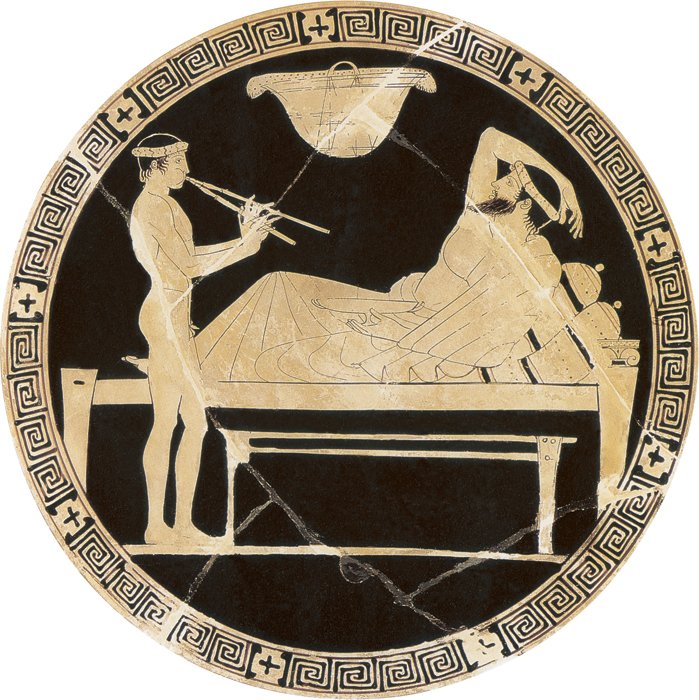
1. Painting of Euaion. Erastes and a Young Musician,
c.460 BC. Red figure dish. Louvre, Paris
Chapter 1. Homosexuality in Western Antiquity
(from Ancient Greece to the Roman Empire)
The earliest Greeks were a loose band of rural tribes who eventually settled into small enclaves known as city-states. The practice of overt homosexuality was already widespread in the Greek city-states by the early part of the sixth century BC and became an integral part of the Greek archaic and classical traditions. Male homosexuality, or rather pederasty, was linked with military training and the initiation of young boys into citizenship. Most of our information about Greek homosexuality is based on the art, literature, and mythology from the city-state of Athens. Exactly why the Athenians of the fourth century BC accepted homosexuality and conformed so readily to a homoerotic ethos is a question difficult to answer. Although each city-state imposed distinct laws and practiced different mores, Sparta, Thebes, Crete, Corinth and others, all bear visual and literary evidence of homosexual interests and practices. The earliest evidence of homoerotic relations in ancient Greece comes from a fragment written by the historian Ephorus of Kyme (c.405–330 BC) telling the story of an ancient ritual that took place on Dorian Crete in the seventh century BC in which older men initiated younger men into manly pursuits like hunting, feasting, and presumably, sexual relationships as well. (Lambert in Haggerty, 80)
The extent to which homosexuality in the ancient world was a significant aspect of Greek culture can be found in their myths, rites and rituals, legends, art and literature, and in the customs of society as a whole. The major artistic and literary sources on Greek homosexuality are found in late archaic and early classical poetry, the comedic plays of Aristophanes and others such as Euripedes, Aeschylus, and Sophocles; the dialogues of Plato, and paintings on Greek vases. (Dover, 9) It was in the writings of Plato (c.429–347 BC) above all where the topic of homosexual love was debated most vigorously. In his dialogues, Plato focused on male homosexuality, seeing it as a higher spiritual goal than heterosexual physical contact and procreation. The three famous dialogues of Plato—the Lysis, Phaedrus, and Symposium narrate imaginary and sometimes ironic conversations about male sexual and erotic relations. (Jordan in Haggerty, 695) Many of the passages in these dialogues describe male love as paiderasteia (pederasty)—that is, the erotic, active love of an adult man for a beautiful, passive adolescent [the word paiderastia is derived from pais (boy) and eran (to love)]. In the Lysis and Symposium, Socrates (a protagonist in the dialogues) is characterized as the active pursuer of adolescent male beauty. For Socrates, (homo) eros was the search for noble aims in thought and in action. Exactly how the practice of pederasty developed in ancient Greece is disputed, but the surviving mythology from antiquity suggests that Minos, the king of Crete, introduced it to avoid overpopulation of his island.
Athenian society viewed paiderasteia as a principal means of education and socialization of young free-born boys into manhood and citizenship. As an institution, it served as a complement, not a rival, to heterosexual marriage. Although the term “pederast” is today pejorative and refers primarily to sexual predators, in ancient Greece the term carried no such negative connotation and was employed in the context of the erastes-eromenos relationship. In this relationship, an older man (the erastes or lover [“inspirer” in Sparta]), usually bearded and of high social rank, was expected to actively seek out, then win over a youth (an eromenos, or the beloved [the “hearer” in Sparta]) and instill in him an understanding and respect for the masculine virtues of courage and honor. Such attributes would, of course, not only become useful to Greek social stability, but would also help guarantee acts of bravery and loyalty when asked to defend the city-state on the battlefield.
It is in Plato’s Symposium where homosexual love is expressed and praised at length between an older, bearded lover (erastes) and a younger, hairless beloved youth (eromenos: aged from puberty to seventeen years old). The Symposium is part of what is called “banquet literature,” or a collection of informal discussions on various topics, including the philosophical and moral merits of love and the delights of young men and boys. There are many vase paintings illustrating what went on at these banquets or symposia in which young boys often served as cupbearers for invited guests.
Plato’s Symposium describes the strict rules of courtship and love governing the erastes and eromenos relationship. There were many taboos. For example, under no circumstances was a boy allowed to take the role as aggressor, pursuer, or penetrator. Also discouraged was the courtship or sexual activity between two boys or men of the same age or social rank. Intergenerational and correct class courtship was the expectation.
The majority of our primary visual information on the customs and habits of homosexual courtship and sexual practices in ancient Greece comes to us from vase paintings. Greek vases, used for carrying water, storing wine and olive oil, and serving food and drink, were produced in large quantities by local craftsmen and exported all over the Mediterranean region. Many were sold to middle- and upper- class clientele and often carried hand-painted scenes of gods, myths, heroic deeds, or images of everyday life. Many vases, dating from the sixth and fifth centuries BC, show older males conversing with younger males, offering them gifts, touching their genitals, or embracing them. Also commonly depicted were vignettes of males engaged in athleticism, courtship and graphic sexual acts. Quite often, an erastes would have a vase made specifically for his eromenos to be presented to him along with other courting gifts such as a hare, a cockerel, or a stag. These offerings were standard and associated with the hunt, further underscoring the function of pederastic courtship as a rite of passage. Sometimes, short inscriptions were applied or the word “kalos” (is beautiful) would appear preceded by the name of a favorite boy or adolescent youth.