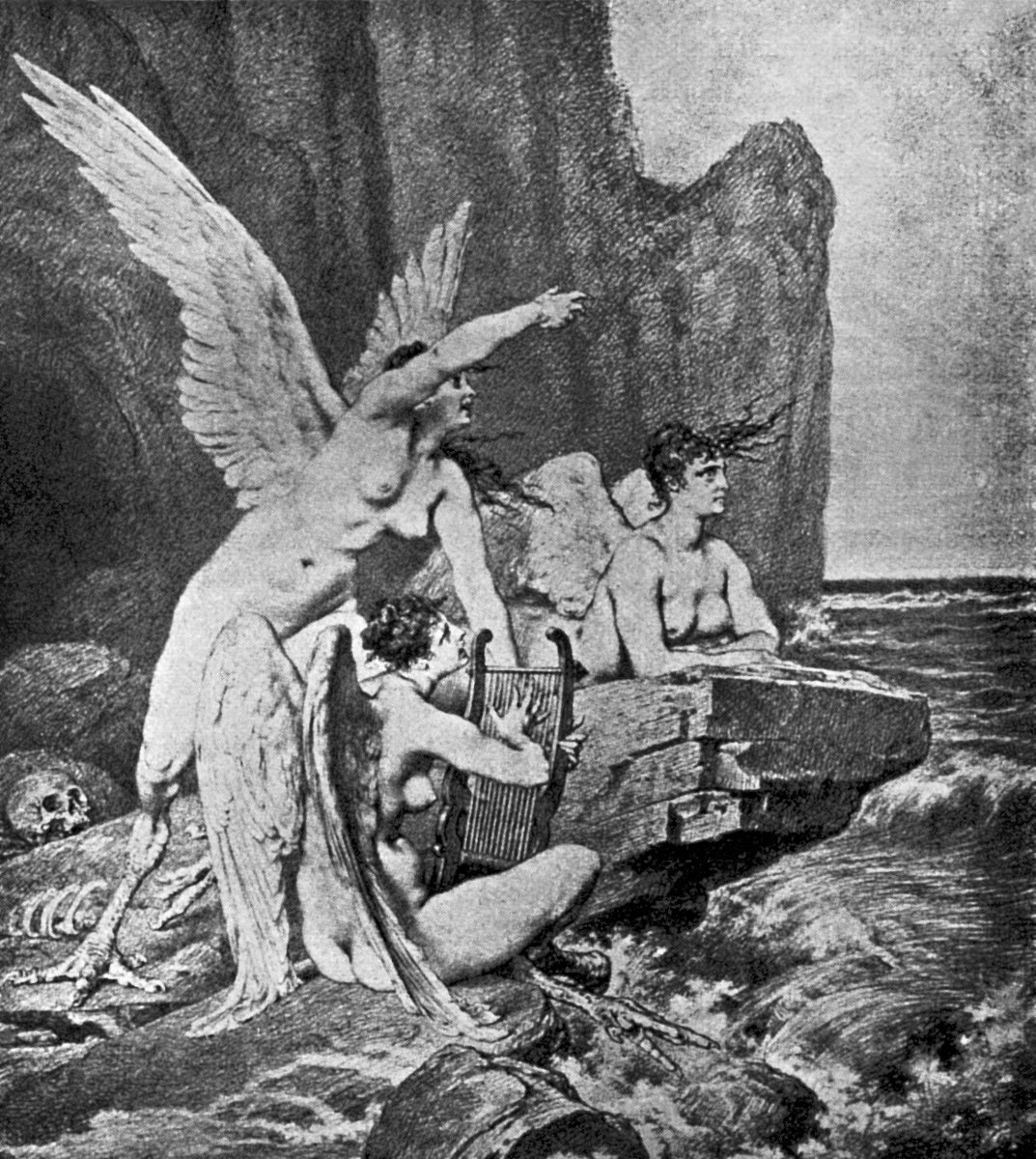
Heinrich Lossow, The Sirens, 1890.
Darwin’s Rutting Apes
At the beginning there was Darwin. In Origin of Man (1875) he wrote: “We must assume that the rhythms and cadences of oratorical speech are attributable to previously developed musical abilities. Along these lines we can comprehend why music, dance, song and poetry are such ancient arts.” We can go even further and assume that musical sounds form a foundation for the development of speech. Darwin refers to this principle in The Expression of Emotions in Man and Animals (1872). Darwin points out that birdsong mainly serves to attract a mate and that it expresses the sexual drive and enchants the female. At the beginning of his development, man is supposed to have used his voice for the same purpose. Not as a form of speech, because speech was a late product of human development, but as a way to attract a female or vice versa a male through musical tones, which is a characteristic found in many primitive animals.
The origins of music are nature’s sounds: the sounds of joy, as well as the sounds of pain that emanate from humans and animals alike in times of rut and sexual enticement. During rut, animals (frogs, bucks, horses, lions and many others) scream and birds sing and tempt in extraordinary ways. The repetition of mating calls in timely intervals leads to rhythm and song. The rhythmic repetition of the same sounds exhibits something highly suggestive and fascinating and thereby serves sexual attraction. Ivan Bloch in The Sexual Life of Our Time (1906) describes this phenomenon as the origin of the profound erotic effect of song and music.
Social biologist Elster is of the opinion that “Birdsong is an elegant precursor to human music – in apes still exemplified as an unmelodious scream of the swollen larynx – that showcases a biological predisposition to music. Coloratura of the human voice is often merely a copy of the songs in the world of birds.”[3]
Darwin’s classical research demonstrates the close relationship that exists between the voice and sex life. The male voice in particular, has a sexually arousing effect on the female but the reverse can be observed as well where a female voice has the same effect on a male. Darwin assumes that the earliest relatives of humankind enticed each other with musical sounds and rhythms before they had the ability to express their love in articulated language.
In enlightened times, it is no longer the gods who speak through the medium of music: the disposition to music is biological in nature. When man creates music, it is a refined version of natural phenomena. Music’s connection to sexuality can be hidden but not completely removed. Did Schopenhauer himself not already view music as “the direct replica of volition”? The innermost part of eroticism and music is elucidated in the volition to love. Making use of the well-known intoxicative power of music is timeless, and proves that euphoria in particular has a profound effect on erotic and sexual themes. Through this process, sexuality, religion and music can intermingle and musical ecstasy can create a bridge between sexual and religious ecstasy.
Whether speech developed from song, or song from speech, is of particular contention. Philosopher and social scientist Georg Simmel (1858-1918) was convinced that song developed from speech. He hypothesises that song first developed through emotionally charged speech. Emotions, he contends, have shaped the rhythmic and modulating elements of speech.[4] It is in fact the rhythmic beating of the excited heart that influences musical expression. By emphasising humankind’s unique mastery of speech that sets us apart from the animal kingdom, Simmel seems to diverge from Darwin’s theory of evolution: song is not a creation of nature, but elevated speech, which distinguishes humankind from apes.
All the same, rhythm is a special element from which the unique effects of music transfer to physical-spiritual functions:
“Rhythm has concrete dimensions that may adequately be compared to the rhythm of the heartbeat. The tempo of the regular heartbeat is ‘moderate’ (moderato). Due to its increased speed, a more rapid tempo like allegro giusto, scherzando or presto has an invigorating and provocative effect. An accelerando (stringendo) tempo that lasts for many beats can have a strong astringent effect. This is done without help of the Melos, meaning that the effect is accomplished while the melody stays relatively homogenous, or by a simple repetition of the same sequence of notes played in increasing tempo.”
If we acknowledge that rhythm is the biological reason for the effect of musical themes, “then we also have an explanation why Gregorian song, which was a form of church music in the Middle Ages until the musical creations of Händel and Bach came about, was so utterly non-erotic and even anti-erotic, pious, passionless and lacking animalistic instinct.”
Rhythm is the biological manifestation of music. But even the tonal colour of melody is supposedly of a biological nature: “The closer it comes to the ‘sweet’ sounds of nature and sexual life, the stronger the relationship between music, eroticism and sexuality becomes!”
However, music can also be abused to create inappropriate opportunities. According to Elster, strict artistic self-restraint is the solution. “A lack of a strong means of defence brought about by a lack of musical education and upbringing, will make someone fall victim more easily to the sensual and intoxicating effect of sentimental music.” This kind of music, which is found in the rhythm of dance and the sweetness of the Viennese waltz, is also indispensable to red light districts, brothels and other premises of prostitution. Both sexuality and music have been refined and enriched by civilised human beings. As is the case in the animal kingdom, men use music to sexually excite women and make them comply with their sexual advances. “The female, sexually receptive to sentimental and euphoric music, will follow the male subconsciously and, persuaded by music, engage more easily in the first sexual act of marriage.”