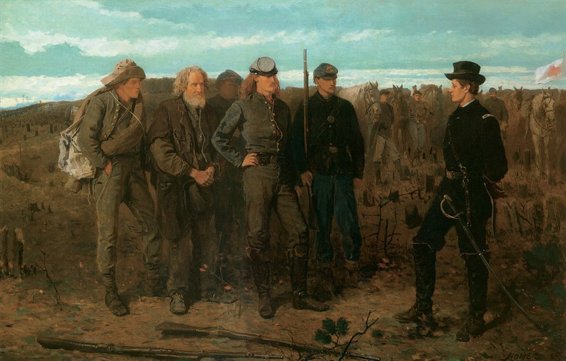
Winslow Homer, Prisoners from the Front, 1866.
Oil on canvas, 61 x 96.5 cm. The Metropolitan
Museum of Art, New York, New York, gift of Mrs. Frank B. Porter.
WINSLOW HOMER
(1836-1910)
Almost a generation behind Eastman Johnson, Winslow Homer, also a largely self-taught artist, carried forward Johnson’s gift of portraying the American scene and added a love of the sea to the rustic genre images. He was born on 24 February 1836 in Boston, Massachusetts to Henrietta Benson and Charles Savage Homer. Henrietta grew up in Cambridge, Massachusetts where she learned the art of watercolour. She was an active amateur painter and went on to exhibit with her son at the Boston Art Association in the 1870s.[3] His mother became Winslow’s first teacher.
An even greater influence on his early art training was the legendary Boston romantic painter, Washington Allston (1779-1843). Though he made two trips to Europe, studying various salon painters including the British artist, Benjamin West, Allston became a leading figure in the early nineteenth-century Romantic Movement in America. His emphasis was on landscape, but he concentrated more on mood and emotion than observation of an actual scene. His skills also extended to writing and he produced poetry, novels and treatises on art. Of these, his philosophy ordained that “primary subjects” seen in the painting were supported by underlying “secondary subjects” that enforced the mood and had religious undertones inspired by the revelations of God.
Though Allston died when Homer was just seven years old, the presence of the Great Man was everywhere in the Boston-Cambridge neighbourhoods where he had painted and written. Poetic tributes, exhibitions of his works and publications of his lectures, edited by Richard Henry Dana Jr. – author of Two Years Before the Mast – created a virtual Allston cult. Homer was surrounded by Allston’s acolytes and could not have avoided the artist’s work and philosophies. Homer’s contemporaries and close associates who knew of Allston’s impact claimed they recognised the ‘primary’ and ‘secondary’ subjects in Homer’s paintings and understood the ‘secret’ to the success of the works. To appreciate Allston’s romantic sensibilities, one of his poems follows.
Art
O Art, high gift of Heaven! How oft defamed
When seeming praised! To most a craft that fits,
By dead, prescriptive Rule, the scattered bits
Of gathered knowledge; even so misnamed
By some who would invoke thee; but not so
By him,—the noble Tuscan—who gave birth
To forms unseen of man, unknown to Earth,
Now living habitants; he felt the glow
Of thy revealing touch, that brought to view
The invisible Idea; and he knew,
E’en by his inward sense, its form was true:
‘T was life to life responding,—highest truth!
So, through Elisha’s faith, the Hebrew Youth
Beheld the thin blue air to fiery chariots grow.
Washington Allston, Lectures & Poems, 1850.
At the age of nineteen in 1855, Homer was apprenticed to the Boston lithography shop of John Henry Bufford who had studied under New York’s George Endicott and Nathaniel Currier (soon to be partnered with James Merritt Ives) to find practical applications for his art.
He remained at Bufford’s for two years and then embarked as a freelance illustrator finding sketch work at Ballou’s Pictorial and Harpers Weekly. He opened a studio at the Tenth Street Studio Building in New York City. Located at 51 West Tenth Street between Fifth and Sixth Avenues, the Studio Building was a virtual rabbit warren of artist studios that radiated out from a central domed gallery. Artists from all over the country came to the location and took rooms nearby, giving Greenwich Village its new and future reputation as a Bohemian arts centre.