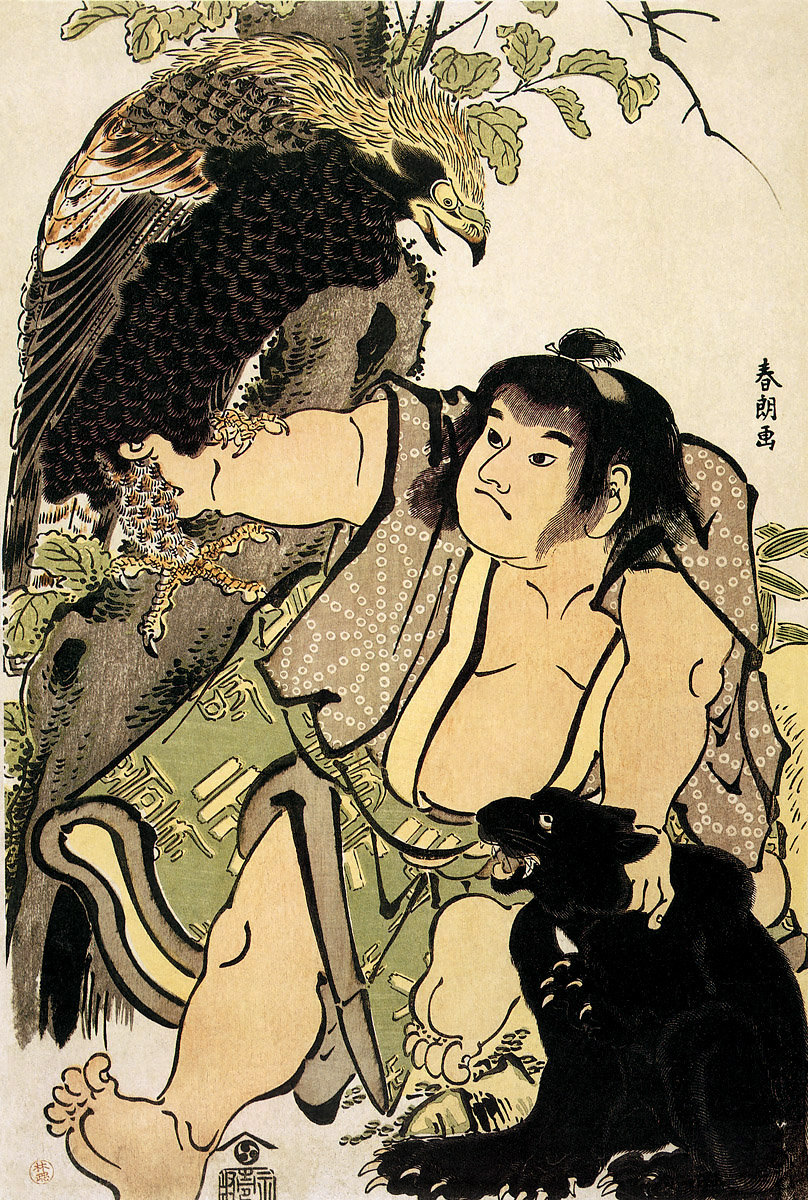
Kintoki the Herculean Child with a Bear and an Eagle, c. 1790-1795
Nishiki-e (polychrome woodblock print), 37.2 x 24.8 cm (ōban). Ostasiatische Kunstsammlung, Museum für Asiatische Kunst, Staatliche Museen zu Berlin, Berlin
HOKUSAI’S LIFE
In the autumn of 1760, a child was born in a humble suburb of Edo whose place in the world’s art was destined to be important. His adoptive parents were from the artisan class; the father a maker of metal mirrors to the court of the Shogun, the mother a member of a family that was not without celebrity in its time, but had lighted upon evil days. Her grandfather had been a retainer of the courtier Kira, in whose defence he had fallen by the hand of one of the forty-seven ronin during the midnight attack, the climax of that tragic episode of 17th-century Japan. Perhaps to this soldier ancestor, we may trace the pride and independence that characterised Hokusai all his life, just as the employment of his father might be supposed to influence the child’s tastes and capacity in the direction of art.
Possibly because he was not an only son, he left home at fourteen to be apprenticed to an engraver. Though he did not remain at this trade for more than four years, the experience thus gained must have been exceedingly useful to him later in life, when he had to direct the men who were cutting his own work. At the age of eighteen he left this employment to join the school of the great designer, Shunshō, whose colour prints are among the treasures of modern collectors. Under his guidance, Hokusai became an apt imitator of his master’s style. His originality, however, could not long be suppressed. An enthusiasm for the vigorous black-and-white work of the Kano school irritated the old professor, whose dainty art aimed at very different ideals.
At last, in 1789, a quarrel over the painting on a shop sign resulted in the expulsion of the disobedient pupil. No doubt such an inquisitive, unconventional scholar must have sadly perplexed a master who had long been regarded, and quite rightly, as one of the leaders of the popular school. Yet in those years spent under Shunshō‘s guidance, the younger man must have learned all that was to be learned about ukiyo-e art, and no further advance was possible for him until he gained his freedom.
Thus, at the age of twenty-nine, Hokusai was cast adrift upon the world to try to make a living by illustrating comic books, and even writing them. He was attracted for a time by Tosa painting, and worked in imitation of it; but, work as he might, he was unable to make a livelihood. At last, in despair, he quit art and turned hawker, selling at first red pepper and then almanacs. After some months of misery, an unexpected and well-paid commission to paint a flag aroused hope in him once more. Working early and late, he succeeded in executing illustrations for a number of novels, and designed many surimonos – the dainty cards used for festive occasions – which gradually improved his reputation. It was about this time that he learned, or rather came in contact with, the rules of perspective, and began to catch something of the grandeur of the early art of China.
In the spring of 1804, he made a popular hit by painting a colossal figure in the court of one of the Edo temples. On a sheet of paper more than eighteen yards long and eleven yards wide, with brooms, tubs of water, and tubs of ink, he worked in the presence of a wondering crowd, sweeping the pigment this way and that. Only by scaling the temple roof could the people view the bust of a famous saint in its entirety. Hokusai followed up this triumph by painting, on a colossal scale, a horse, the fat god Hotei, and the seven gods of good luck. At the same time, to show the range of his powers, he made microscopic drawings on grains of wheat or rice, and sketched upside down, with an egg, a bottle, or a wine measure. These tricks gained him such a reputation that he was commanded to draw before the Shogun, an honour almost without precedent for a painter of the artisan class.
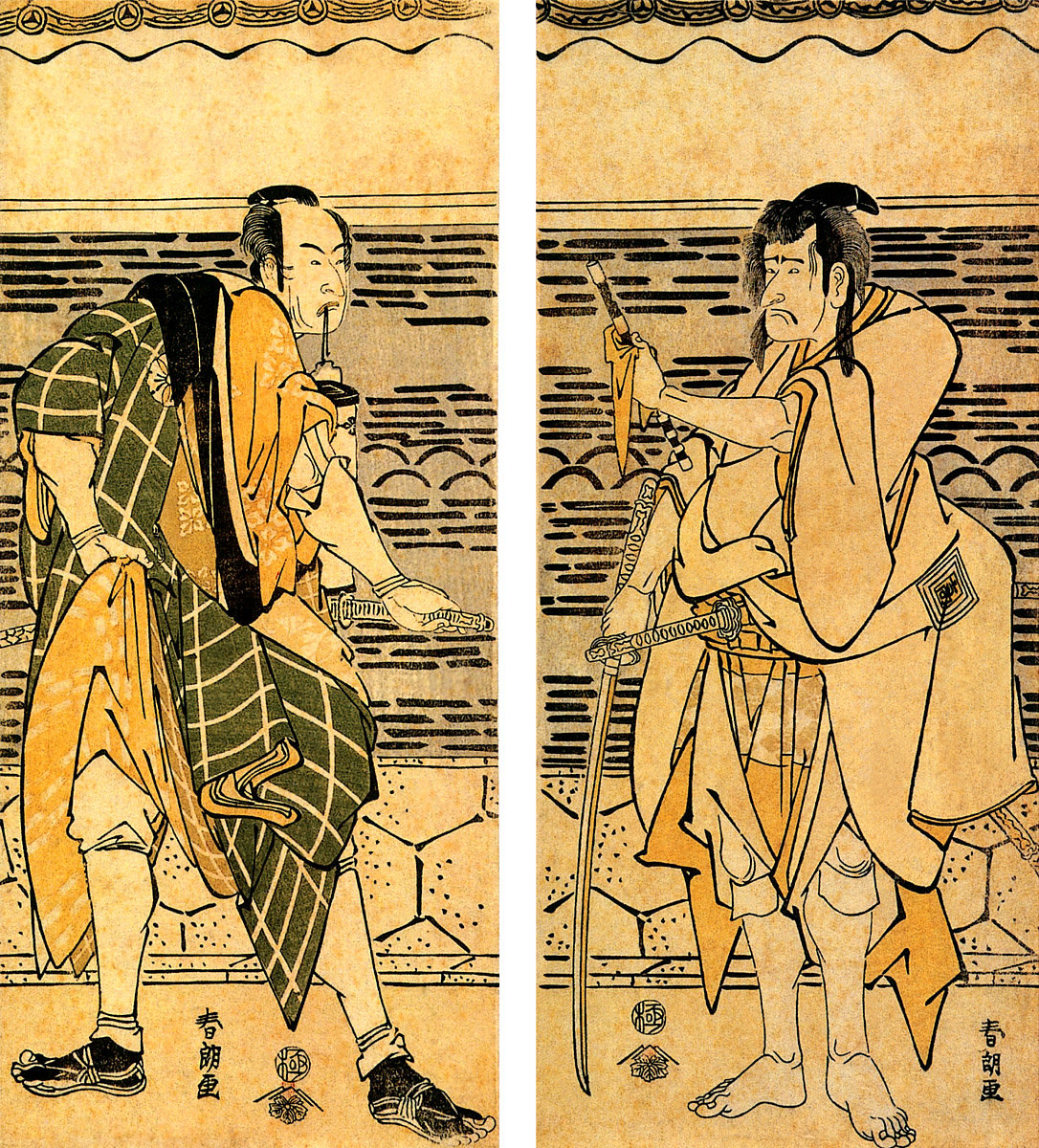
Actor Ichikawa Komazô III as Shirai Gonpachi and Actor Matsumoto Kôshirô IV as Banzui Chôbei, c. 1791
Diptych, nishiki-e (polychrome woodblock print), 31.8 x 13.7 cm; 31.8 x 14.4 cm. Museum of Fine Arts, Boston
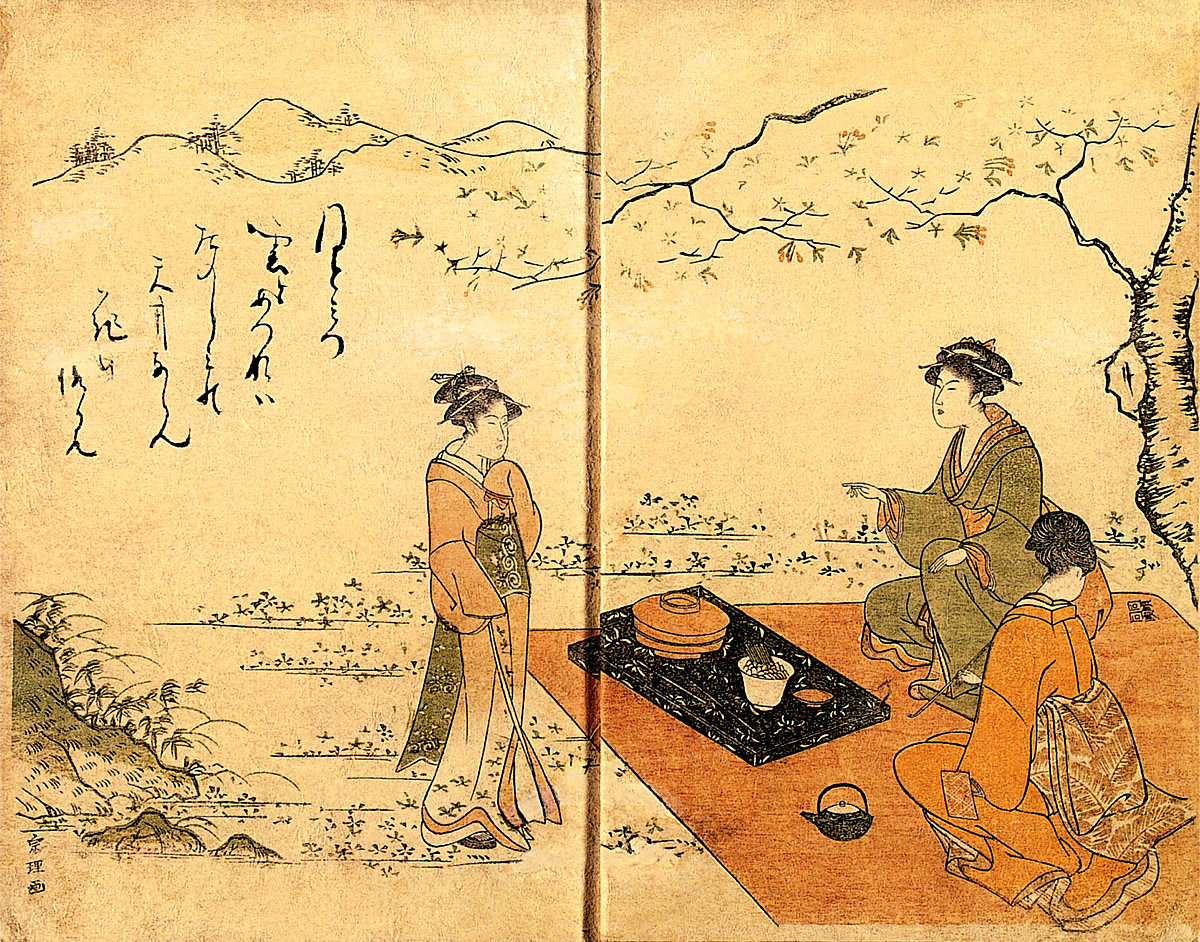
Collection of Surimonos Illustrating Fantastic Poems, c. 1794-1796
Surimono, nishiki-e (polychrome woodblock print), 21.9 x 16 cm (each page, koban). Gerhard Pulverer Collection, Freer Gallery of Art, Smithsonian Institution, Washington, D.C.
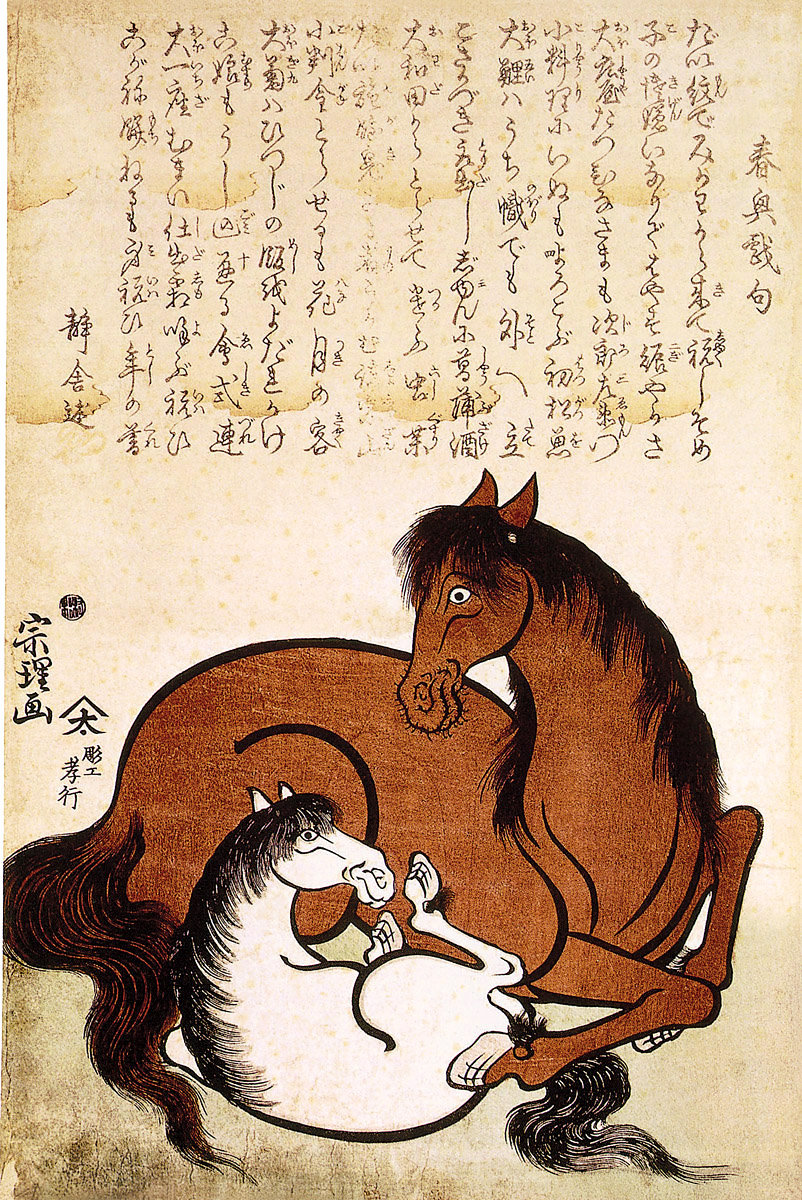
A Mare and Her Foal, 1795-1798
Nishiki-e (polychrome woodblock print), 35.5 x 24 cm (aiban). Bibliothèque nationale de France, Paris
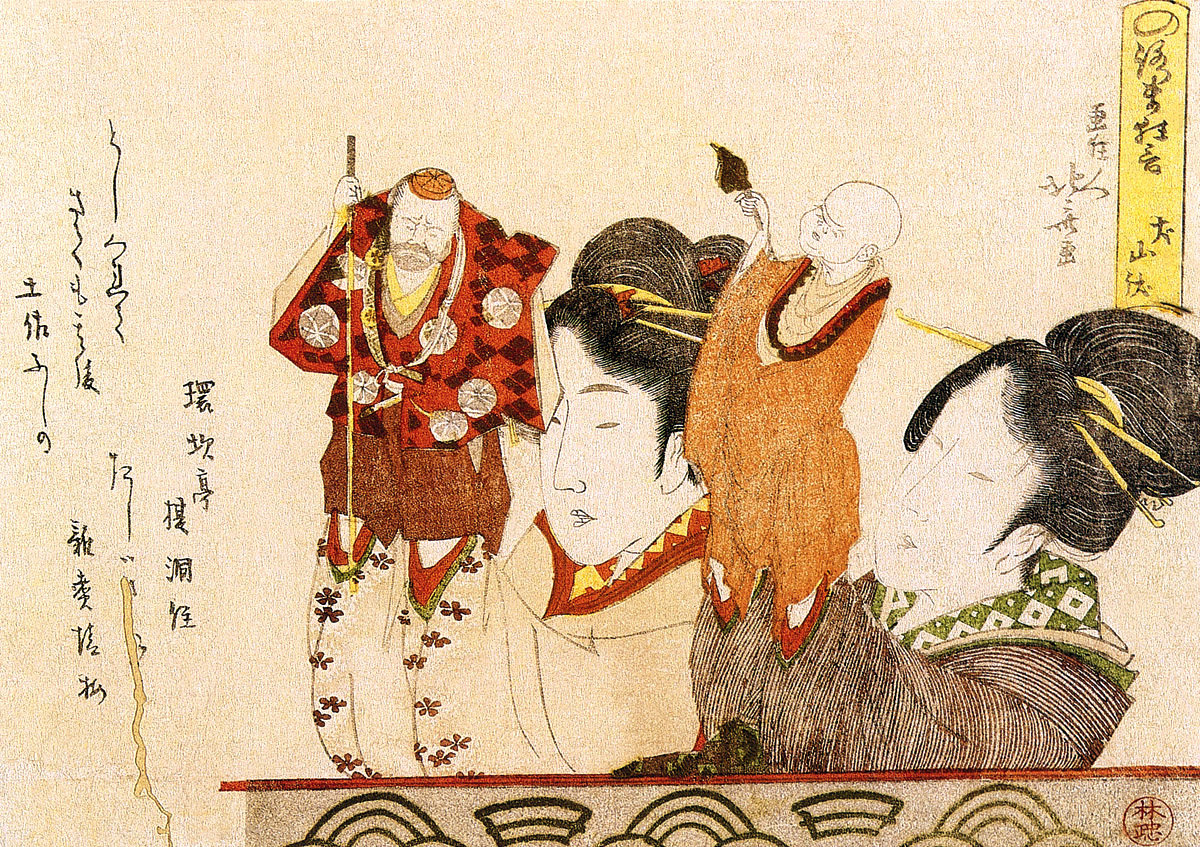
Two Women Puppeteers, c. 1795
Surimono, nishiki-e (polychrome woodblock print). Private collection, United Kingdom
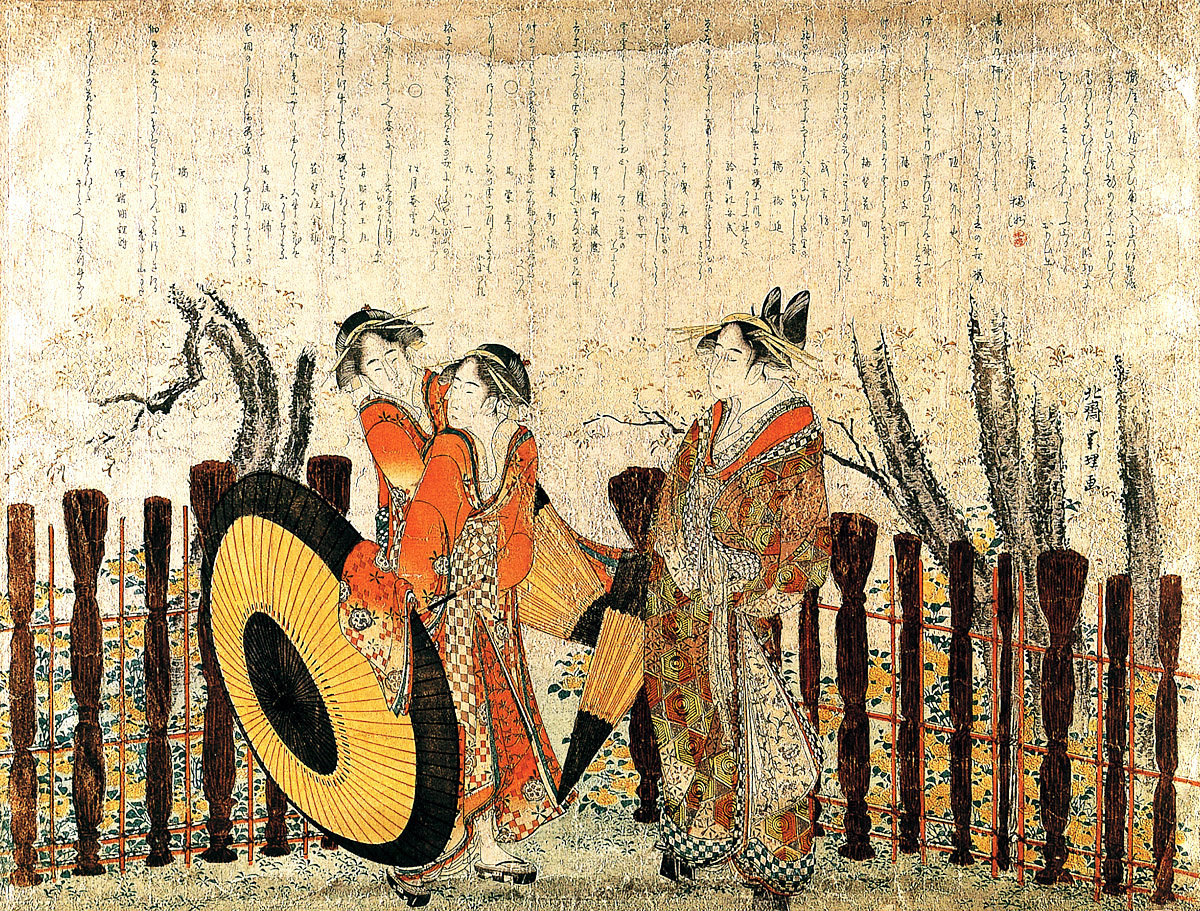
An Oiran and Her Two Shinzō Admiring the Cherry Trees in Bloom in Nakanocho, c. 1796-1800
Double-length surimono, nishiki-e (polychrome woodblock print), 47.8 x 65 cm. Musée national des Arts asiatiques – Guimet, Paris
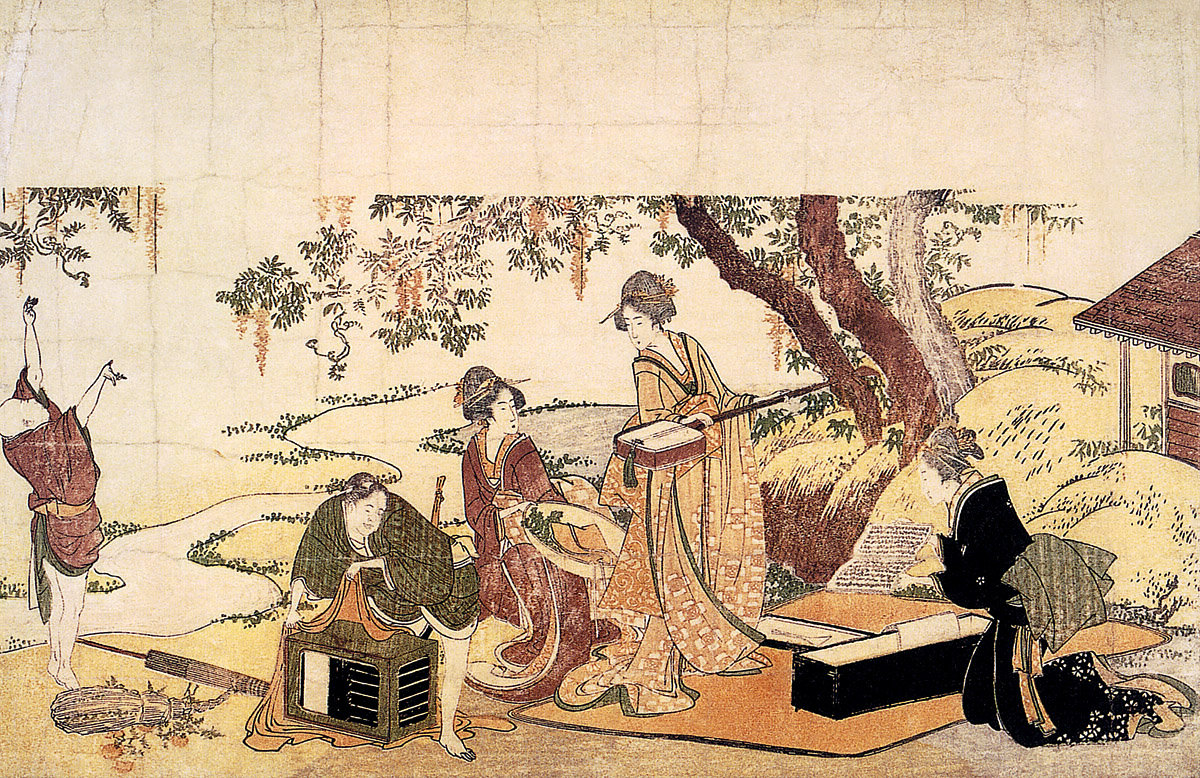
Concert under the Wisteria, c. 1796-1804
Nishiki-e (polychrome woodblock print), 25.2 x 38.4 cm (ōban). Musée national des Arts asiatiques – Guimet, Paris
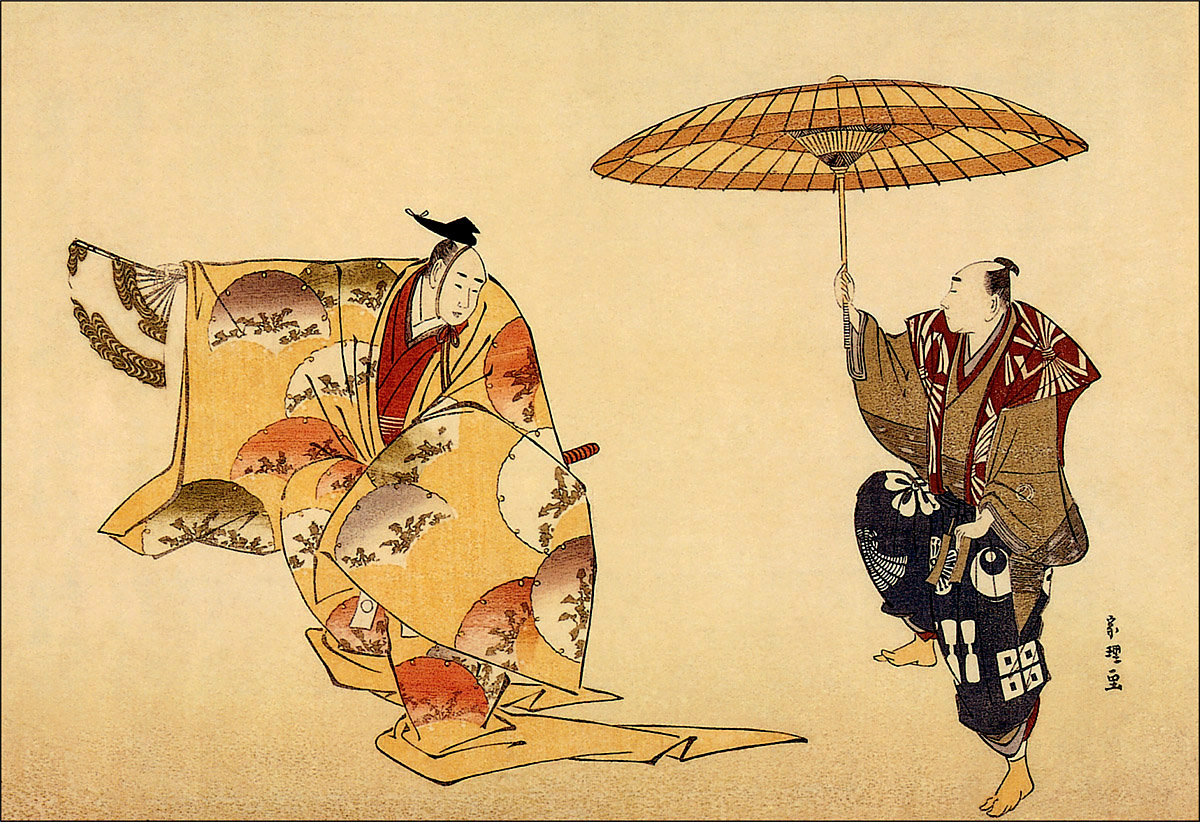
Suehirogari, 1797-1798
Nishiki-e (polychrome woodblock print), 20.7 x 31.9 cm. Library of Congress, Washington, D.C.
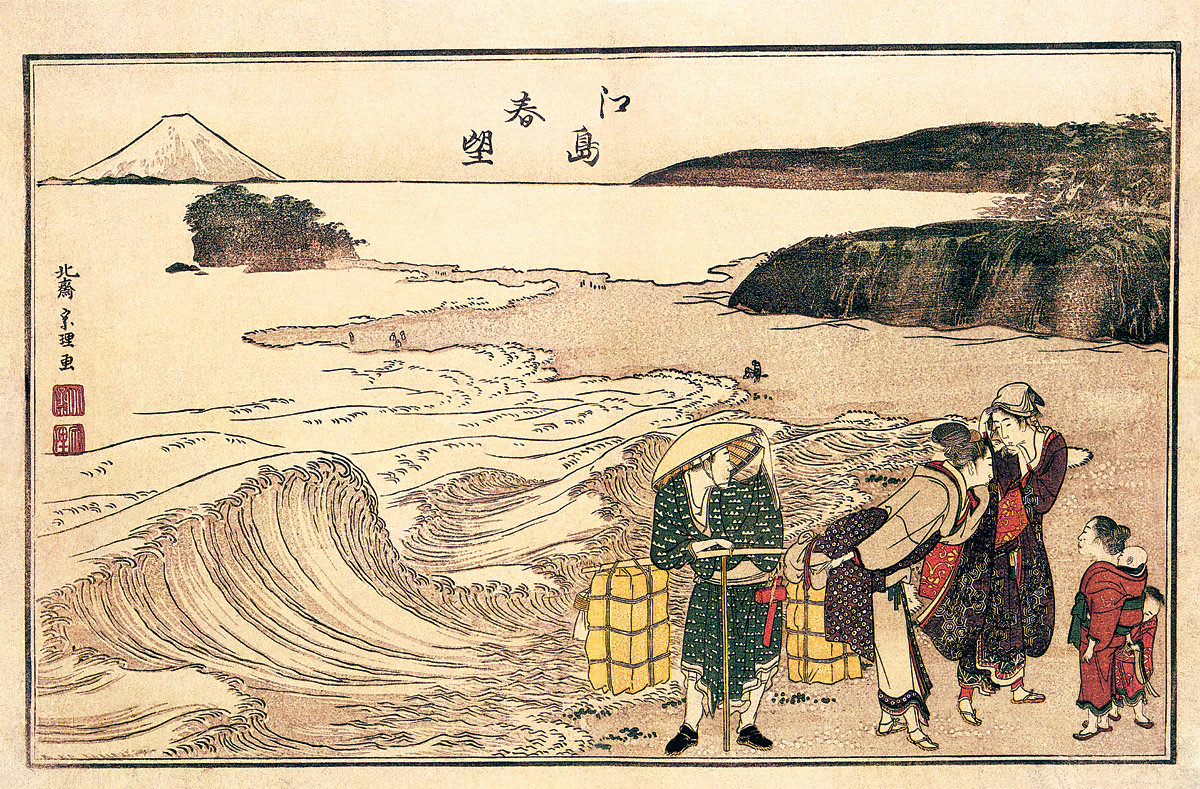
Spring at Enoshima (Enoshima shunbō), from the series The Threads of the Willow (Yanagi no ito), 1797
Nishiki-e (polychrome woodblock print), 24.9 x 38 cm (ōban). British Museum, London
In 1807 his connection and squabbles with Bakin, the famous gesakusha, began. They first collaborated on a book, The One Hundred and Eight Heroes. Their collaboration lasted about four years, and was dissolved by an unusually violent quarrel. The pair seemed indeed to have been ill-matched. Bakin, serious, distant, absorbed in his literary studies, possibly a bit of a pedant, was no companion for the quick, capricious artist. Hokusai’s first acquaintance with the actor Baiko was equally characteristic. Baiko, who was especially famous for his manner of playing ghosts, one day sent to ask Hokusai to draw him a new kind of phantom. No reply came, so Baiko called in person. He found the painter in a room so filthy that he had to spread out a rug he had prudently brought with him before he could sit down.
To his attempts at polite conversation and his remarks about the weather, Hokusai made no answer, but remained seated without even turning his head, until at last Baiko retired, angry and unsuccessful. In a few days he returned with humble apologies, and was well received, and from that time forward the two were friends.
In 1817 Hokusai went to Nagoya for six months, staying in the house of a pupil. Here he repeated the tour de force that had gained him so great a reputation at Edo, by painting a great figure, in the presence of a crowd of spectators, on a sheet of paper so large that the design could only be shown by hoisting it onto scaffolding with ropes.
More important, however, than this advertisement of his dexterity, was the publication of the first volume of the Hokusai manga, which, according to the latest authority, appeared around this time. The word has been variously translated as ‘various sketches’, ‘spontaneous sketches’, ‘rough sketches’, ‘casual sketches’, and so on.
This volume was the first of the famous series of fifteen which contains so much of the artist’s best work.
In 1818 he continued his travels, visiting Osaka and Kyoto before returning to Edo. It would seem that Hokusai met with but moderate success there. The place was the headquarters of the classical schools of painting. Years later, when nearly seventy years old, he was attacked by paralysis, but cured himself with a Chinese recipe that he found in an old book. Whatever the merits of the medicine, the old artist was thoroughly cured, for it was about this time that he produced the three sets of large colour prints which are, perhaps, his most important works, Voyage to the Waterfalls of the Various Provinces (Shokoku taki meguri), Picturesque Views of Famous Bridges from Various Provinces (Shokoku meikyō kiran), and the Thirty-Six Views of Mount Fuji (Fugaku sanjūrokkei). It is possibly owing to the misfortunes of the following years that these series seem to be incomplete. Certainly Hokusai had good reasons for not undertaking any commissions that did not bring in money, for in the winter of 1834 he had to flee from Edo and live in hiding at Uraga under an assumed name. The reason for this flight is uncertain, except that it was caused by the misdoings of a grandson. When writing from Uraga, he would not give his address, though he suffered great privations. When important business recalled him to Edo, he visited the capital secretly.
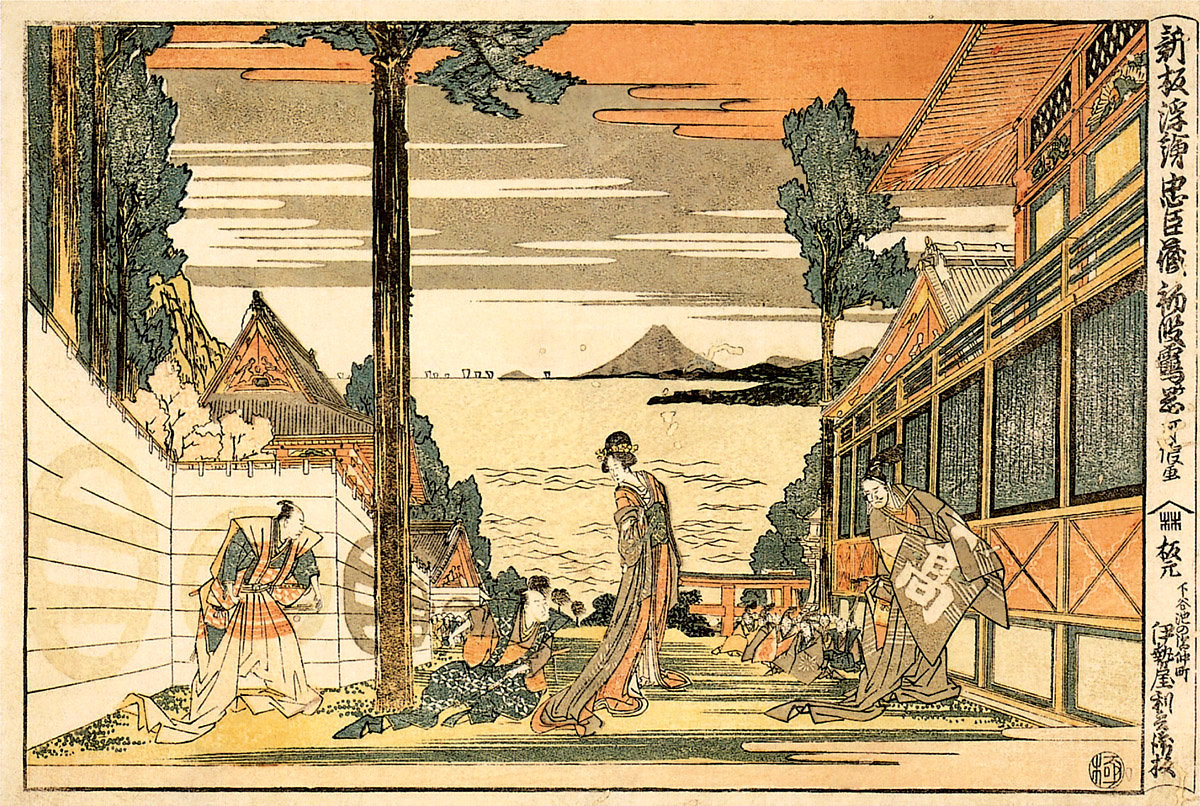
Act I (Shōdan), from the illustrated book Chūhingura (Shinpan ukie Chūhingura), c. 1798
Nishiki-e (polychrome woodblock print), 22 x 32.7 cm (aiban). British Museum, London
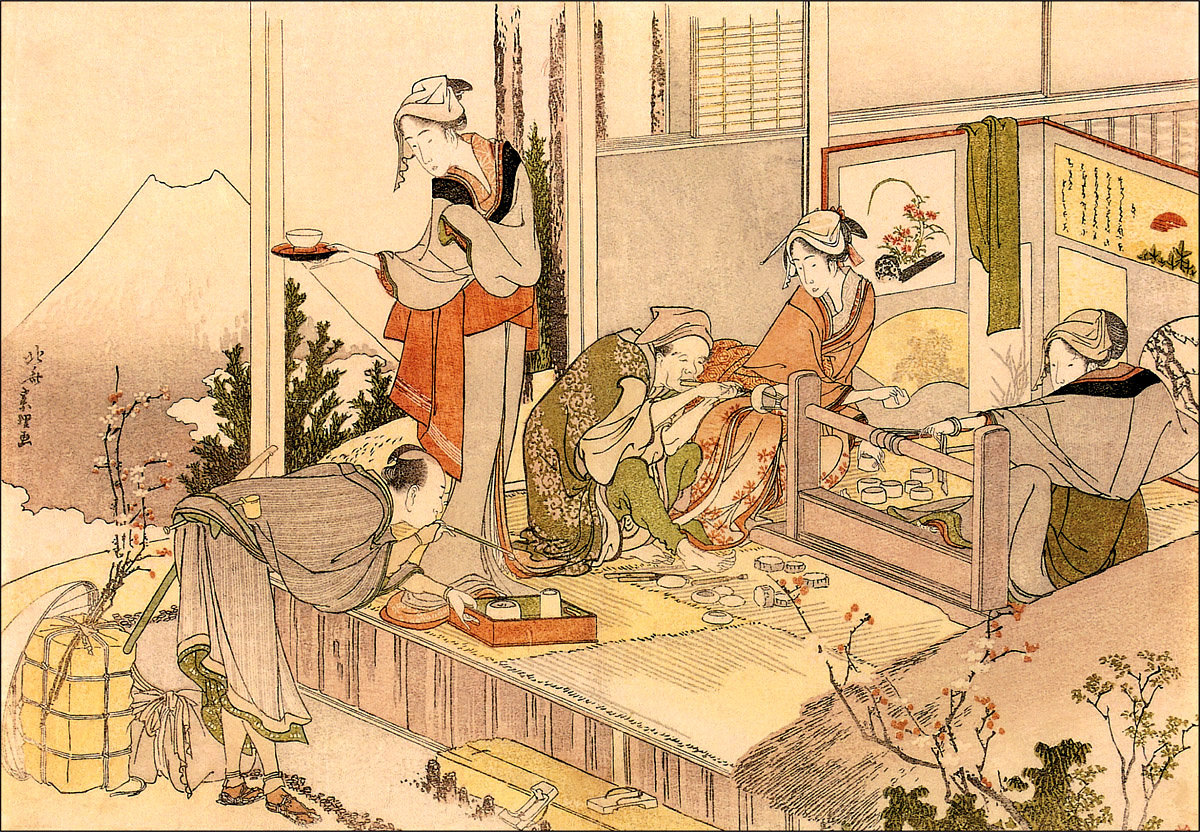
An Artisan’s Shop, from the album The Mist of Sandara (Sandara kasumi), 1798
Nishiki-e (polychrome woodblock print), 20 x 31.6 cm (aiban). Clarence Buckingham Collection, Art Institute of Chicago, Chicago
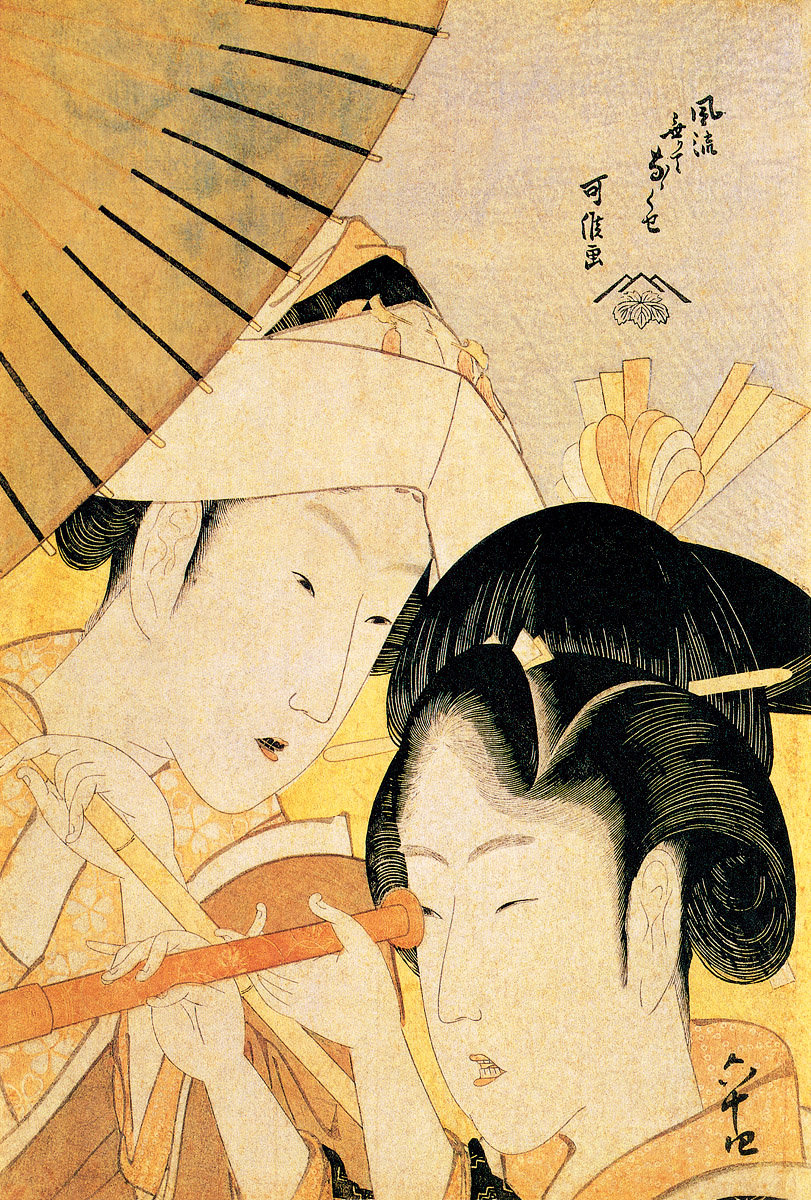
Women with a Telescope, from the series The Seven Bad Habits (Fūryū nakute nana kuse), late 1790s
Nishiki-e (polychrome woodblock print), 36.8 x 24.8 cm. Kobe City Museum, Kobe
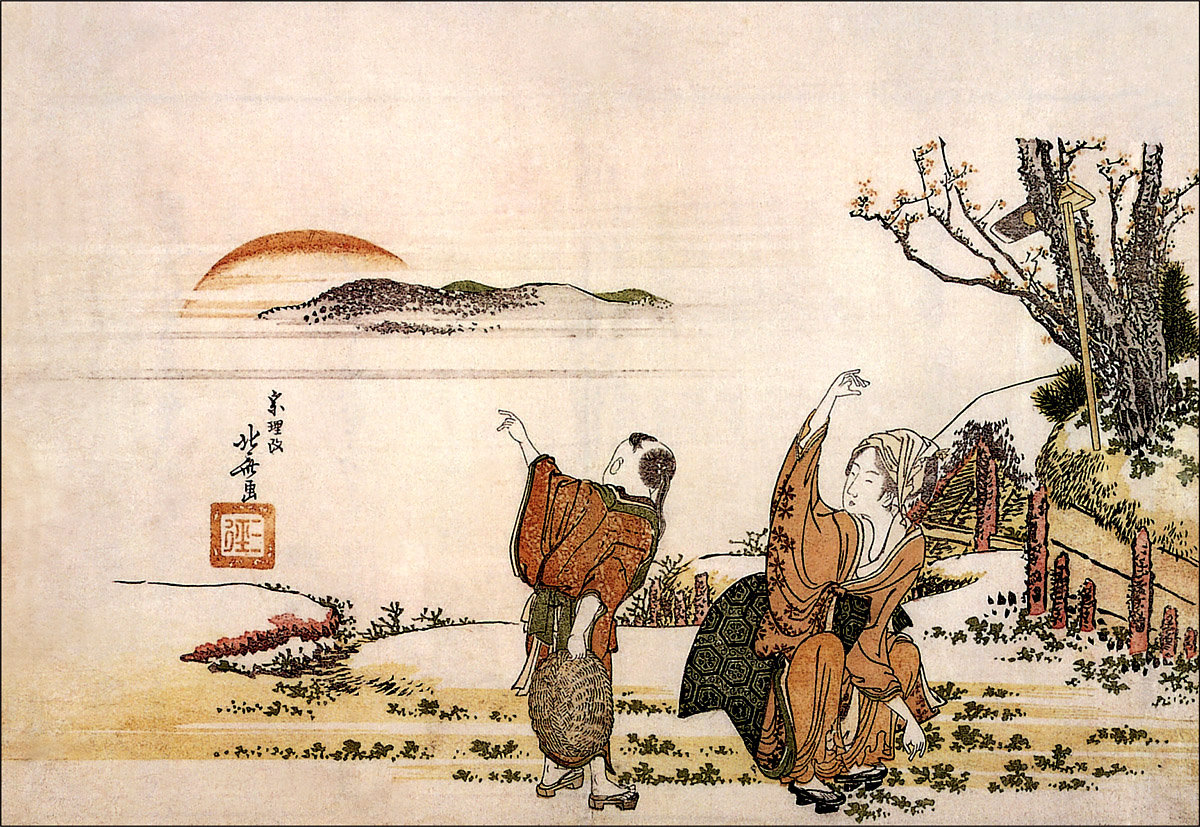
Dawn of a New Year, from Mad Poems for Fresh Grasses (Kyōkahatsuwakana), vol. I, 1798
Kyōkabon, nishiki-e (polychrome woodblock print), 16.3 x 22.5 cm. British Museum, London
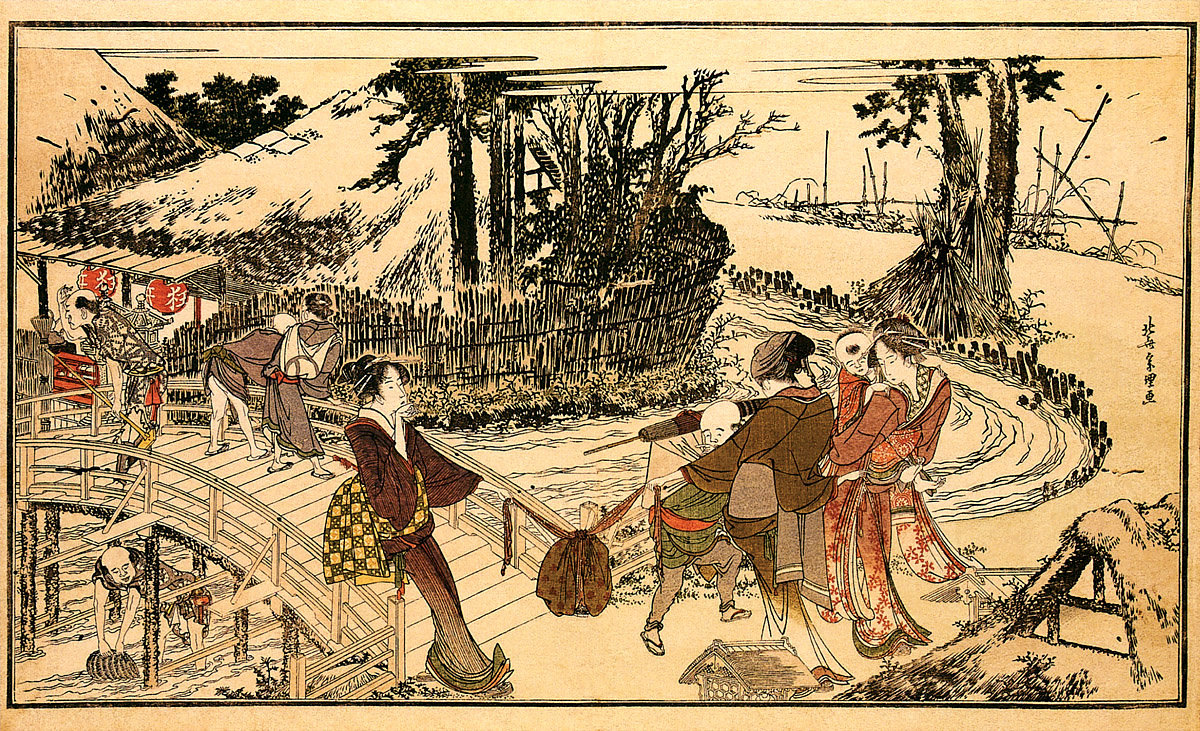
Crossing a Bridge, from the kyōka album The Stamping Song of Men (Otokodoka), 1798
Nishiki-e (polychrome woodblock print), 20.6 x 36 cm (aiban). Musée national des Arts asiatiques – Guimet, Paris
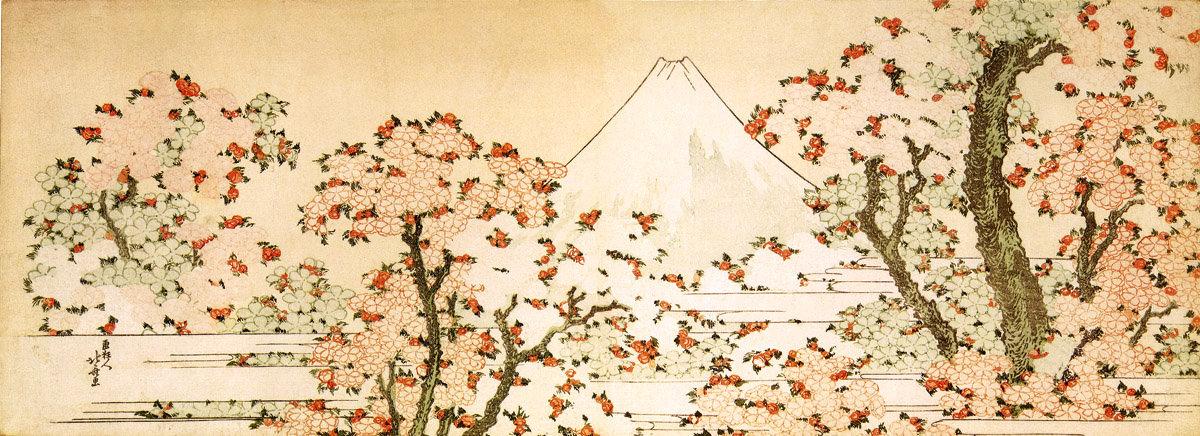
Mount Fuji behind Cherry Trees in Bloom, c. 1800-1805
Surimono, nishiki-e (polychrome woodblock print), 20.1 x 55.4 cm. Rijksmuseum, Amsterdam
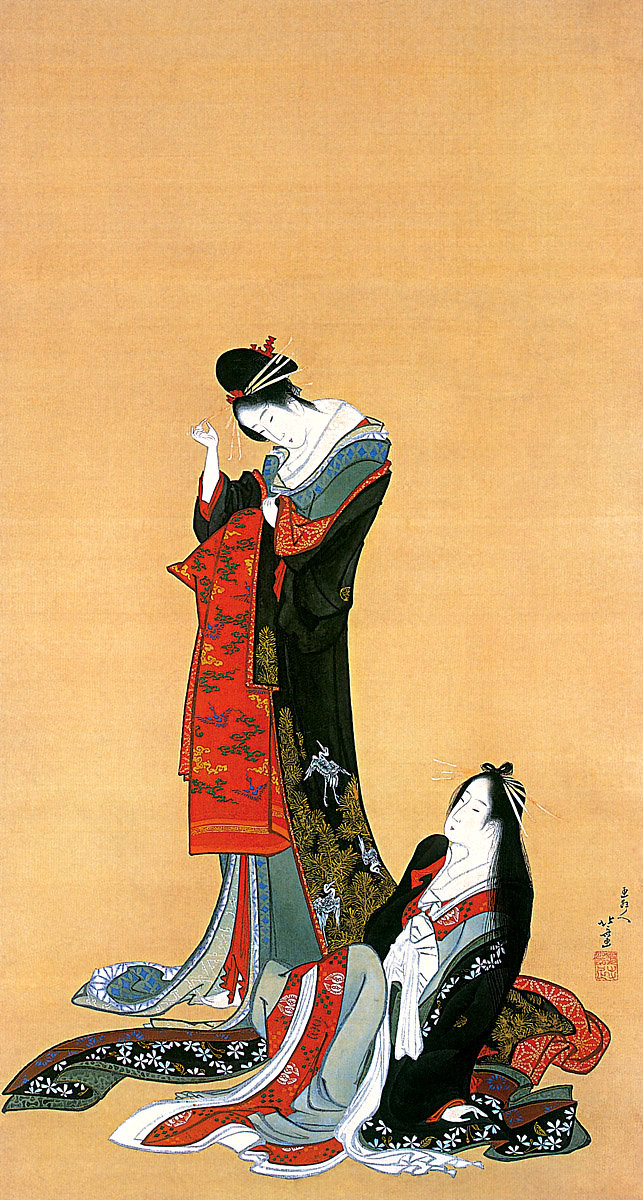
Standing Courtesan with an Apprentice, c. 1802
Kakejiku, ink and colour on silk, 76.5 x 41.2 cm. Hokusai Museum, Obuse
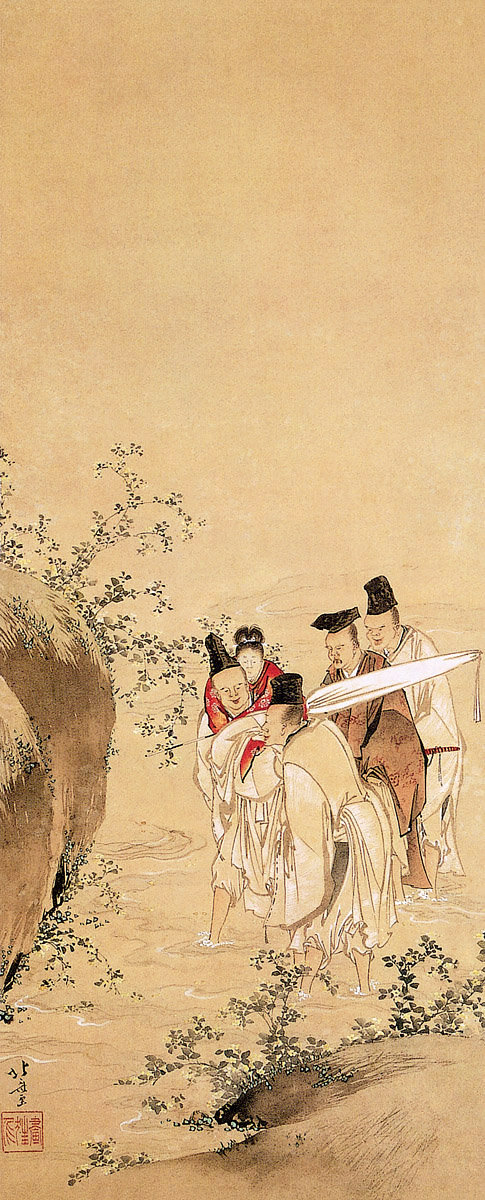
The River of Jewels near Ide, c. 1802
Ink, colour, and gofun on paper, 100.9 x 41.4 cm. Chiba City Museum of Art, Chiba
It was not until 1836 that he was free to return safely, but at an unpropitious time. The country was devastated by a terrible famine, and Hokusai found that the ordinary demand for art had ceased. In the following years, his patience was again severely tried by a fire that burned his house and all his drawings.
Only his brushes were saved. The poor old man had to keep more constantly than ever to his work, both as a consolation in his troubles and as means of avoiding starvation. Year after year he went on designing with undiminished power and activity. And though he never emerged from the state of chronic poverty, he never seems to have been again threatened by positive want.
Hokusai was twice married, and had five children: two sons and three daughters. The eldest son was a scamp, who inherited the mirror-making business, and was a cause of endless trouble to his father. The younger became a petty official with a taste for poetry. His eldest daughter married her father’s pupil Shighenobu, and, before she was divorced from her husband, became the mother of the child whose excesses made it necessary for Hokusai to go into hiding at Uraga. Another daughter died in youth. The youngest, Oyei, married a painter; but her independent spirit led to a speedy divorce, and she returned home to be, for many years, the devoted companion to her father, whom she did not long survive. Her portrait of Hokusai when about eighty years old forms the frontispiece of De Goncourt’s book. When the house got quite unbearably filthy, the pair did not clean it, but relocated. Hokusai thus changed his abode no less than ninety-three times in the course of his life.
In spite of the enormous mass of his work, he remained poor. His devotion to his art made him proud and inaccessible to those who came to buy his drawings without showing him proper deference. But many stories are told of his kindness to children, and of his behaving with great delicacy of feeling under trying circumstances.
Though his artistic reputation among his own class was enormous, and had even spread to the Shogun’s court, he was only known by sight to his intimate friends.
Except his daughter, Oyei, Hokusai had no pupils in the ordinary sense of the word, but he had followers who were able to catch something of his manner. Of these, his son-in-law Shighenobu was the earliest. Hokusai’s mature style was more closely imitated by Hokkei, a fishmonger turned artist (and a graceful artist, too), who taught Gakutei, the celebrated designer of surimonos, and Hokuba, whose book illustrations show a genuine appreciation of Hokusai’s dexterity, but lack his spirit and insight.
The remaining artists who directly imitated Hokusai need not be taken into account, but three other painters of distinct originality owe much to his influence: Keisai Yeisen, Kiosai, and Yosai. Nevertheless, if we seek to trace the influence of Hokusai, we shall not find its clearest evidences in such work as this, any more than we can lay at his door the utter decay into which the Tosa, Buddhist, and Kano schools have fallen.
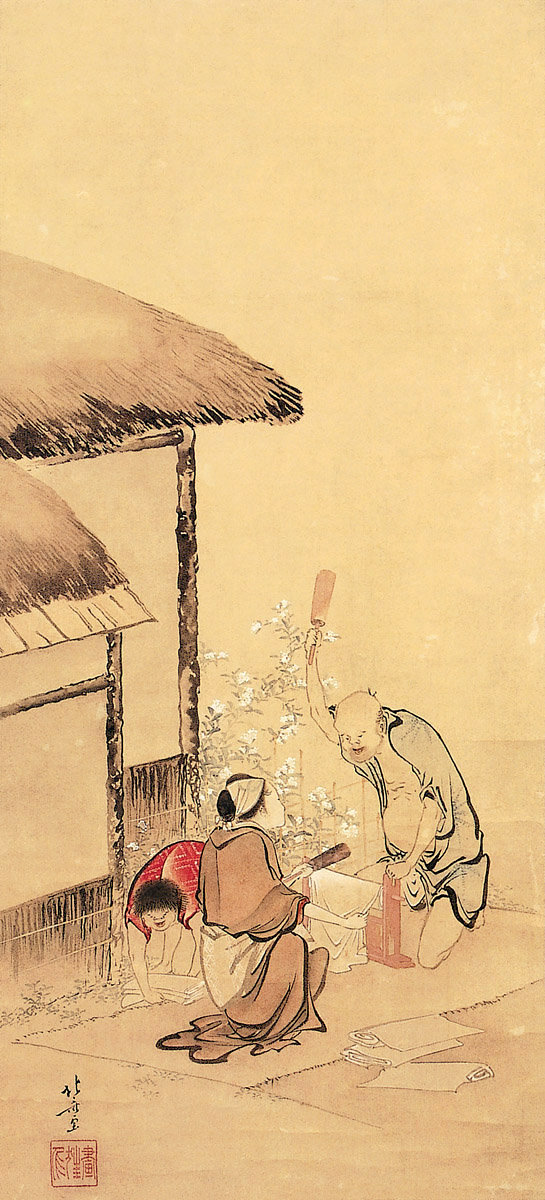
The River of Jewels near Mishima, c. 1802
Ink, colour, and gofun on paper, 88.2 x 41 cm. Hokusai Museum, Obuse
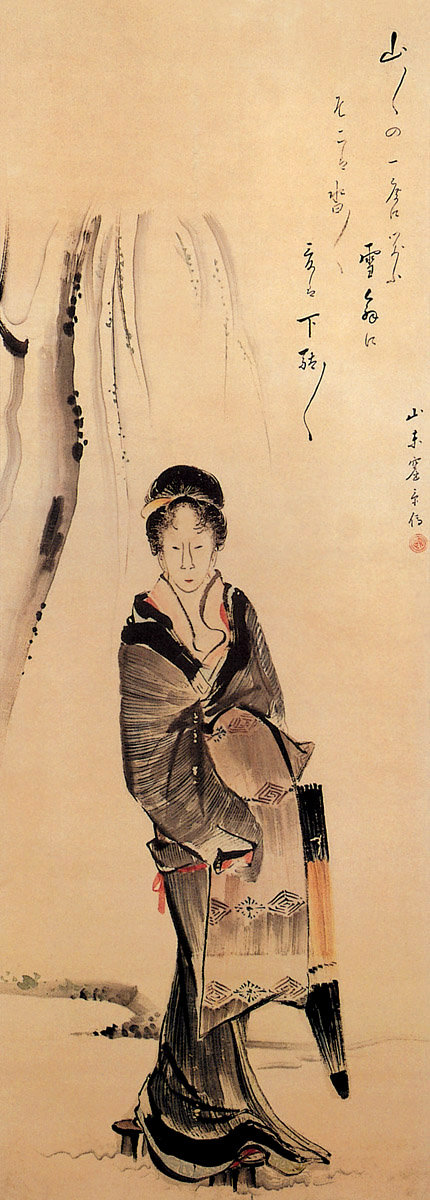
Woman beneath a Willow in Winter, c. 1802
Black and coloured ink on paper, 136.5 x 46.2 cm. Henry and Lee Harrison Collection
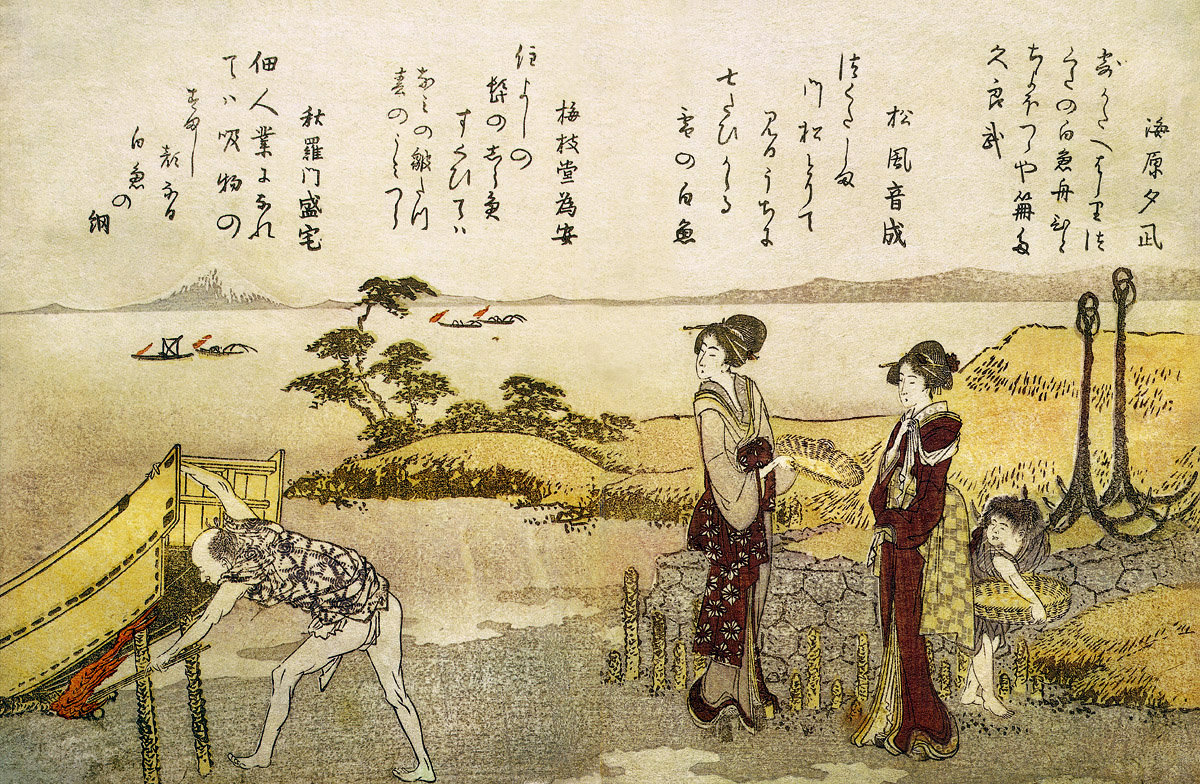
Two Women and a Servant on the Banks of the Sumida; a Man Sealing the Bottom of a Boat, from the series Birds of the Old Capital (Miyakodori), 1802
Galerie Berès, Paris
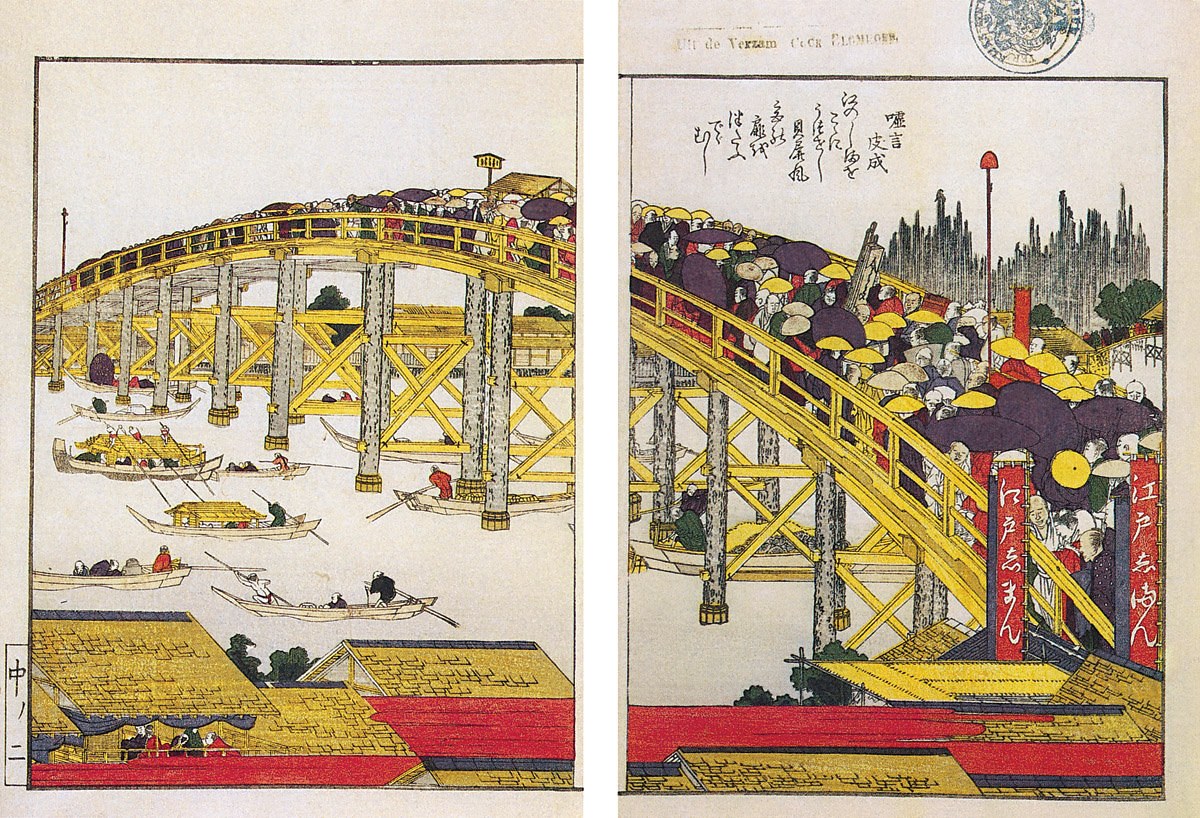
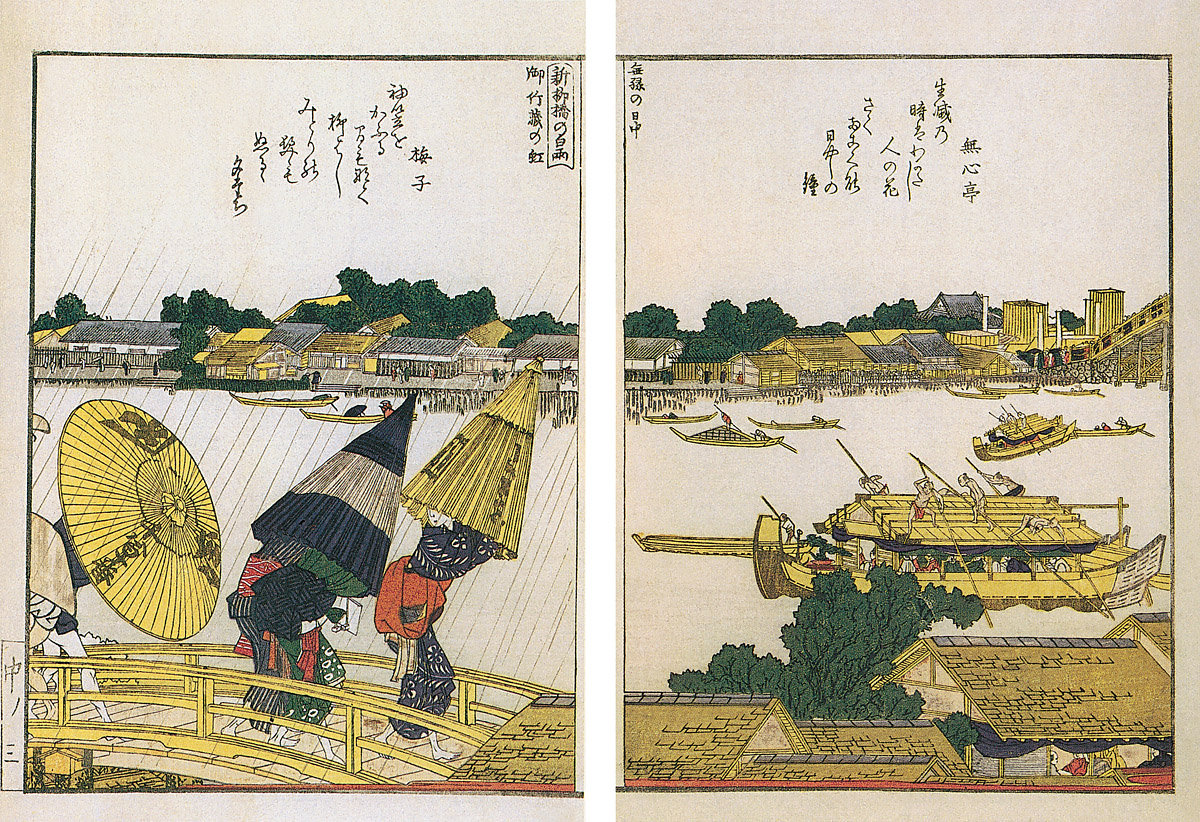
Panoramic View of the Sumida Banks with the Shin Yanagibashi and Ryogokubashi Bridges, from the Illustrated Book of the Two Banks of the Sumida in One View (Ehon Sumidagawa ryogan ichiran), c. 1803
Ehon, nishiki-e (polychrome woodblock print), 27.2 x 18.5 cm each. Rijksmuseum Volkenkunde, Leiden