CHAPTER 1
A Strategic Sector for Countries1
Strategy is about making choices, trade-offs; it is about deliberately choosing to be different.
Michael Porter2
I would like to start by taking us back a few thousand years in our history, the history of ancient Peru. This history never ceases to amaze us. Let us place ourselves in the Supe Valley, 182 km from the city of Lima. There lie the remnants of the city of Caral, the oldest civilization in America, which is over 5000 years old. It is the most ancient example we have of a civilization with complex systems of life that allowed it to develop successfully. According to the Peruvian anthropologist, archaeologist, and educator Ruth Shady (the discoverer of Caral), “the complex socio-political organization that built it and the advanced level of knowledge in science, technology, and art, reflected in its architecture as the oldest in America, is only comparable to other civilizational centers of the Old World, such as Egypt, Mesopotamia, and India3.”
But let us pause for a moment to reflect on what the term “civilization” means. We can say that it is a fundamental concept that defines forms of social grouping amalgamated by common elements and very strong social relationships that require governance structure and sustainability over time. According to Samuel Huntington, professor of Political Science and director of the John M. Olin Institute for Strategic Studies at Harvard University, a civilization is:
The highest cultural grouping of people and the broadest cultural identity they have, barring what distinguishes humans from other species. It is defined by common objective elements, such as language, history, religion, customs, institutions, and by the subjective self-identification of people4.
Huntington sheds more light on those elements that interacted in civilizations such as Chinese, Indian, or Greek, by stating that these “were based on cultural homogeneity that included language, law, religion, administrative practice, agriculture, animal husbandry, land tenure system, and perhaps kinship as well5.”
Among these basic elements that allow the development of civilizations, one of the most important is undoubtedly agriculture. Civilizations, to be sustainable, had to have agricultural systems that allowed them to remain united within a civilizational framework. Agriculture was, and continues to be, a key element in every civilization for its existence and survival.
In the city of Caral, agriculture was so important and developed that, according to Shady, “to elaborate agricultural calendars and predict climatic events, laboratories were installed. These laboratories allowed them to determine the beginning and end of planting and harvesting campaigns, as well as the changes that nature presented in order to adapt to them.” This is R+D+i (Research+Development+innovation) applied to agriculture thousands of years ago!
Returning to our time, in the conferences where I have the opportunity to give to university students, entrepreneurs, and academics about various aspects of Peruvian agriculture, I pose the following question: What is the first thing that comes to mind when you hear the word agriculture? The answers, in almost all cases, are related to activities of traditional family agriculture in rural areas. Very few relate agriculture to modernity, well-being, or the economy. In fact, in my own case, one of my earliest memories related to agriculture is that of a poor peasant wearing tire sandals and making furrows with a hoe. This image was ingrained in the minds of millions of Peruvian children by the propaganda of the military governments of that sad period in our history, the distant days of dictatorship.
I continue to ask this question on a daily basis, as an “acid test” to understand how ordinary citizens perceive a sector that has everything to be a winner but is not sufficiently integrated into a national vision. This contrasts with the dawn of our civilization when agriculture, in addition to being supported by long-term public policies, was conceived as an essential natural and survival element.
The history of Peru has various examples of sectors with great potential but which ultimately were not sustainable over time. This is due to a constant struggle of economic actors to survive in an environment tainted by mediocre, opportunistic, or poorly focused political decisions.
However, sometimes, as the popular saying goes, “the planets align” creating a conducive business environment for investment and the development of certain economic sectors. This is what happened in Peru with agriculture at the beginning of this millennium. Over twenty years ago, various elements “positively synchronized” within the framework of a country’s development strategy to make possible this “green miracle” that is modern Peruvian agro-export agriculture, which has positioned Peru as a reliable food supplier to the world
Below, I would like to explain, from my point of view, some of the elements that helped make this possible.
Adequate Regulatory Framework
It is important to remember a disastrous event in the agricultural history of Peru. On June 24, 1969, during the military dictatorship of General Juan Velasco Alvarado, Decree Law No. 17716, the Agrarian Reform Law, was promulgated. Like many demagogic and populist laws, it purported altruistic aims such as promoting agricultural and livestock development to increase production, productivity, and ensure commercialization; ensuring the adequate conservation, use, and recovery of natural resources; as well as establishing agricultural insurance to cover risks of drought, frost, and other calamities, among others. No one could be against these aims; on the contrary, they are historical demands of millions of agrarian producers.
However, using blind interventionism of the State, imbued with ideology, the dictatorship of that time had no better idea than to execute the agrarian “reform” aligned with its “fundamental objectives of the revolution,” whose result was, as already foreseen due to the prior loss of democracy, more poverty, more informality, and more backwardness in agriculture. This could not be otherwise, since the government at that time based the reform on the redistribution of land, mainly from private property. This institutionalized theft was carried out by declaring the expropriation of private property as a matter of public utility and social interest, which the Peruvian State has not yet finished paid for to this day. This is another example of state irresponsibility, which causes so much harm to the progress and freedoms of countries.
It was an economic and social disaster for the country since it not only did not guarantee social justice but also did not increase productivity or raise the incomes of peasants. This issue continues to harm not only millions of families living from agriculture but also all those individuals whose properties were expropriated without any compensation. Clearly, it could not have turned out otherwise since “the end does not justify the means,” a wise and timely restructured phrase. Unfortunately for citizens, those in power do not hesitate to use in its original sense: “The end justifies the means,” attributed to the Italian philosopher and politician Nicolás Machiavelli in his book The Prince.
After decades of backwardness, between 1990 and 2019, a series of structural regulatory changes occurred and helped promote investment attraction, as well as the creation of a competitive business environment for entrepreneurial development in Peru, across all sectors. One of these sectors was agriculture, which had been neglected after the disaster that was the agrarian reform.
Finally, in the twilight of the Fujimori government, in 2000, Law No. 27360, the Agrarian Promotion Law, was promulgated under the leadership of a visionary in the Ministry of Agriculture at that time: José Chlimper Ackerman. This is one of the few laws where both authorities and politicians agreed to adapt regulation to the reality of an economic sector, rather than the other way around. However, in the case of agriculture, no matter how much they wanted to do it, they could not change those natural and operational conditions, but could damage them. Perhaps this is the most disruptive factor of the law.
On the other hand, the Agrarian Promotion Law, in itself, constitutes an element of structural reform that is sorely needed in our countries, as it not only has a positive and direct impact on the productive economic sector but, most importantly, it directly impacts the welfare of citizens, becoming an efficient factor for lifting thousands of rural families out of poverty and integrating them into the formal economy. This was an efficient catalyst for the creation of a new middle class, and that is why this law has been so successful. In other words, the Agrarian Promotion Law has been the best social program created by a Government, as it generated industry and employment where there was none, fostered economic development where there was none, and created formal employment especially for women and young people where there was none. Furthermore, the law lifted hundreds of thousands of families out of poverty in rural areas, the most depressed and poorest in the entire country, among other positive impacts.
Public Institutional Framework
The continuity of public policies requires a state institutional framework willing to provide sustainability but in a robust manner and without ideological entanglements. Thus, it is necessary to execute concrete, effective, and efficient actions that accompany the development and growth of economic sectors and the country as a whole. This attitude and commitment were fundamental in the progress of the new Peruvian agriculture. Institutions such as the health authority Servicio Nacional de Sanidad Agraria del Perú (SENASA-National Service of Agrarian Health); the export promotion agency Promperú; the Ministry of Foreign Trade and Tourism (MINCETUR) or the Ministry of Foreign Affairs, among others, are fundamental pieces in the vigorous development of modern agriculture and the Peruvian agro-export sector.
Free Trade Agreements
Once again, I bring up another question that I usually ask in various forums with university students, professionals, or entrepreneurs to explain one of the paradigms that we have in our society and that prevents us from using our full potential: How many consumers does Peru have? A direct question that goes straight to the jugular. Ask yourselves this same question and compare your answers with what I am going to explain in the following lines.
We only need to look beyond ourselves to answer this question and think with perspective. Peru does not have a market of 33 million consumers, as some believe, but of more than 7 billion. The global market is its natural market. This change of paradigm is fundamental and not only citizens must know and understand it but also, and with much more responsibility, the public sector and politicians, as they have the responsibility to lead the country’s destiny.
This is one of the most important keys to the development of public policy: “being market-oriented” and considering that we are part of a world that is constantly evolving and with which we are totally connected, for better or for worse. If a public policy is designed from a bureaucratic vision, based on isolation and from the mistaken idea that our market is only internal, competitiveness is lost. This is because the policy design will be limited to local conditions and variables, and it will not be designed to be sustainable and competitive in a rapidly evolving world and an ultra-competitive market.
The keyword here is “perspective.” If you take away a person’s perspective, you sever their future. Then they will not be able to see beyond what is around them; they will not be able to compare; they will not be able to understand the magnitude of the possibilities they can aspire to expand their world.
Now, in order to reach markets with competitive advantages, the State has established the public policy of entering into trade agreements, as well as free trade agreements with the world’s leading economies. This is one of the public policies that have transcended governments, presidents, ministers, congress members, and various politicians. Once again, reality has prevailed over ideology, over intransigent political positions, and over protectionist positions that never lead to having an economy with competitive actors capable of developing in a globalized world with highly efficient and developed markets. As of 2022, Peru has twenty-four trade agreements6, three agreements about to enter into force, and seven under negotiation.
We see, then, how Peru’s opening reform to the world has allowed companies to transform themselves by emphasizing growth, both in productivity and competitiveness, and sustainability in order to be adequately positioned to sustain themselves in ultra-competitive global markets.
Modern Entrepreneurs
The transformation of producers into first-world agricultural entrepreneurs has been one of the most significant disruptive changes in modern agriculture. The rules of the international free market served as an incentive to create new business models, increase productivity, and thrive in this highly competitive market.
Peruvian agricultural producers have had to undergo a relatively rapid evolution to compete in these markets. From the implementation of drip irrigation technologies, which were previously not used in the country, to the establishment of processing plants with computerized controls to tailor agro-products for commercialization in the vast international market. All of this while meeting the standards and requirements set by each country.
Furthermore, the demands of international markets compel producers to adopt the best global practices in cultivation and processing, as well as in environmental and social matters. Below, I present some of the characteristics and competencies adopted by Peruvian agricultural producers aimed at modern export markets:
Figure 1. Characteristics and competencies of Peruvian agricultural producers
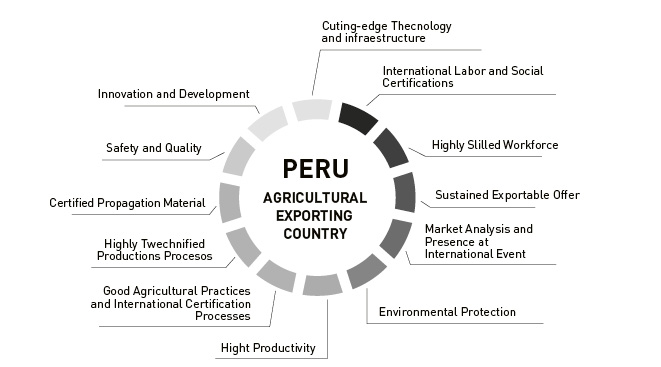
All these characteristics shape a distinct producer who must not only be deeply rooted in the land and its creative nature, and master it in all its aspects, but also must be the best and most productive entrepreneur. To achieve this, they have had to evolve, learn, adapt, and adopt technologies, attract talent, etc., and then apply all of this organically to be able to compete. In this way, little by little, they have carved out a path in international markets where only the best remains, demonstrating their sustainability.
Productive infrastructure and foreign trade
The coast of Peru is a natural desert region dotted with very fertile valleys. Peruvian historian Jorge Basadre noted:
The coast of Peru is above all a sandy expanse. It is a sea in reverse, an anti-sea. Giant hands filled several times to sow the land there in mythological ages. Assemblies of hills populate this vastness. Some of these hills resemble disfigured faces; others, threatening fists; others, backs of gigantic animals dozing. Behind the fence of the hills, the clouds sometimes spy on the dead landscape... The valleys on the coast are green islands surrounded by yellow immensity7.
Although it is also true that Peru is among the top ten countries in the world in terms of freshwater resources. The problem we face is that water seems to be “poorly distributed” by nature, as almost all of it goes to the Atlantic drainage basin and very little (only 1.8%) goes to the Pacific drainage basin8. That is why large irrigation projects were developed, which, despite taking decades to plan and build, allowed water to be brought from the Atlantic drainage basin to the Peruvian coast (Chavimochic, Olmos, etc.).
We must take into account that to develop modern agro-exporting agricultural activity, it is necessary to promote the development of infrastructure in ports, airports, highways, electricity, internet, irrigation channels, etc. to ensure viability to productive sectors oriented towards international markets, as is the case with modern Peruvian agriculture. This has been happening gradually; for example, high-level operators were contracted to enhance such infrastructure, which made exports more competitive and led to growth in the following years.
Currently, there are fertile valleys in areas that were desert in the past. This transformation process has undoubtedly demonstrated that when the State makes the right decisions, it is possible, in a relatively short time, to attract investment and develop an economic sector.
Public-private joint effort
Another element that has naturally strengthened in this new “business climate” in which modern Peruvian agriculture develops is the joint work of the State and the business sector. At Conferencia Anual de Ejecutivos (CADE, Annual Executive Conference) held in Urubamba, Cusco, in November 2010, Michel Porter timely pointed out that “there lies the opportunity and challenge for Peru, as it requires coordinated and cross-cutting work between the public and private sectors9.” Nothing could be truer. The real example can be clearly seen in the results obtained by entrepreneurs in the Peruvian agro-export sector, which have made the agricultural sector the second largest exporter in Peru after Mining.
Likewise, Klaus Schwab, founder and executive chairman of the World Economic Forum (WEF), also spoke to us about the importance of public-private collaboration at the WEF’s annual meeting in Davos in 2023:
We see that multiple political, economic, and social forces are creating greater fragmentation on a global and national scale. To address the root causes of this erosion of trust, we need to strengthen cooperation between the governmental and business sectors, creating the conditions for a strong and lasting recovery. At the same time, it must be recognized that economic development must become more resilient and sustainable, and that no one should be left behind.
After explaining these six elements, it is relevant, in the conceptual discussion about the importance of agriculture for a country, to ask ourselves the following question: Is agriculture a strategic sector for countries? To answer this, it is necessary to return to the words of Michael Porter: “Peru should instead adopt a comprehensive economic and social strategy to transform the economy, based on the country’s unique advantages10.”
As a demonstration of the enormous advantages our country possesses, Peru has 84 life zones out of the 114 in the world; 28 of the 32 types of climates, as well as more than 650 types of fruits in the coast, highlands, and jungle, in addition to a large number of new varieties under research.
So, why could agriculture be a winning sector? Because agriculture has a set of inherent elements that, with the right conditions and actions, generate positive economic and social impacts that make it a strategic sector. To better understand this, let us look at some aspects of the structural nature of agriculture in economies.
Food Security
Most countries pay special attention to their agriculture. It could not be otherwise. From the dawn of civilization to the present day, agriculture has been established as an essential element for the sustenance and development of every civilization.
In 1996, the World Food Summit was held at the headquarters of the Food and Agriculture Organization of the United Nations (FAO) in Rome to discuss food security. There, in front of 112 heads of state and more than 70 high-level representatives from other countries (including a Peruvian delegation), seven global commitments were signed, composing the Action Plan. Among them, I will mention two commitments that I believe are relevant to clarify this point:
Third commitment: we will strive to adopt participatory and sustainable policies and practices for food, agriculture, fisheries, forestry, and rural development in areas of high and low potential. These policies and practices are essential to ensure sufficient and reliable supply at the household, national, regional, and global levels. Additionally, they are crucial for combating pests, drought, and desertification, considering the multifunctional nature of agriculture.
Fourth commitment: we will strive to ensure that food and agricultural trade policies, and trade policies in general, contribute to promoting food security for all through a fair and market-oriented global trading system11.
That is what happened in Peru, precisely, with the establishment of a public policy for formal and modern agriculture, which is market-oriented, as well as promotes and serves both the domestic and international markets.
Employment
This is one of the variables that most concerns countries: how to ensure that the global workforce of 3.3 trillion workers (out of a total of 7 trillion people in the world) has decent employment?
To give fair importance to agriculture for countries, according to the International Labour Organization (ILO), 1.1 trillion people who belong to the global workforce are employed in the agricultural sector. There is nothing more strategic than a sector that employs the largest workforce in the world: 30% of the global economically active population (EAP)!
In Peru, more than 4 million people make up the economically active agrarian population, which accounts for over 24% of the Peruvian EAP as of 2022. In addition to this, it should be considered that employment generated by modern export-oriented agriculture is formal. Now more than ever, to combat informality, poverty, loss of private investment, and the very low growth of the country, what is required is not more regulation and laws that undermine competitiveness in economic sectors, but rather a reengineering of all regulation affecting the agricultural sector and the elimination of those that are causing harm or generating excessive costs and risks, and driving away investment. This prevents further investment and job creation.
Economic Decentralization
Agriculture develops in rural areas, mainly outside the capital city and urban areas. This, on the one hand, leads to the desired real decentralization from the capital and, on the other hand, decentralized economic development for citizens. The establishment of modern agro-export chains means that people from rural areas and areas of extreme poverty have formal employment and, therefore, increase their economic capabilities, naturally generating new markets and attracting small, medium, and large investments.
The development of modern agro-export chains has contributed to establishing a favorable business environment for the development of other sectors. In this sense, sectors such as services, commerce (for example, the development of new shopping centers), and industry in various provinces and cities connected through this production chain have benefited, particularly, from the development of regional clusters throughout the industry of goods and services that serve the agro-export production chain. In this regard, thousands of MSMEs (Micro, Small, and Medium-sized Enterprises) provide goods and services to the sector, generating employment and regional economic wealth. This helps reduce structural poverty, creates decentralized opportunities, and enables several regions to achieve full employment, among other benefits.
Rural Development
With increased employment and economic activity in rural areas, the development of intermediate cities occurs, contributing to bridging the gaps between urban and rural areas. This phenomenon is key in increasing competitiveness and productivity, as it constitutes pivotal geographical points for connectivity of logistic movement with production areas. Furthermore, public services improve and the construction of rural interconnection infrastructure through roads, etc. is enhanced.
This phenomenon has been occurring in several coastal cities, where the growth of modern agricultural industry has also led to the growth of small towns that are now intermediate cities. However, the lack of planning and inadequate public management have not allowed these cities to develop with the same quality as modern agriculture. In these towns, there are still many unresolved issues by the State, such as lack of water and sewage networks, hospitals and schools, rural roads, etc.
Foreign Trade
If we look at the market in terms of the number of citizens, the Peruvian domestic market has just over 30 million consumers, compared to the global market, which exceeds 7 billion! There is a tremendous opportunity in the development of agro-industry to supply the world. Peruvian agriculture already ranks second among the country’s export sectors. Boosting export sectors, including agro-export, is one of the central axes of the growth strategy.
As we can see, agriculture has all the elements to develop a powerful economic and social transformative strategy, as it combines the generation of formal employment with the generation of wealth in citizenship, the expansion of our products in global markets with the construction of decentralized local economies, etc. Ultimately, it is a sector that helps build a solid economic base, as well as promoting the construction of a sustainable middle class, generating greater well-being and quality of life for citizens.
Therefore, it is a tremendous responsibility of authorities, politicians, institutions, and citizens to preserve these conditions and make them increasingly efficient and competitive, so that agriculture continues to develop and continue to positively and sustainably impact.
During one of his visits to Peru, Michael Porter stated that our country “has many advantages, including natural resources, a great geographical location, and the effort of its population, which must know how to harness both its ability and its capacity for short, medium, and long-term vision.” He also added that “a country cannot be competitive if it does not improve its productivity and even less so if its companies are not competitive enough.” Nothing could be truer; modern Peruvian agriculture has been traversing that path, developing and achieving all mentioned aspects. However, there are still many challenges and a long way to go for all segments of Peruvian agriculture, such as family farming, to be positively transformed.