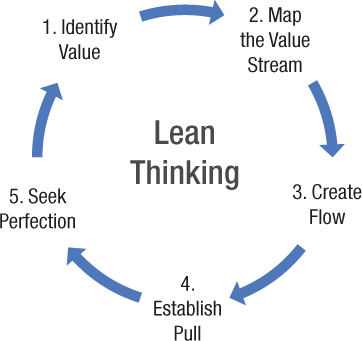
A lot has changed since Dan Jones and Jim Womack wrote Lean Thinking and, in it, outlined the famous five principles. Our understanding of what Lean is has evolved over the years, and many definitions have been put forward by thinkers from around the world.
According to the Lean Enterprise Institute, “Lean is a way of thinking about the creation of the needed value with fewer resources and less waste. Lean is also a practice consisting of continuous experimentation to achieve perfect value with zero waste.”
A lean approach to work helps an organization to innovate and remain competitive, and it is about:
• Understanding what’s really going on at the place where the work is carried out, where value is created – commonly known as the gemba.
• Improving the processes by which products and services are created and delivered.
• Developing and empowering people through problem solving and coaching.
• Developing leaders and establishing an effective management system that allows for communication, transparency, and continuous learning.
Indeed, Lean entails a fundamentally different way of thinking about business. It may have its roots in Toyota’s factories in Japan, but today it has come to represent an alternative, superior approach to doing work – no matter what the work is, the sector or the size of the organization. In a Lean organization, problems are seen as opportunities for meaningful learning, rather than mistakes to sweep under the rug or haphazardly correct. Lean managers act as coaches, helping others to get comfortable with identifying problems and practicing daily continuous improvement.
The term “Lean” was popularized around three decades ago by Jim Womack and Dan Jones, authors of seminal books like The Machine that Changed the World and Lean Thinking. In Lean Thinking, in particular, Womack and Jones described the five principles of Lean, which to this day act as a North Star for every lean practitioner.
Let’s briefly mention the five principles:
• Identify value, as defined by the customer. Over the years, I have seen people struggling to truly understand what value really means. These days, you have many ways to identify the value your customers expect from your products or services – be it a canvas model, an exercise with personas, a Voice of Customer or a SIPOC exercise.
• Map the value stream, to understand all the activities that contribute to the creation of value and identify the waste that lies in the process. In an organization, to become leaner means to develop everyone’s ability to identify waste and understand how each task and process fits into the overall value stream.
• Create flow, ensuring that all of the tasks in the value stream run smoothly, without interruptions or delays (this happens after having eliminated waste). This is key to making a lean system work, as it is at this stage that you remove the waste you have identified while mapping the value stream. Without instilling a “flow view” in everyone, you won’t be able to achieve the smooth creation of value throughout the process and you won’t see any results. Waste comes in many shapes and forms (there are eight main types, often organized in the easy-to-remember acronym TIMWOODS: Transportation, Inventory, Motion, Waiting, Over-processing, Overproduction, Defects, and Skills) and, to see it, you need to look at the process from the perspective of the end user. If, for example, I am waiting three hours to be seen by a doctor, I am going to be more upset by that than by the 30 seconds it takes the doctor to find my file on the computer. Everything that stops/delays the flow, adding time and cost, is waste and must be eradicated, but it is also critical to prioritize the waste that has the worst impact on the customer.
• Establish pull, limiting work-in-progress and inventory and ensuring the right information and resources are available where needed. This also entails letting customer demand set the pace of the work – no demand, no activity. The work gets activated whenever a customer requests a product (a pizzeria wouldn’t make a pizza without receiving a customer order first). The aim of pull is to avoid overproducing, which translates into more costs and time but not into customer value.
• Seek perfection, remembering that Lean is a never-ending journey that has continuous improvement at its heart. There is always room for improvement, in any situation. It is key to ensure that new standards are enabling you to sustain a new and improved process, which you will then continue to challenge as you work towards your vision – an “ideal situation” – through successive PDCA cycles. Lean organizations have a good mechanism in place to not only ensure that processes perform, but also to allow for improvement activities that provide ever greater value to customers.
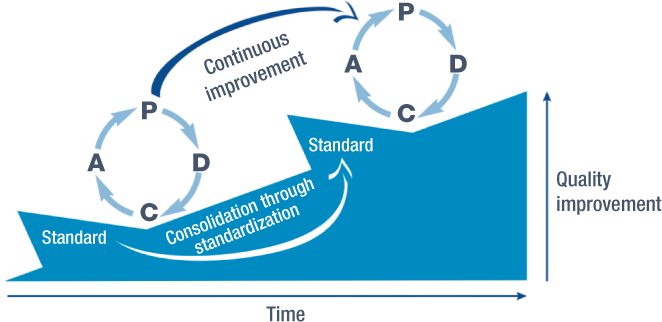
These five principles constitute the backbone of Lean Thinking and need to be internalized by everyone in the organization. The more people understand them and use them to grow and inform their work, the better.
Sadly, what we see is that a lot of the time, Lean is met with resistance – often, incredibly fierce – coming from people who instinctively reject its teachings simply because they are so used to doing things a certain way that they become blind to the fact that there are always new and better ways of working.
So how can you ensure that Lean reaches as many people in your company as possible (including naysayers)? How can you help this “new logic” to permeate every corner of your organization? This book aims to offer a few answers to these questions.
To define Lean Thinking and its many facets in a few words is no easy task. For this reason, over many years spent applying the methodology in countless companies, I have compiled a list of the most common questions businesses and students ask me about Lean and tried to answer them. In almost every instance, these questions can be traced back to the many misconceptions around Lean Thinking that still exist.
Here are a few of the most frequent questions:
– Is Lean about cost-cutting? No, it is not. Removing waste leads to cost reduction, but that’s not its main goal. When they free up capacity (measured in man hours), Lean organizations strive to find other ways to use it, rather than reducing headcount. For example, they try to find other positions for the people in the company whose jobs are no longer needed, enabling them to generate new opportunities for growth or to boost the capabilities of their peers.
– Is Lean a transformation program that is in no way tied to the company’s P&L? No. Lean can support the success and ensure the continuity of the business by contributing to the optimization of margins, even though this is not its main or only focus. When initiating a Lean Transformation, your goal should be to create a culture of generating value for customers; cost reduction will then come as a natural result of the elimination of waste.
– Does Lean work outside of manufacturing? Of course, it does! For the past 20 or so years, Lean has spread to pretty much every industry and human endeavor, bringing impressive results to organizations ranging from hospitals to restaurants, offices, hotels, software development firms, banks, etc.
– What is the difference between Lean and other improvement methodologies like Total Quality Management or Six Sigma? Lean puts more emphasis than any of them on the philosophical, “social” side of management – the people side. Lean is not just a technique, it’s an enabler of a cultural revolution.
– Is Lean a secret recipe? No, it’s a framework. You can’t copy and paste it, but you can draw inspiration from its model and from other people’s journeys.
– Does Lean work in any culture? For the longest time, people have believed that Lean can only succeed in Japan. “It’s a Japanese thing,” they would tell you. Nothing further from the truth! Toyota has plants around the world that are just as successful as their Japanese counterparts. While Japanese culture and history have undoubtedly contributed to the creation and evolution of Lean, it is more useful and compelling to trace the strength of this approach back to the uniqueness of Toyota. As far as context goes, Lean has more to do with Toyota than with Japan. In that sense, it works with any culture in the world.
– Is it difficult to implement Lean? Not as difficult as it is to sustain it. Starting a project is fairly easy, but to develop leaders so that change can be sustained is really difficult.
– Is Lean a new management philosophy? It is if we forget it’s been applied at Toyota for decades now!
– Is Lean a “project” with a final delivery date? No. In fact, it’s a new way of thinking and acting, an alternative culture inspired by the never-ending pursuit of perfection. It should be considered a journey (that’s why we talk about “continuous improvement”) and not a project with a deadline.
– Should a Lean Transformation rely on “improvement events”? Planned events provide great help in enabling change, but you will need to follow up, provide teams with the necessary capabilities, and ensure you can sustain your initial achievements. If you don’t, your transformation will be nothing more than an event-planning activity.
– How do we pursue a Lean Transformation while dealing with the current work to be done? Lean should not be considered a parallel project (“I didn’t have time to do Lean today”) or an extra task. Rather, it should become the way things are done in an organization. Instead of seeing Lean as an extra investment in time and effort, you should see waste elimination and process improvement as part of your work. Don’t wait for the right moment to start… the right moment is now.
– Is it right to “try Lean” and then decide whether to continue based on the results we achieve? Lean is not something you just try. To kick-start this kind of cultural change requires a lot of conviction. These days, we know that Lean works in any kind of environment. What you should worry about is not whether it can work for you, but whether you can make it work (hint, it requires a shift in mindset and the involvement of people).
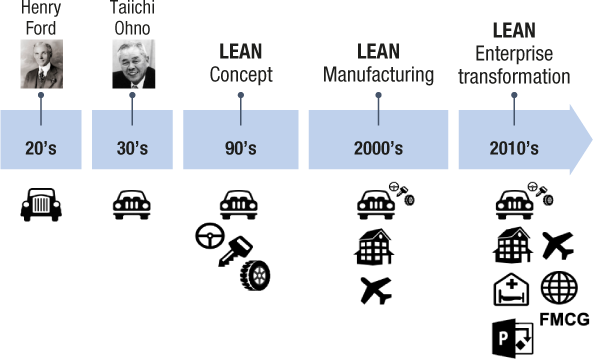
As mentioned earlier, our understanding of Lean has evolved significantly over time. At first, we thought it was mostly a production system, something that only applied to manufacturing. It took us a few years to realize it was actually a whole learning-based people-centric management system that can really be adapted to organizations operating in any industry. So, over time we have gone from talking about “Lean Production” or “Lean Manufacturing” to referring to “Lean Thinking”, “Lean Enterprise” and, eventually, “Lean Transformation”. And it is on this last concept that I’d like to focus in this section of the book.
My own lean journey began in the late 1990s, when I graduated in Mechanical Engineering. A couple of years before, I had started working in a Delphi site near Barcelona that produced diesel pump engines for cars and that was selected as a pilot plant for a Lean Transformation. By then, Delphi was collaborating with the Lean Enterprise Institute to introduce a lean culture in the company.
The site had carried out different programs since the 1980s – quality circles, TPM, 5S, Total Quality, Shainin methods for problem solving, Six Sigma, and so on. It had, therefore, a solid base to build on, with an advanced understanding of continuous improvement activities and techniques. When Lean came to the site, then, it was not difficult for people to interiorize it. It was simply a continuation of the work they had been doing. This time, however, the focus was more on flow and adjusting capacity to demand (based on the demand scenarios we analyzed, we even had to stop some equipment).
The fact that I spoke English and that I had no previous experience with traditional production systems made me the ideal candidate to join the group of young engineers that was put in charge of bringing Lean to the teams, based on the Delphi Manufacturing System.
We had been working on this for two years, when Yamada-sensei visited us and helped us to influence some cultural activities with the teams to improve flow across the operational system by identifying waste. Finally, in the early 2000s, sensei Kazumi Nakada came to our site as part of a two-year program to introduce a “real” lean culture, spanning from new process design to implementation and continuous improvement activities.
Around that time, Professor Lluís Cuatrecasas, then President of Instituto Lean Management in Spain, invited some of us young Delphi engineers to explain what we were doing at the site to students in the Master’s program he taught at the Universidad Politècnica de Catalunya. We were lucky to fulfill a perfect cycle of Learn-Do-Teach, which helped us to consolidate our own knowledge of Lean Thinking. When we started to explain Lean to students at the end of the 1990s, some of them, who were not familiar with the automotive sector, told us that Lean was not applicable in their environments and, more generally, in non-Japanese cultures.
In the 2000s, we translated Lean Thinking by Jim Womack and Dan Jones into Spanish. The book helped us to deepen our understanding of Lean and provided useful examples we could use to devise our own Lean experiments in automotive, but also in services, hospitals, and the hospitality industry.
During a Lean Enterprise Institute summit in Atlanta in the late 2000s, John Shook shared some deep reflections on Lean Transformations, as he invited our community to balance Lean systems and tools with people development and cultural change.
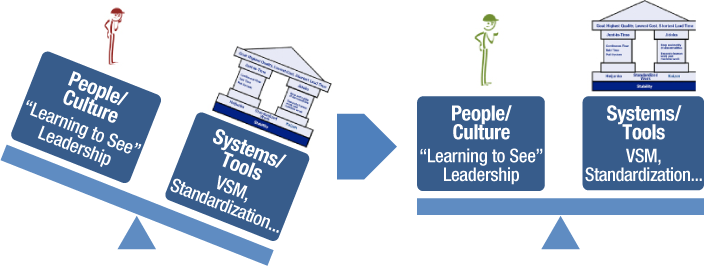
As Shook stated in his e-letter Lean Practice Applies to All Work, Everyone, Every Day, All Day, “Lean isn’t Lean if it doesn’t involve everyone”. By the early 2010s, he then introduced the Lean Transformation Framework, which is inspiring countless organizations to figure out their path to a Lean Transformation with its five dimensions (we will discuss the LTF in more depth in the next chapter).
Based on my personal experience, in hindsight, Lean Thinking has evolved from “something applicable only to automotive and Japanese organizations” to a way of thinking that works in any sector and culture that understands that providing value to customers and doing more with less is the key to success.
The timeline below summarizes, at a high level, the key milestones in the evolution of Lean Thinking.
Everyone is talking about “transformation” these days. With the world changing at an unprecedented pace and uncertainty mounting, the ability to adapt to new circumstances and transform has become the Holy Grail for businesses the world over. But what do we mean by “Lean Transformation” exactly?
In my mind, a Lean Transformation is simply a way to achieve a future condition we wish for by balancing the introduction of tools and techniques with the cultural change that a turnaround calls for. Of course, this is easier said than done, particularly when we find ourselves having to change a “traditional” organization with a Taylorist approach to management.
TRADITIONAL BUSINESS |
LEAN BUSINESS |
A lot of (undefined) work-in-progress – be it products, services, customer orders, patients, or information – as a consequence of poor management practices. |
Work-in-progress is limited and kept under control. When the maximum allowed level is reached, supplier activity will not feed any more into the system. |
Complex equipment and solutions. |
Small and simple equipment/solutions. |
Work in big batches. |
Quick changeovers between activities allow the system to work with small batches, with an increased ability to react to customer demand and better lead-times. |
No ownership of management system. |
People involvement and ownership of management system. |
Inspections to ensure quality, often at the end of the production cycle. |
Error-proofing systems (Poka Yoke), ensuring that defects don’t appear and that, if they do, they are not passed on to the downstream step in the process. |
Low efficiency and performance of equipment and activities. |
High efficiency of equipment and activities. |
Changes take long time to be implemented. |
Kaizen and/or Kata spirit. Continuous and controlled improvements are implemented in the system. |
Management is far from the system and not supporting people’s needs. |
Chain of help ensures people receive support in the event of a problem (andon systems are in place, ensuring quick response). |
Not an organized system. Difficult to identify what is normal and what is not. |
Well organized system. Easy to see and identify abnormalities. |
Complex, and many times “hidden”, controls and management system. Process needs to adapt to technology. |
Simple and visual controls and management system. Technology is at the service of the process. |
Activities in the process are not linked together. The process is managed to obtain better results locally (vertical thinking). |
Value Stream organization. Activities in the process are connected with one another. Management is oriented towards obtaining better global results (horizontal thinking). |
Flow is not intuitive. Complex spaghetti charts for products, services, customers, patients, information. |
Intuitive and visual pull flow for products, services, customers, patients, information. |
Indeed, as evidence shows, the majority of Lean Transformations fail. Why is that? What are the most common reasons behind failure? What are the most common mistakes organizations make? If we can identify them, we are to avoid them. That’s why in the next few pages, I will discuss the most commonly cited factors leading to the failure of a Lean turnaround and share some recommendations on how to build the foundations for a successful transformation architecture.