BAROQUE ART
While Italian Renaissance artists created highly organised spatial settings and idealised figures, northern Europeans focused on everyday reality and on the variety of life. Few painters have equalled the Netherlandish painter Jan Van Eyck, for example, in his close observation of surfaces, and captured more clearly and poetically the glint of light on a pearl, the deep, resonant colours of a red cloth, or the glinting reflections that appear in glass and on metal.
Spanning both north and south Europe during the Renaissance was Albrecht Dürer of Nuremburg. Durer followed the Italian practice of canonical measure of the human body and perspective, though he retained the emotional expressionism and sharpness of line that was widespread in German art. Though he shared the optimism of Italians, many other northern painters were pessimistic about the human condition. Giovanni Pico della Mirandola’s essay on the Dignity of Man presaged Michelangelo’s belief in the perfectibility and essential beauty of the human body and soul, but Erasmus’s Praise of Folly and Sebastian Brant’s satirical poem Ship of Fools belonged to the same northern European cultural milieu that produced the fantastic visions of Hieronymus Bosch’s Garden of Earthly Delights triptych and Pieter Bruegel’s raucous peasant scenes. There was hope for humankind in paradise, but little consolation on earth for beings consumed by their passions and caught in an endless cycle of desire and fruitless yearning. Northern humanists, like their Italian counterparts, called for the classical virtues of moderation, restraint and harmony – the pictures of Bruegel represented the very vices against which they warned. Unlike some of the contemporary Romanists, who had travelled from the Netherlands to Italy and been inspired by Michelangelo and other artists of the time, Bruegel travelled to Rome around 1550 but remained largely untouched by its art. Instead he turned to local inspiration and staged his scenes amidst humble settings, earning him the undeserved nickname ‘Peasant Bruegel’. Brueghel was a herald of the realism and bluntness of the northern European Baroque.
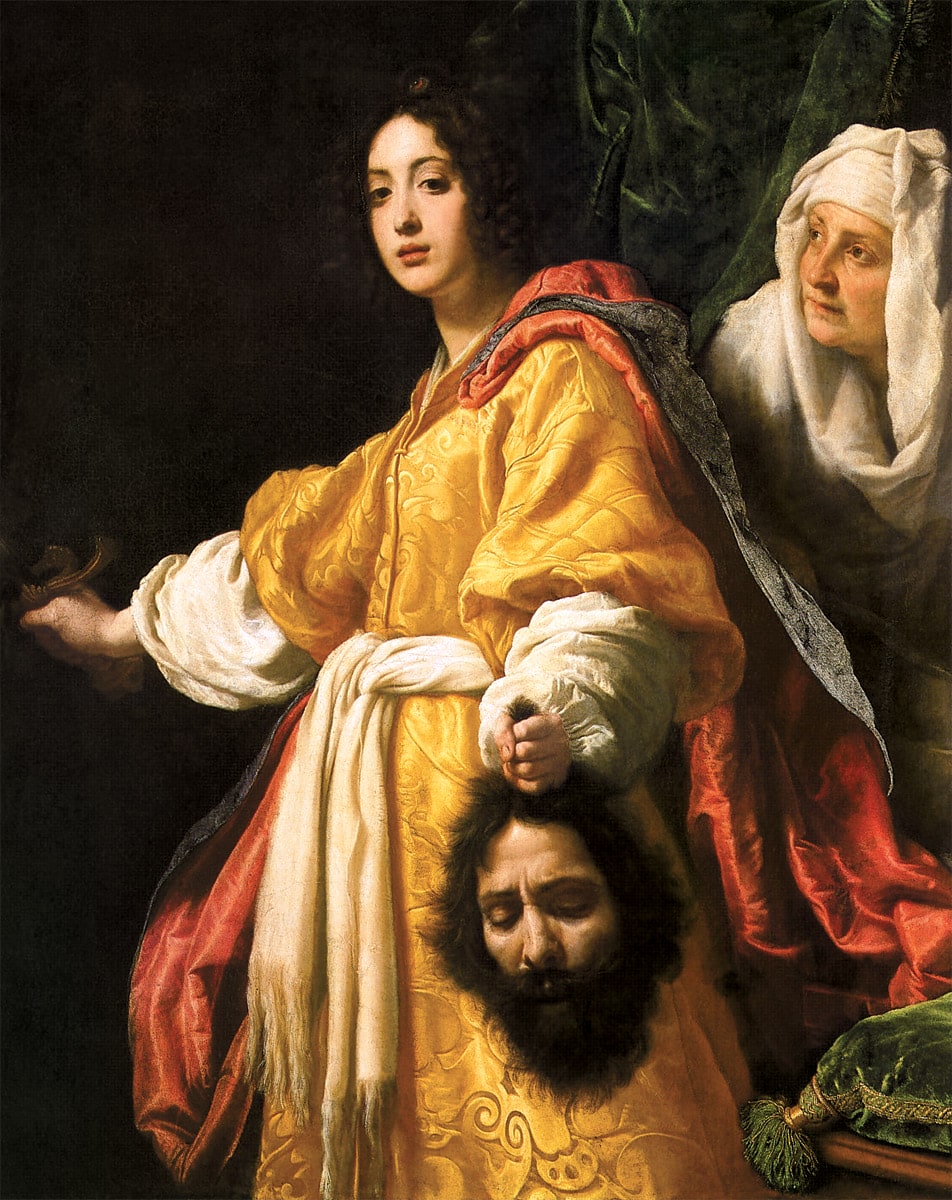
The great intellectual revolt set in motion by theologians Martin Luther and John Calvin in the sixteenth century provoked the Catholic Church to respond to the challenge of the Protestants. Various church councils called for reform of the Roman Catholic Church, and participants at the Council of Trent declared that religious art should be simple and accessible to a broad public. A number of Italian painters, however, known as Mannerists, had begun developing a form of art that was complex in subject matter and style. Painters eventually responded to ecclesiastical needs as well as to the stylisations of Mannerism. We call this new era the age of the Baroque, which was ushered in initially by Caravaggio. He painted mainly religious subject matter, but in the most realistic and dramatic manner possible, and gained a following among ordinary people as well as among connoisseurs and even Church officials. Caravaggism swept across Italy and then the rest of Europe, as a host of painters came to adopt his chiaroscuro and suppression of vivid colouring; his earthy tones and powerful figures struck a chord with viewers across the continent who had tired of some of the artificialities of sixteenth-century art.
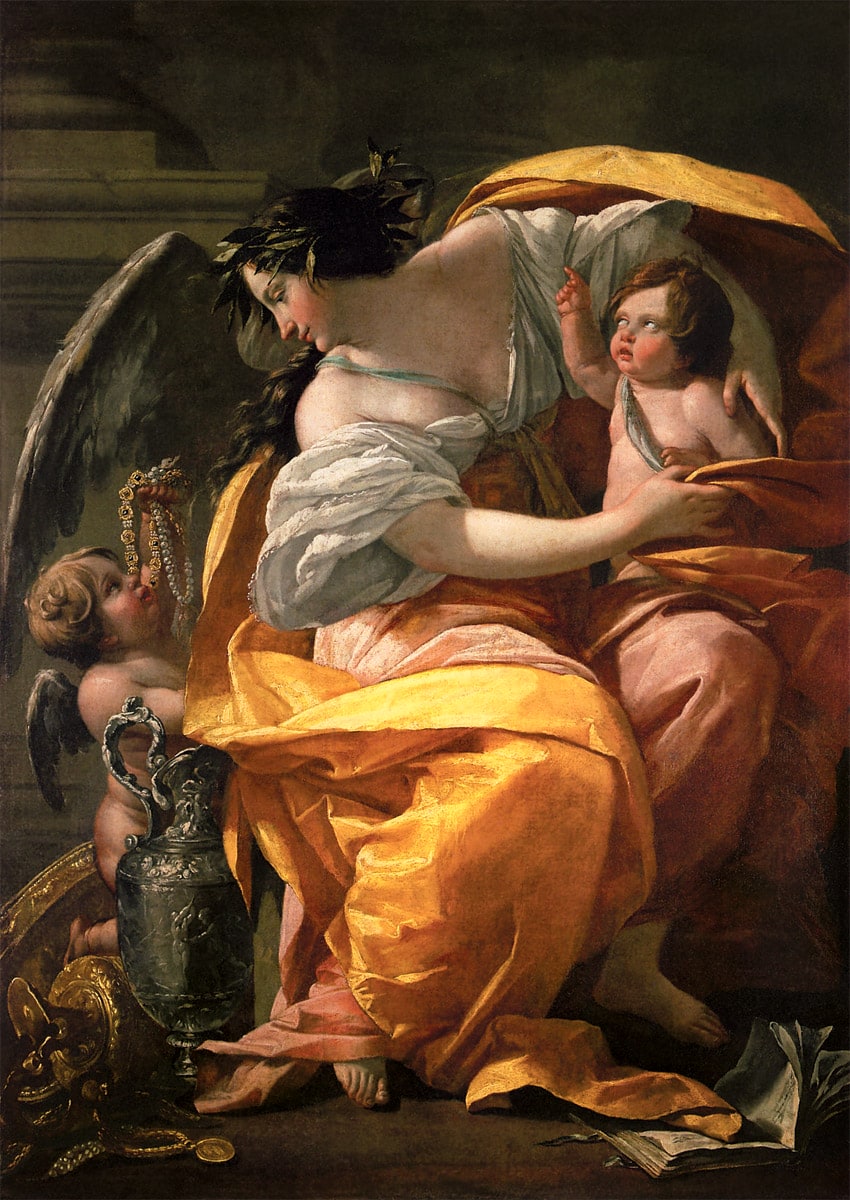
In addition to the Caravaggism of the early Baroque, another form of painting later called the High Baroque – the most dramatic, dynamic and painterly style yet seen – also developed, built on the foundations laid by the sixteenth-century Venetians. Peter Paul Rubens, an admirer of Titian, painted huge canvases with fleshy figures, rich landscapes, broken brushwork and flickering light and dark tones. His pictorial experiments were the starting point for the art of other northern European artists such as Anthony Van Dyck; the latter had a large following among the European elite for his noble portrait manner. Rubens brought back the world of antiquity, painting ancient gods and goddesses, but his style was anything but classical. He found a ready market for his works among European aristocrats who liked his exuberance, and among Catholic patrons of art who found in his flamboyant sacred scenes a weapon for Counter-Reformation ideology. In Rome, Bernini was Ruben’s counterpart in sculpture, providing the Catholic Church with two powerful champions for the power and majesty of the Church and Papacy. Italian Baroque painters unleashed a torrent of holy figures on the ceilings of churches in Rome and other cities, with the skies opening up to reveal Heaven itself and God’s personal acceptance of the martyrs and mystics of Catholic sainthood. The Spanish painters Velasquez, Murillo and Zurburán also took up the style, using quieter movement and brushwork, but sharing with the Italians a mystical sense of light and Catholic iconography.
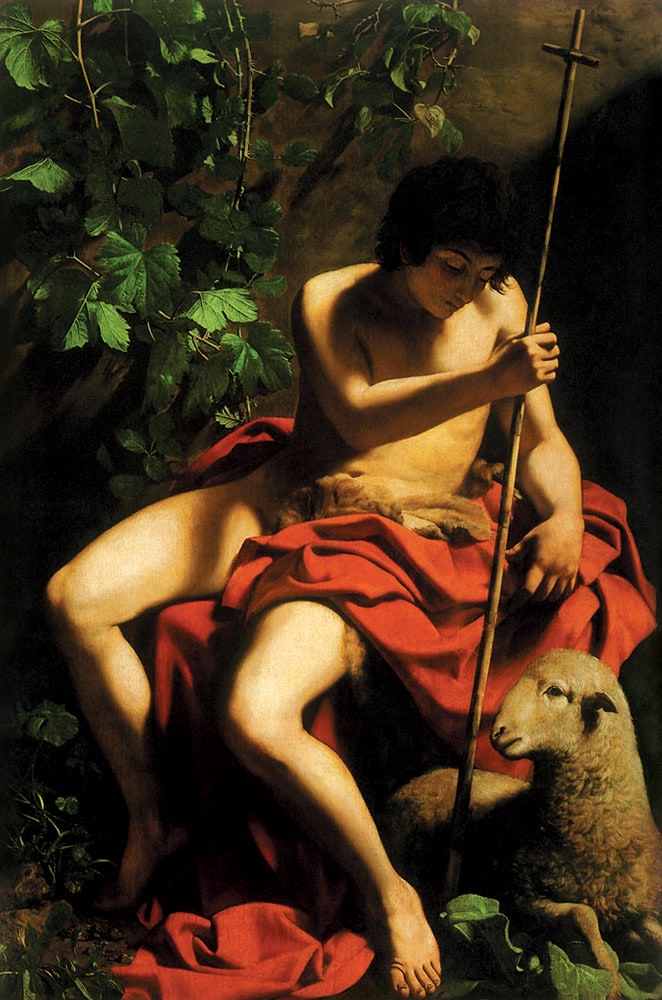
Michelangelo Merisi da Caravaggio, The Martyrdom of St. Matthew, 1599-1600, Oil on canvas, 323 x 343 cm. San Luigi dei Francesi, Rome.
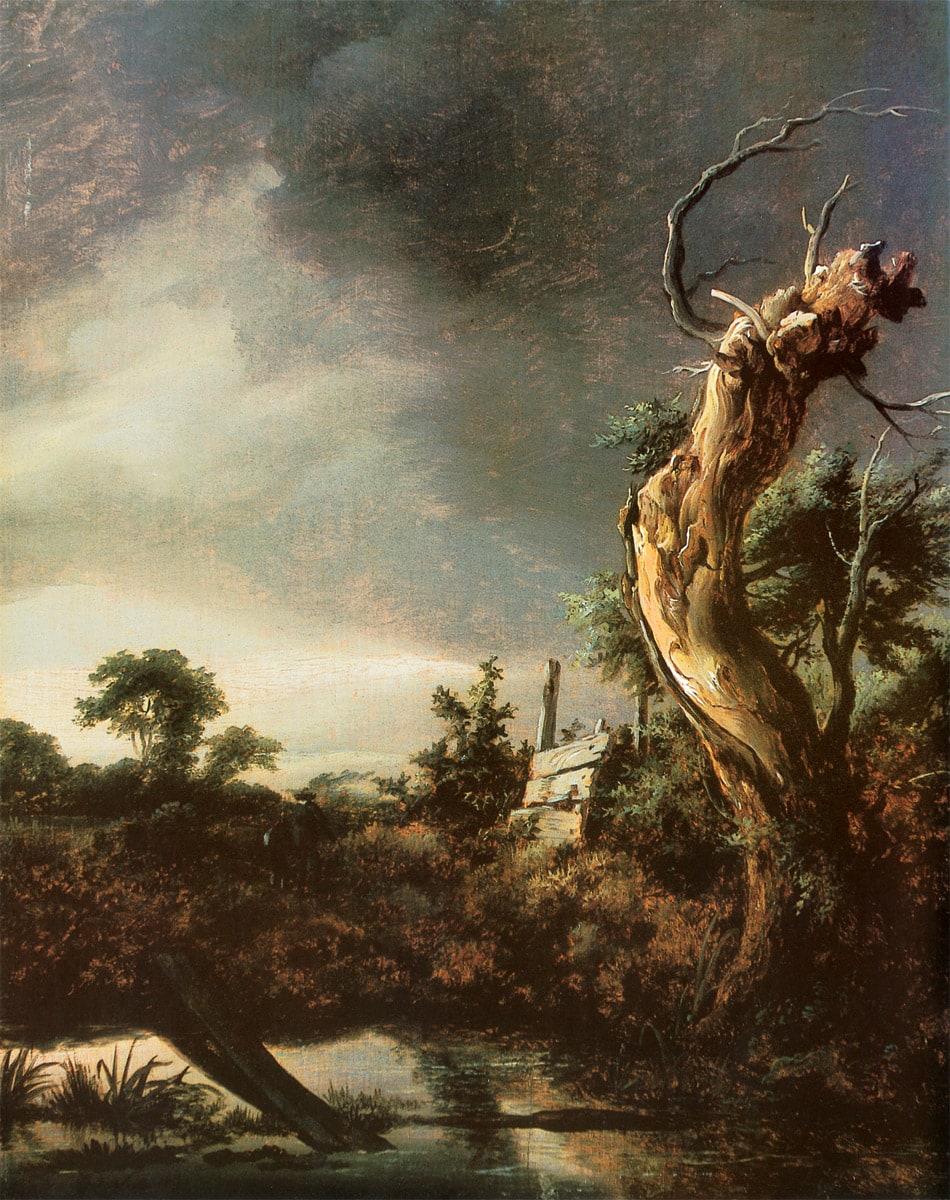
Jacob van Ruisdael, Landscape during a Storm, 1649. Oil on canvas, 25.5 x 21.5 cm. Musée Fabre, Montpellier.
How different from all this were the paintings of seventeenth-century Holland! Having effectively freed themselves from Habsburg Spain by the 1580s, the Dutch practised a tolerant form of Calvinism, which eschewed religious iconography. A growing middle class and increasingly wealthy upper class acted as patrons for the delightful variety of secular paintings produced by a host of skilled painters, with individual artists specialising in moonlit landscapes, skating and tavern scenes, still-lifes, domestic interiors, ships at sea and a great variety of other subjects. From this large school of artists several individual painters stand out. Jacob van Ruisdael is the closest we have to a High Baroque landscape painter in Holland – his dark and sometimes stormy landscapes evoke the drama and movement widespread in European art of the time. Like Ruisdael, Frans Hals’ painting, with its flashy, quick strokes of the brush and exaggerated colouring of skin and garments, approaches a pan-European sensibility of the High Baroque. In contrast, Jan Steen typified the realism and local character of most Dutch art of the Golden Age, and added a moral slant through the depiction of households in disarray and misbehaving peasants. Finally, the paintings of Rembrandt van Rijn stand alone, even amongst the Dutch. Raised as a Calvinist, Rembrandt shared some beliefs with the Mennonites, and was happy to depart from Calvinist strictures against representing biblical scenes. His later paintings, with their quiet introspection, make the perfect Protestant counterpart to the showy, dynamic Roman Catholic paintings of Rubens. From his early, tighter technique influenced by Dutch ‘fine painters’, Rembrandt developed a broad, shadowy manner derived from Caravaggio, but expressed with much greater pictorial complexity. This style later fell out of favour among the Dutch, but Rembrandt remained true to it, leaving a legacy that would be admired by nineteenth-century Romantic painters and modernists with a taste for painterly abstraction. Rembrandt was also distinctive for the universality of his art, which was steeped in knowledge of other styles and literary sources. Although he never travelled to Italy, he absorbed many of the tenets of Italian painting, and included in his works elements inspired by artists such as the late Gothic artist Antonio Pisanello and the Renaissance masters Mantegna, Raphael and Dürer. His style evolved constantly, and he had the broadest artistic mind and deepest understanding of the human condition of any painter of his age.
Clearly, just as there were many ‘Renaissances’ in art, there were many forms of the Baroque, and the High Baroque was challenged by the Classical Baroque, which had its philosophical roots in ancient thought and its stylistic basis in the paintings of Raphael and other High Renaissance classicists. Annibale Carracci had embraced a classical approach, and painters like Andrea Sacchi challenged the supremacy in Rome of High Baroque painters like Pietro da Cortona. However, the quintessential classicist of the seventeenth century was the Frenchman Nicolas Poussin, who developed a style perfectly suited to the growing ranks of philosophical Stoics in France, Italy and elsewhere. His solid, idealised figures, endowed with broad physical movements and firm moral purpose, acted out a range of narratives, both sacred and secular. Another Frenchman developed a different form of classicism: the Epicurean paintings of Claude Lorrain at first seem to differ sharply from those of Poussin: in Claude’s pictures edges melt away, waters ripple subtly and hazy views of infinity appear in the distance. Yet both painters conveyed a sense of moderation and balance, and appealed to similar kinds of patrons. All these painters of the seventeenth century, whether or not classical in temperament, participated in the explosion of subject matter of the time; not since antiquity had art-making seen such diversity of iconography of both sacred and profane subjects. With the exploration of new continents, contact with new and different peoples across the globe, and novel views offered by telescopes and microscopes, the world seemed to be an evolving and fractured place and the diversity of artistic styles and pictorial subject matter reflected this dynamism.
Louis XIV (d. 1715), the self-designated Sun King who modelled himself after Apollo and Alexander the Great, favoured the classical mode of Poussin and of painters such as his court artist Charles Le Brun, who, in turn, glorified the king with a number of murky paintings celebrating his reign. There arose at the end of the seventeenth and beginning of the eighteenth century a debate over style, in which painters allied themselves with one of two camps – the Poussinists and the Rubensists. The former favoured classicism, linearity and moderation, while the latter group declared the innate primacy of free colouring, energetic movement and compositional dynamism. When Louis XIV died, the field in France was open, and the Rubensists took the lead, bringing forth a style we call Rococo, which – roughly translated – means ‘pebble work Baroque’, a decorative version of painterly Baroque.
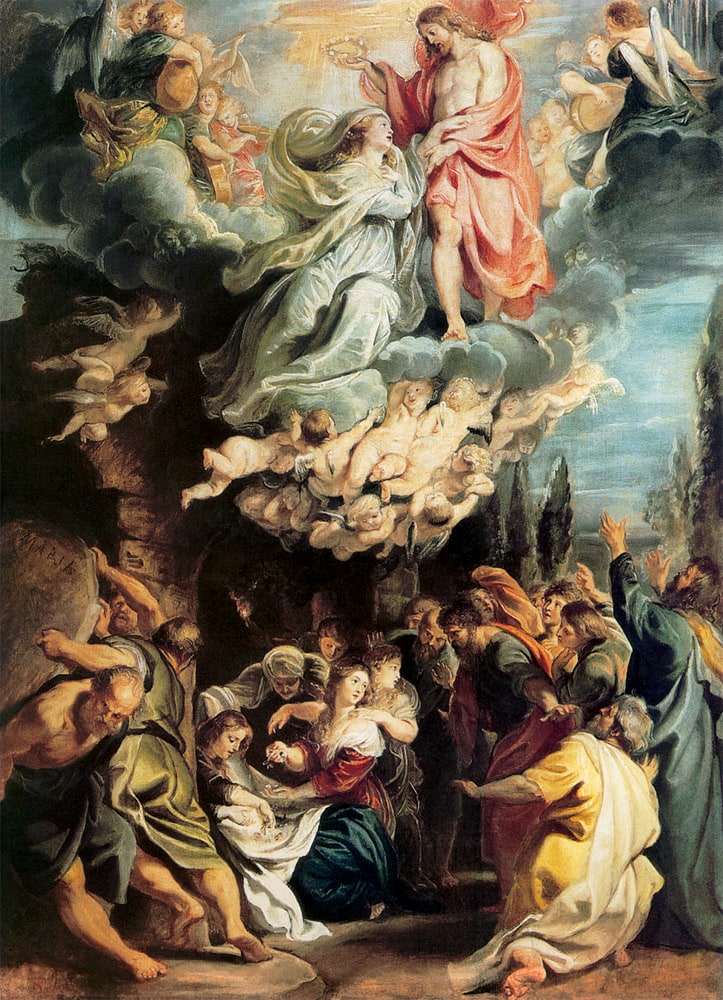
Peter Paul Rubens, The Coronation of the Virgin, 1609-1611. Oil on canvas, 106 x 78 cm. The State Hermitage Museum, St Petersburg.
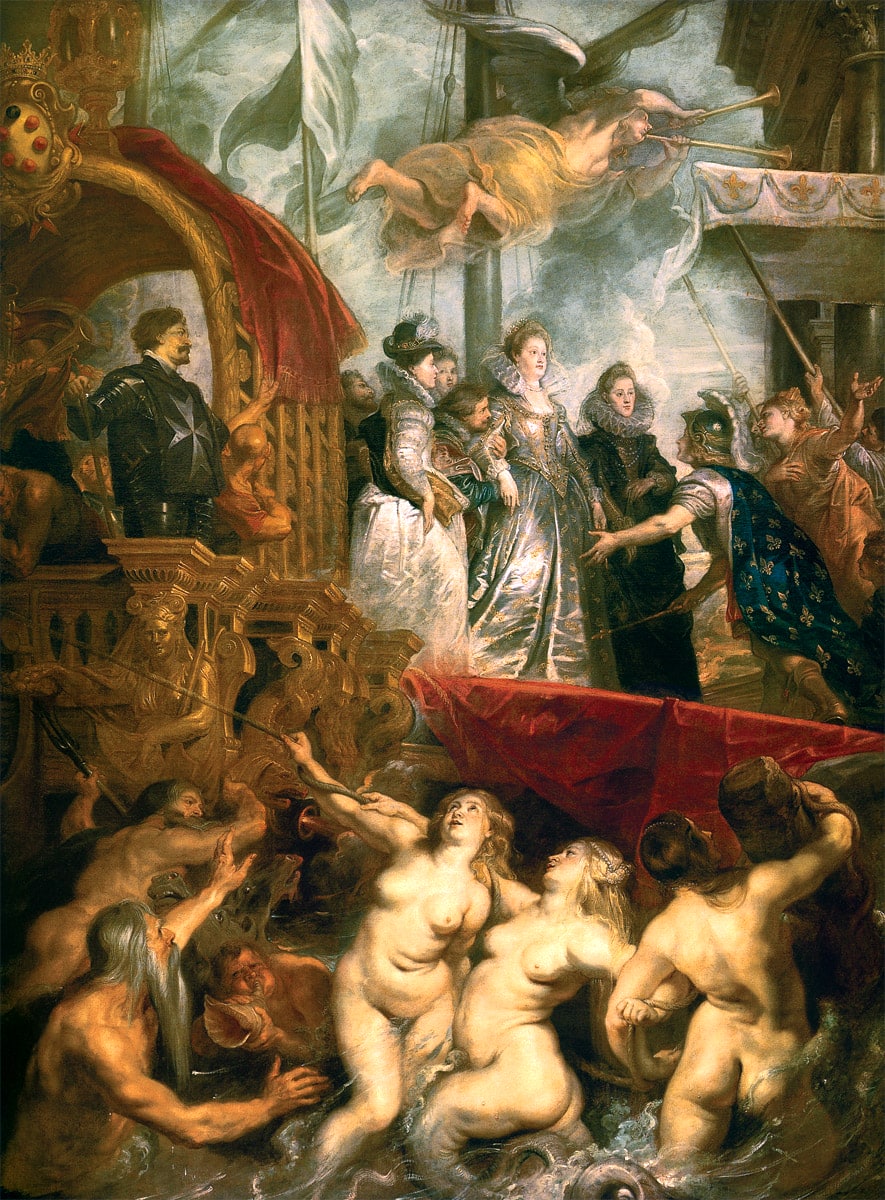
Peter Paul Rubens, The Landing of Maria de’ Medici at Marseille, c. 1621-1625. Oil on canvas, 394 x 295 cm. Musée du Louvre, Paris.