SER DEL BARÇA ÉS EL MILLOR QUE HI HA

Argentine coach César Luis Menotti used to say that you could tell if Barça had won the day before by the faces of the people you met when you arrived at Barcelona airport. That the mood of everyone reflected the fortunes of their beloved club, which had played the day before. That is why it has never been unusual to hear Barça fans say that “first and foremost, I am a Barça fan”. And they say it from the bottom of their hearts. It’s a feeling that knows no boundaries, that makes the Barça anthem sound so good, that confirms that it doesn’t matter where you come from, that a flag and colours unite you. That this loyalty is passed on from generation to generation. It is passed on from parents to children. It does not die and it endures over time, through both success and adversity.
FC Barcelona is a point of reference for thousands of fans, not only on a sporting level, but also socially and politically. Without forgetting an important fact: FC Barcelona remains in the hands of the 143,086 members who, with their restrictions, control the club and elect the president who will lead the club during his term of office. This is a far cry from its rivals, which are in the hands of billionaires, are owned by third parties or are outright “state clubs”. Barça has members and supporters all over the world, and their numbers have grown enormously since the advent of social media.
In his inaugural speech as president of Barcelona in 1968, Narcis de Carreras said: “Barcelona is more than a football club, Barcelona is more than just a place where we go to watch the team play on a Sunday; more than anything, it is a spirit that is deeply rooted in us, it is a set of colours that we cherish above all else”. It was an important speech that will forever remain a reference point in the club’s history. It gave rise to the slogan “El Barça és més que un club” (“Barçá is more than a club”), the best way to define the club.
The writer Francisco Candel, in his book Los otros catalanes (The other Catalans) recounts that many immigrants were aware that one way of facilitating their integration was to carry a Barça membership card in their wallet. No one can deny that the bulk of the immigration to Catalonia after the Civil War found an ideal way to do this in the ranks of Barcelonismo.
A good example of this was the late Manolo Escobar, a popular singer who moved to Barcelona from his native Almería in 1946 and, in the shadow of the Barça of the Five Cups, became a staunch “culer” (Barça fan). He followed the azulgrana (blue and garnet - Barça’s colours) team whenever he could (including the tragic finals in Seville and Athens). President Enric Llaudet decorated him with the gold and precious-stone medal for his services to Barcelona.
Manuel Ibáñez Escofet, journalist and key figure in Agustí Montal i Costa’s candidacy, defended Barça’s special character, saying “people are sustained by institutions that are above petty politics, above party politics. People look for havens of active coexistence such as FC Barcelona, the Orfeó Català (Catalan Choral Society), the Centre Excursionista de Catalunya (Catalonia’s Excursion Centre) or the Ateneo (Cultural Centre)”. For him, the club was “an example of the expansion of a sporting society that is firmly rooted in the collective work, nourished by shared enthusiasm and which finds in this bond the main reason for its greatness”.
Perhaps this is why Manuel Vázquez Montalbán, the great journalist and writer, dared to state categorically that “FC Barcelona is the symbolic unarmed army of Catalonia”. Undoubtedly an exaggeration, his statement is nonetheless partly true, given the importance of the Barcelona team at all levels throughout its history. The club has been closely linked to the region since a few years after Joan Gamper founded the club on 29 November 1899.
There are special ambassadors at this level, such as the singer-songwriter Joan Manuel Serrat and the tenor Josep Carreras, who have taken their Barcelonismo (devotion to Barça) all over the world. The singer-songwriter from Poble Sec has made many of his fans all over the world hum his song “Temps era temps” (Once upon a time), learn about the existence of Kubala, Barça’s legendary striker, and convert to the team by imitating their idol. Carreras, on the other hand, always showed his Barcelona sympathies and maintained a friendly rivalry with his colleagues Luciano Pavarotti, a Juventus fan, and Plácido Domingo, a born Madridista (Real Madrid fan). Carreras played a key role in Barça’s centenary celebrations, singing to a packed Camp Nou. The Catalan tenor has not forgotten his participation. The same goes for Serrat, who sang Barça’s anthem a cappella at the stadium. He used to say that “children are made to play. To play for the sake of playing. To have fun playing”. That must be the philosophy, the DNA of the blue and garnet team.
Barça is unique in the world because it combines its ambition to win with playing well, especially in the last forty years, after Johan Cruyff and his Dream Team set the bar very high for those who took over at Barça.
It defines what FC Barcelona stands for, the football and multi-sport aspect that Joan Gamper envisioned and developed when he founded the club. Xavi Hernández summed it up perfectly when he pointed out that “Barça is unique in the world because it combines the ambition to win with always playing well, especially in the last forty years, after Johan Cruyff and his Dream Team set the bar very high for those who took over at Barça”.
This is true, although Xavi neglected to add that this penchant for eye-catching football goes back many years, and that Barcelona fans have always favoured technical gestures over physical strength, although they have never failed to reward the efforts of the players who wore the blue and garnet.
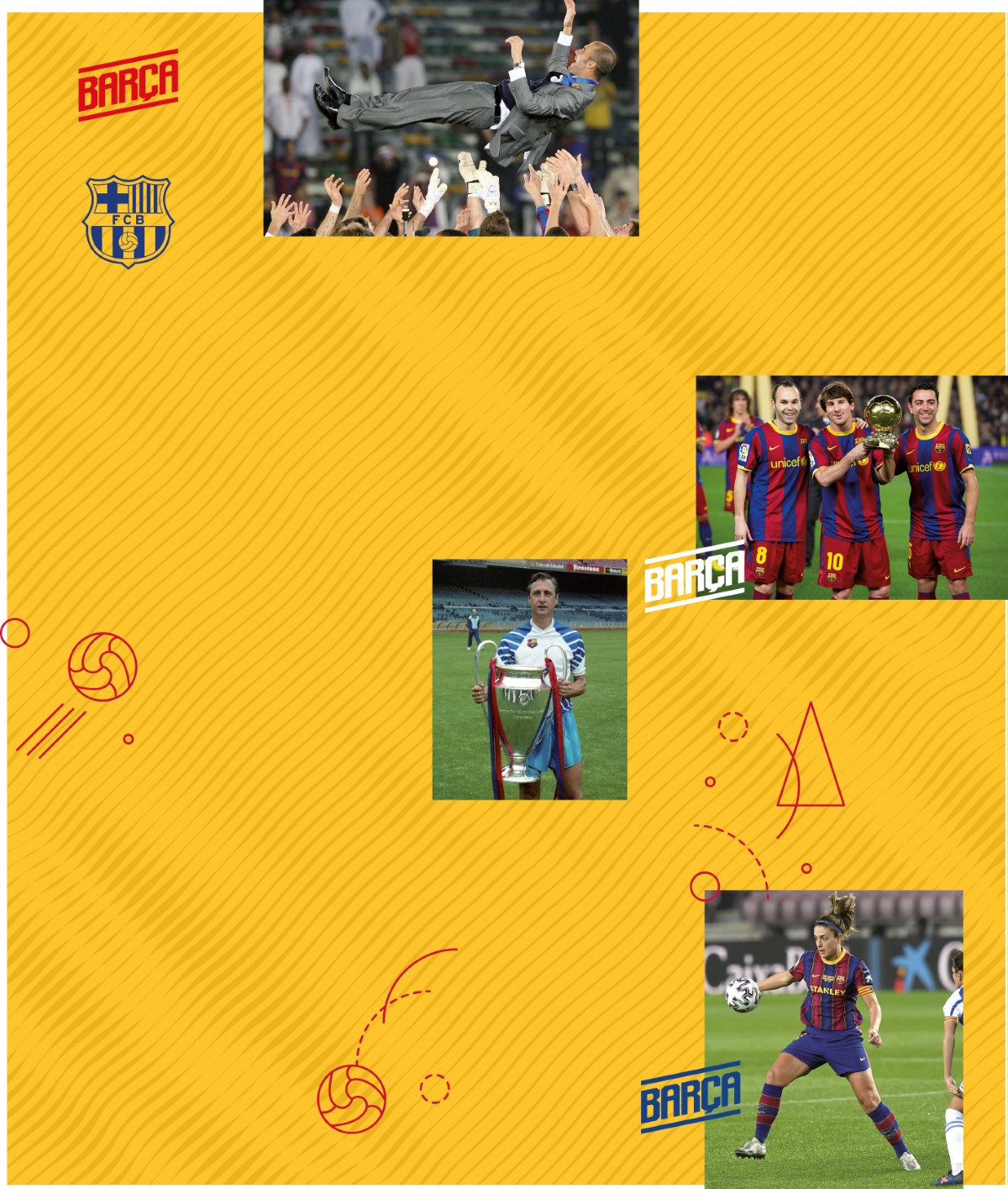
Barça has seen the likes of Laszi Kubala, Luis Suárez, Johan Cruyff, Ronaldo, Romário, Ronaldinho, Rivaldo, Hristo Stoichkov, Pep Guardiola, Xavi Hernández, Andrés Iniesta and Lionel Messi. They have collected golden balls and golden boots. They have won titles in Spain, Europe and the rest of the world. But most importantly, they have exported a philosophy of play that has produced great teams such as Ladislao Kubala’s Barça of the Five Cups, Johan Cruyff’s Dream Team or Pep Guardiola’s side. These teams have inspired schools around the world. The 2010 FIFA Ballon d’Or podium with Lionel Messi, Andrés Iniesta and Xavi Hernández was the culmination of this way of understanding football at Barça over the years.
Don’t think that it’s all an exaggeration. It is not unusual for Barça members or supporters to ask to be buried next to a Barça shirt or flag. At one point, FC Barcelona had to change the route of the fans’ visit to the Camp Nou because, on several occasions, relatives of the deceased were found to have secretly thrown their loved one’s ashes onto the pitch.
Joan Gamper was a visionary of his time. But not even his privileged mind could have imagined what would become of the club he founded with a group of young foreigners and Catalans living in Barcelona. FC Barcelona is now a club with 143,086 members, millions of followers in Spain and the rest of the world, and a social media presence of its own.
But above all, as this book goes to press, Barça is a football team that has won 27 league titles, 31 Copas del Rey, 14 Spanish Super Cups, 2 League Cups, 5 Champions Leagues, 3 Club World Cups, 7 European Super Cups, 4 European Cup Winners’ Cups, 3 Fairs Cups, 2 Latin Cups and 3 Eva Duarte Cups. In addition, there are 96 European titles in the multi-sport sections, including European Cups in basketball, handball, roller hockey, futsal and women’s football. Adding up all the sections, including football, FC Barcelona has added 225 trophies to its museum since 2010.
FC Barcelona brings together a series of treasures in all areas that should be highlighted, where you can relive heroic moments, unforgettable matches, historic goals, team exploits and players to support. All these treasures must not be forgotten. This is what this book, Barça’s Treasures, is all about. It is a work to be read and enjoyed. It is the confirmation that belonging to Barça és el millor que hi ha (“is the best there is”).