1. Before 1850
Native to the Americas, tobacco first arrived in Europe during the sixteenth century after it was ‘discovered’ by the Spanish conquistadores. Bishop Bartolomé de las Casas - one of the earliest chroniclers of the Spanish colonisation of South America — in his Historia de las Indias (‘History of the Indies’) described tobacco smoke as ‘heady and intoxicationg’, ‘like the bouquet of a strong wine’. And so, for a time, because of their dominance in Latin America, Spain and Portugal became the principal suppliers elsewhere in the world of a product derived from a plant which although native to tropical climes could grow perfectly well in more temperate conditions.
Little by little, the whole of Europe fell under the spell of tobacco and got used to the idea of smoking it. A legend about how it had been introduced to the continent grew up. One Jean Nicot was held to have been the French ambassador in Lisbon who in 1561 sent the seeds of the plant to the Queen of France, Catherine de Medicis. (The plant genus was certainly later named after him Nicotiana.) But in Europe methods of enjoying tobacco were restricted at this time to chewing it or smoking it in a pipe — there were no cigars and no cigarettes.
The first cigars to be manufactured in Europe were made in Seville (Spain) in 1676. In 1731 the royal Spanish cigar factories were founded by King Philip IV. And by the turn of the next century, close on 5,000 workers were processing Cuban tobacco leaves in the Andalusian capital.
The history textbooks tell us that cigars arrived in France at the time of the French Revolution following the capture of a Dutch merchant ship full of them by the privateer Antoine Delpierre, out of Boulogne, in 1793. Cigar-smoking was immediately taken up by the soldiers of the Grande Armee who, in the wake of the Emperor Napoleon’s campaigns, thereupon spread the habit all over much of continental Europe. By 1815, the year of the Battle of Waterloo, cigar-smoking was well entrenched as part of the prevailing culture — to such an extent that Marshal Ney, before facing a firing squad for treason on 7 December 1815, was permitted a short time to play the flute and then to light up a last cigar.
The cigar very quickly became associated with a certain lifestyle, and especially among members of what might now be described as ‘the idle rich’ as a fashion accessory. During the Regency period at the beginning of the nineteenth century in England, cigar-smoking was extremely popular among the well-to-do young men known to their admirers as Dandies. These were notable figures who, for a time (and for those who could afford aristocratic pretensions) were considered to govern the ‘rules’ not only of supreme taste in clothing but of manners and social address. The epitome of their style was calm serenity with a cuttingly sardonic wit. Their leader was George Bryan ‘Beau’ Brummell, friend and confidant of the Prince Regent, contemporarily acknowledged by all at court to be the arbiter elegantiarum, and once quoted as saying, ‘In this world, for as long as you have no influence, stay where you are. Once you have achieved influence and made your mark, move on.’
It was in this atmosphere of somewhat provocative refinement that the Dandies — a description that they did not use of themselves — used to meet at their ‘seegar’ parties. Leaders of taste and fashion, imaginative yet inspirers of the imagination of poets of the time, these were the true fathers of the cigar - band.
Lord Byron (who was undoubtedly well acquainted with the Dandies although he could not be considered one himself), before he died so romantically in Greece at the siege of Missolonghi in 1824, was similarly fond of a good cigar and at one stage penned a brief ode entitled Sublime Tobacco.
The cigars they smoked then, however, suffered from two major defects. The wrapper — the rolled, large outer leaf — that was used to contain the filler — the more aromatic leaf inside, which endowed the cigar with most of its flavour — had an exasperating tendency to detach itself and so cause the whole cigar to disintegrate. And tarry nicotine used to smear itself all over the smokers’ fingers, turning them to a colour that was less than socially acceptable.
The Dandies therefore decided to have a strip of paper or even of silk put around their cigars, and that it should be decorated in some way, preferably with something bright and colourful like a humming-bird’s feather or brilliant gemstones. In fact they were doing no more than employ a technique already used by Catherine de Medicis and Catherine the Great of Russia who both, in their private apartments, liked to smoke cigars that had first had a thin strip of tissue-paper wound around them.
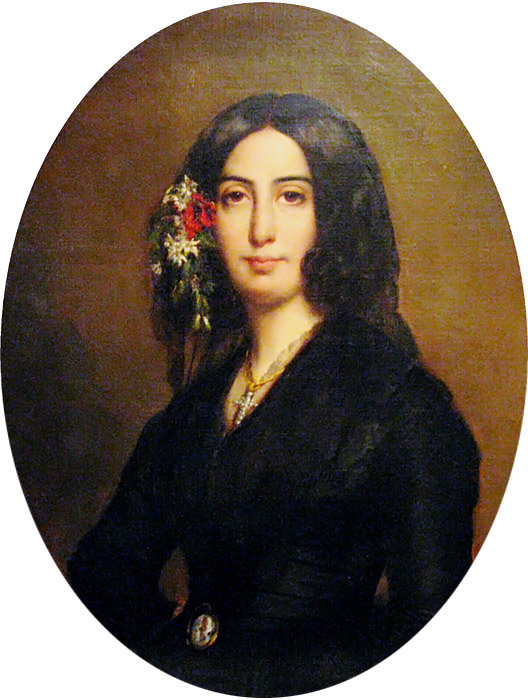
Portrait of George Sand
During the nineteenth century, it was the bohemian milieu of the artist that was the most popular environment for cigars. Indeed, the cigar became something of a characteristic feature: all those engaged in one way or another with art doted on cigars. Once again, the smoking of a cigar was soon perceived to be the height of elegance and panache — this time for both men and women. The author George Sand (real name Amandine Aurore Lucie Dupin) once shocked a young Russian aristocrat by lighting up a truly enormous cigar. A different but equally strong reaction came from General Gallifet, a model of military strictness to his men, who observed a young lady touching a match to a cheroot and could not restrain himself from striding up to her and embracing her in his powerful arms while saying, ‘Come on, my dear, let’s go and stand in front of the urinal together…!’
Other writers inspired by the world of cigar-smoking included Prosper Merimee, whose story of a gypsy girl working in a cigar and cigarette factory became the libretto for the extremely successful opera Carmen, composed by Georges Bizet. It was a story that actually derived from real life: Merimee had visited the cigar factory in Seville and had met the charmingly beautiful gypsy girls employed there. As the heroine of the opera, Carmen was the basis of the myth that the girls who made the cigars added something of themselves, something indefinable and almost mystical, to enhance the excellence of the cigars they made.
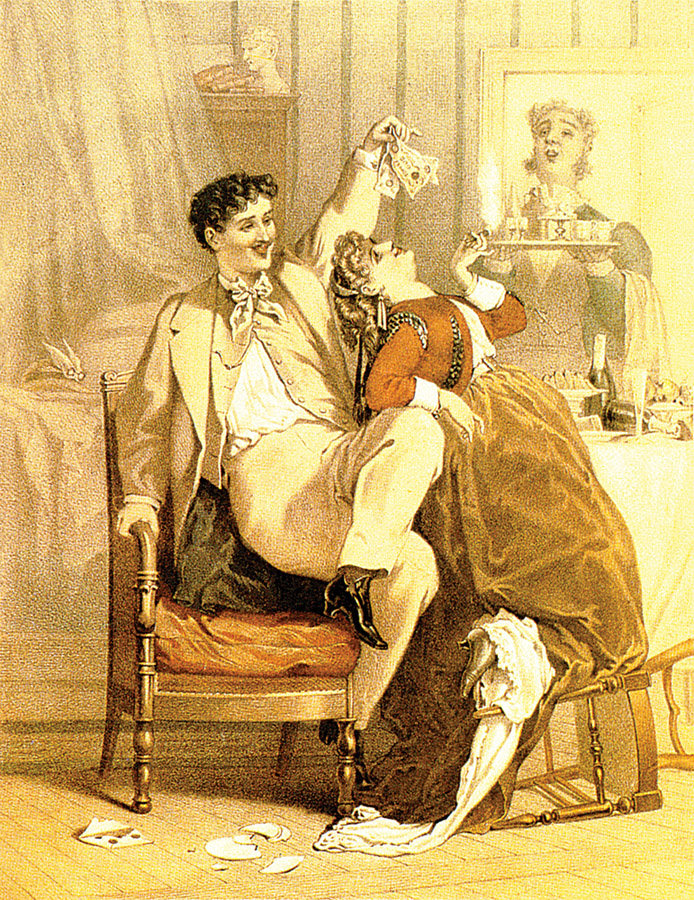
Student in Paris Published in La Lanterne Comique
Novelist Pierre Louys described the girls. ‘Yes, there were certainly some skinny little bodies among that weird assortment of humanity, but they were all interesting. And I stopped short more than once at the sight of a shapely woman’s figure. […] A warmly passionate upper body, nicely rounded, with the velvety sheen of a fruit and a skin coloration that was bright and clear and deep, from which jutted — with some elan — both the armpits clothed in curly astrakhan fur and the darker tops of the swelling breasts.’
The poet Theophile Gautier also found them beautiful, sensual — and chain-smoking cigars. ‘Quite a few of them kept a cigar butt stuck in one corner of the mouth with all the insouciance of an officer of the hussars.’
In his collection Zino Davidoff preserved a letter written in 1857 by a young woman. With it was a silk cigar-band, a sentimental souvenir of ‘a very special evening party’.
Influenced by the example of their aristocratic betters the Dandies, and of their artistic brethren the bohemians, the intelligentsia of the middle classes rapidly and in great numbers took up cigar-smoking.
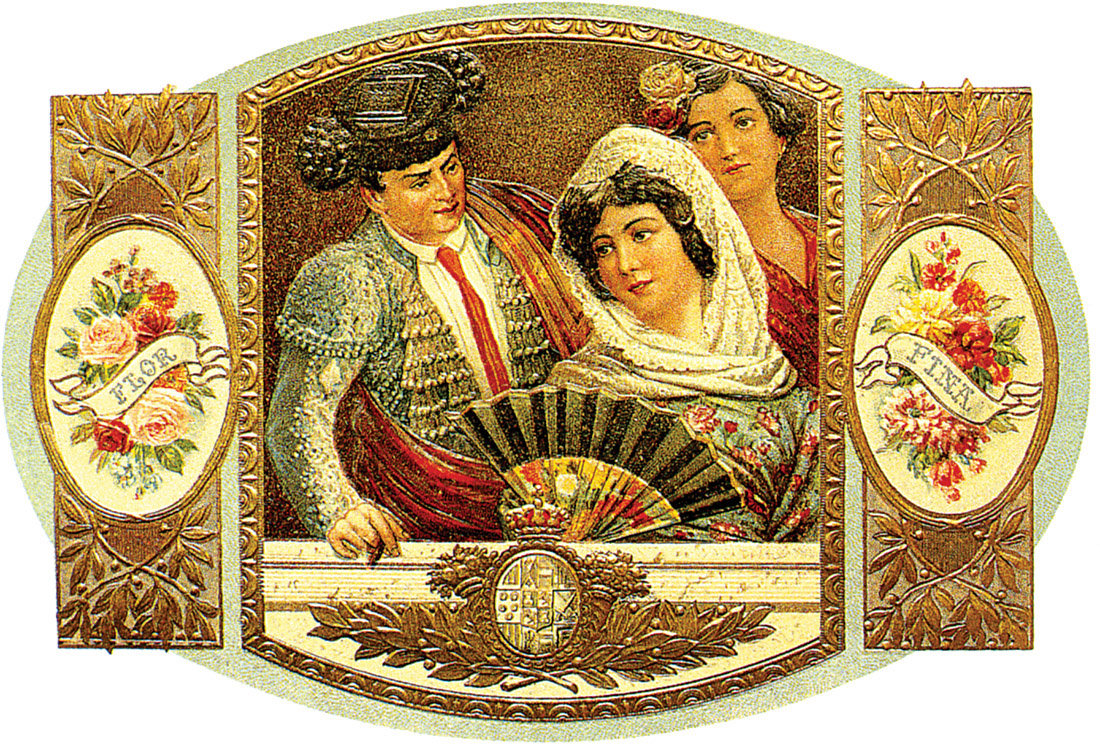
Cartoon drawn by Caran d’Ache