Death of Innocence
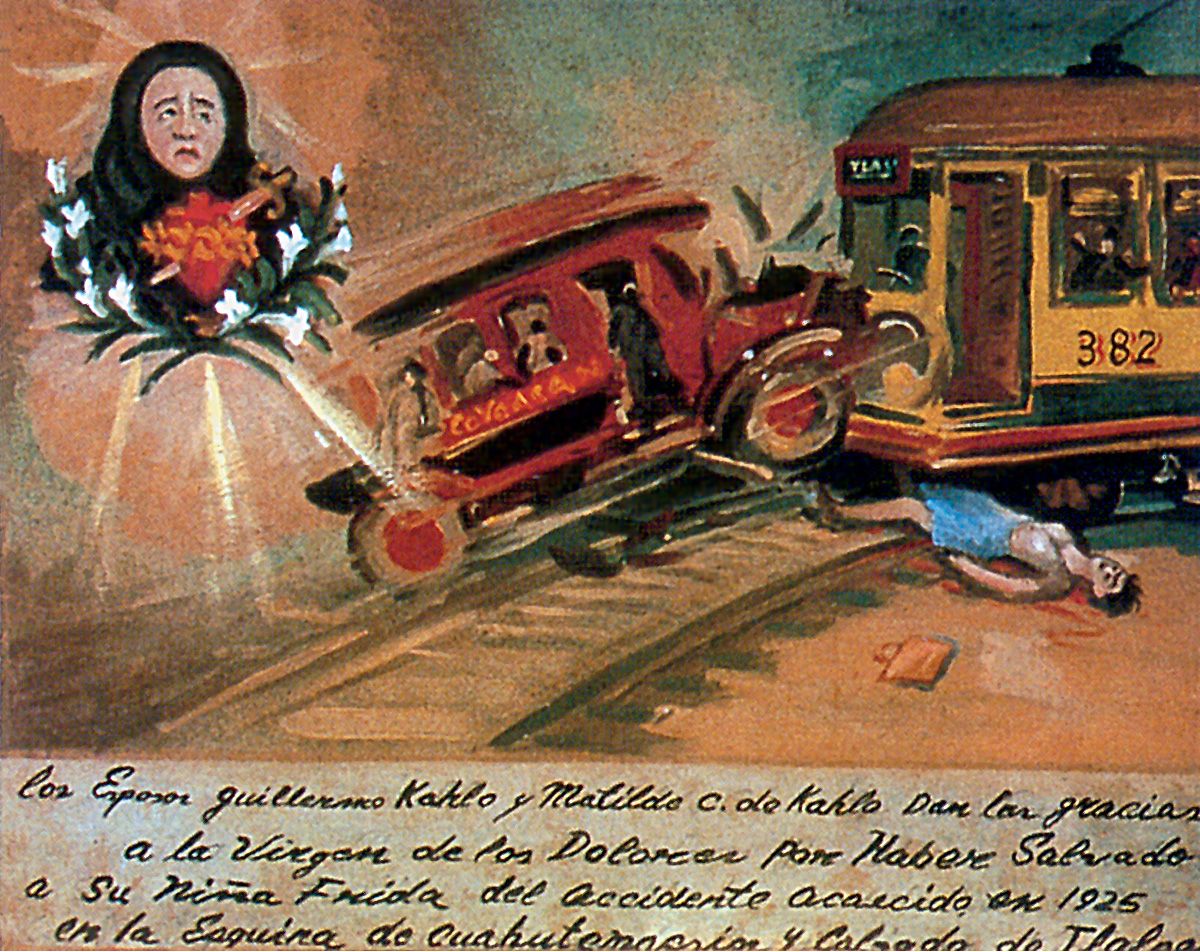
The devastation to Frida Kahlo’s body can only be imagined, but its implications were far worse once she realised she would survive. This vital vivacious young girl on the brink of any number of career possibilities had been reduced to a bed-bound invalid.
Only her youth and vitality saved her life, but what kind of life did she face? Her father’s ability to earn enough money to feed his family and pay Frida’s medical bills had diminished with the Mexican economy. This necessitated lengthening her stay in the overburdened, undermanned Red Cross hospital for a month.
“The Red Cross Hospital was very poor. We were kept in a kind of tremendous slave quarters, and the meals were so vile they could hardly be eaten. One lone nurse took care of 25 patients.”[3]
After being pinned to her bed, swathed in plaster and bandages, she was eventually allowed to go home to La Casa Azul. Being away from her friends in Mexico City, she penned a voluminous correspondence to them and especially to Alejandro Gómez Arias.
Their sexual relationship ended prior to the accident and they had agreed each could see other people.
When they met as “friends” however, Frida shrugged off Alejandro’s boasts of female conquests. But he became sullen when she ticked off the young men she had bedded. They were too much alike.
While she was recuperating from the accident, Alejandro’s parents sent him to Europe and to study in Berlin. The long separation and worldly adventure considerably cooled what ardour remained in him for the small town Mexican girl he left behind.
Frida, conversely, kept up a flurry of letters filled with pitiful longing to see him as she lay in her plaster prison.
“When you come I won’t be able to offer you anything you’d want. Instead of having short hair and being a flirt, I’ll only have short hair and be useless, which is worse.”
“All these things are a constant torment. All of life is in you, but I can’t have it… I’m very foolish and suffering much more than I should.”
“I’m quite young and it is possible for me to be healed, only I can’t believe it; I shouldn’t believe it, should I? You’ll surely come in November.”[4]
Gradually, her indomitable will asserted itself and she began to make decisions within the narrow view she commanded.
By December, 1925, she regained the use of her legs. One of her first painful journeys was to Mexico City and the home of Alejandro Gómez Arias just before Christmas. She waited outside his door, but he never came out to meet her.
Shortly thereafter, she was felled by shooting pains in her back and more doctors trooped into her life.
Her three undiagnosed spinal fractures were discovered and she was immediately encased in plaster once again.
Trapped and immobilised after those brief days of freedom, she began realistically narrowing her options. At the Preparatory School she had begun studies that would lead to a career in medicine. That dream faded when she accepted her physical limitations.
As days of soul searching continued, she passed the time painting scenes from Coyoacán, and portraits of relatives and her friends who came to visit.
As an artist, she only visited the scene of her accident once in a pencil drawing that showed her bandaged body with the small bus and the trolley car crushed together against the corner of the market building.
It was a cathartic drawing, pulled from her imagination and the testimony of others. How many times in her dreams and day dreams had she stood apart from that terrible scene before she drew it – and then left it unfinished?
The praise her paintings elicited surprised her and she began deciding who would receive the painting before she started it – often writing the name of the recipient on the canvas.
She gave them away as keepsakes, assigning them no value except as tokens of her feelings. Of these early efforts, her best portraits succeeded in reaching beneath the skin of the sitter and stood alone and original without technical tricks, or imposed sentiment.
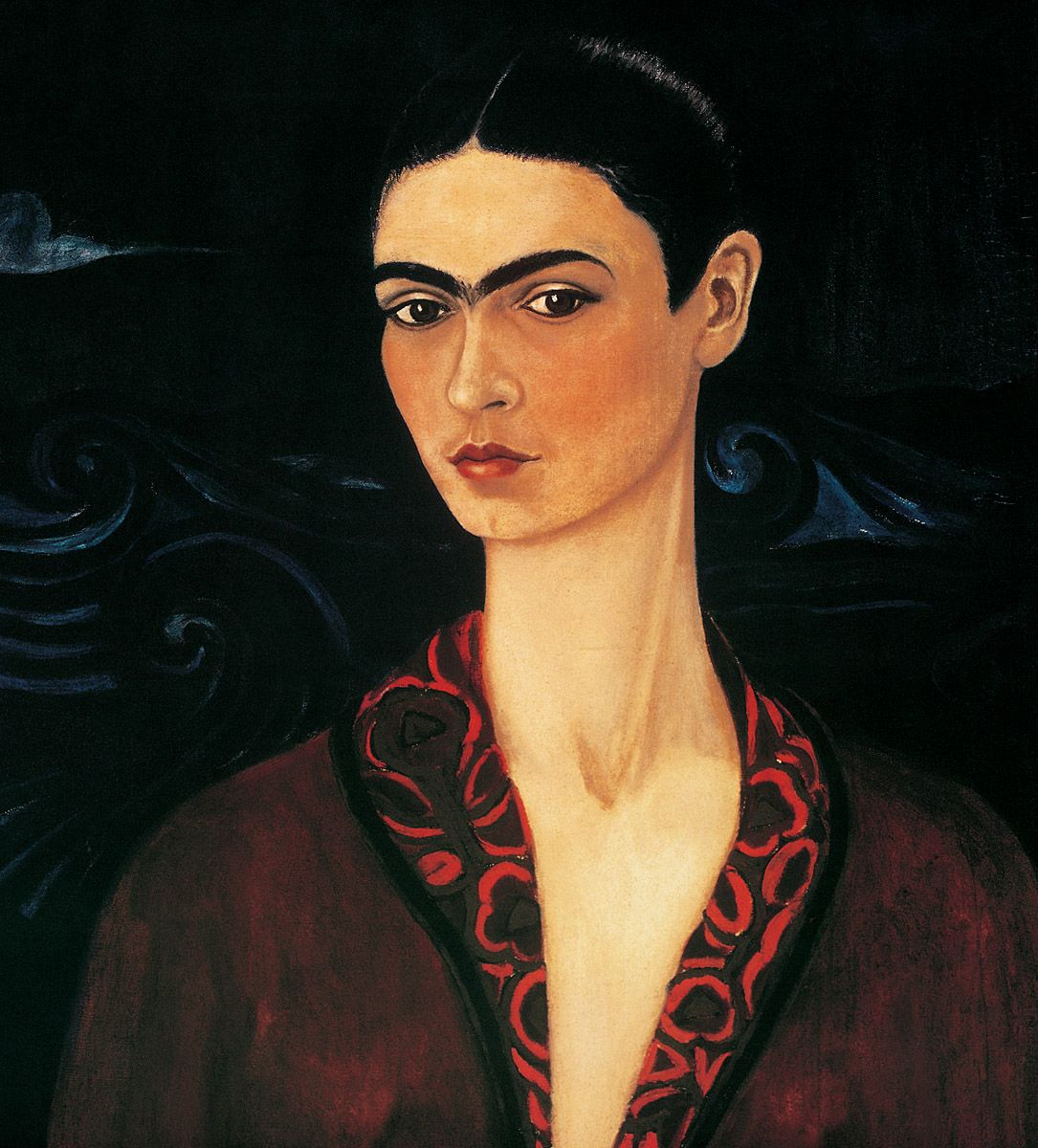
Her most successful work was a self-portrait, painted specifically for Alejandro Gómez Arias in yet another vain attempt to win him back.
With this painting, she began a remarkable lifetime series of fully realised Frida Kahlo reflections, both introspective and revealing, that examined her world from behind her own eyes and from within that crumbling patchwork of a body. Officially titled Self-Portrait with Velvet Dress, her 1926 gift to Alejandro was named, “Your Botticeli” (sic).
While on his tour of Europe, Arias had mentioned that Italian girls were “so exquisite, they look like they were painted by Botticelli”.
Frida added some of the elegant mannerisms of the sixteenth-century painter, Bronzino (1503-1572), a favourite of hers. In the portrait she holds her hand open to Arias, a possible desire for reconciliation.
Her skin glows with an ivory cast and the blush of health in her cheeks, not the pasty face of a surrendering invalid. Her gaze is direct and challenging beneath her exaggerated single eyebrow.
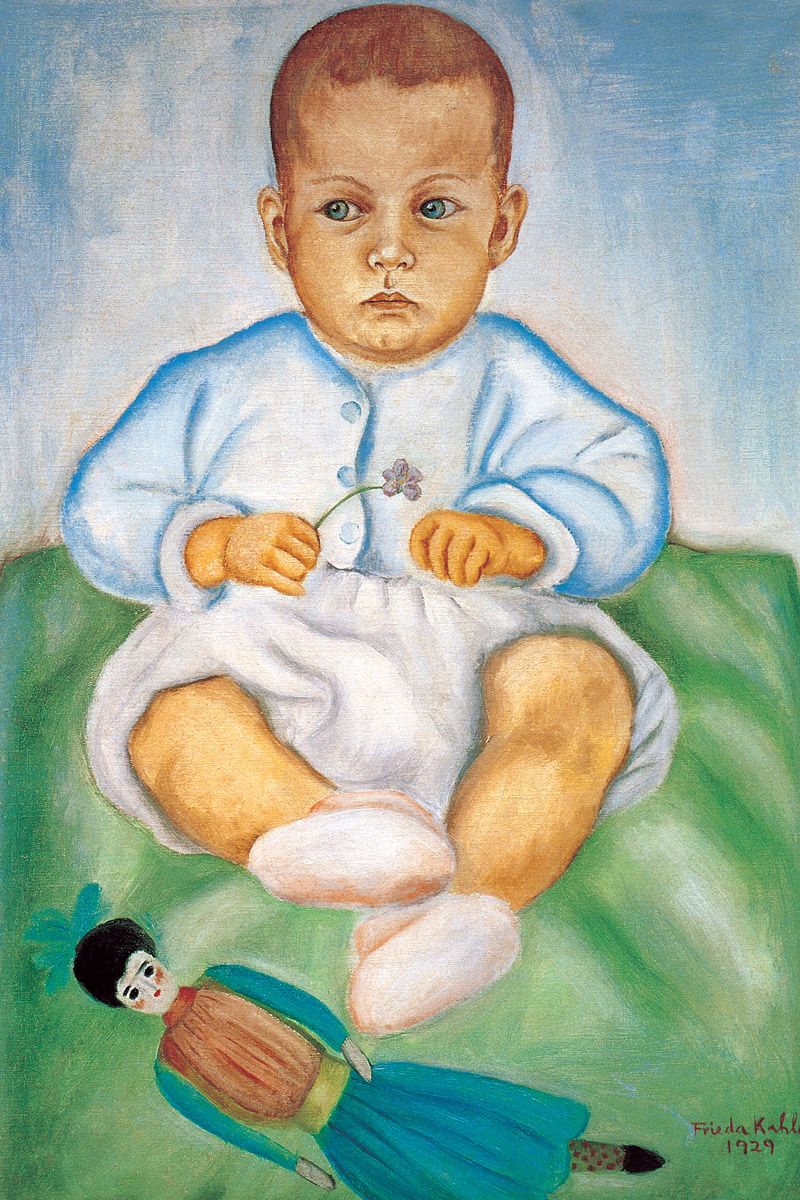
Frida Kahlo, Girl in Diaper (Portrait of Isolda Pinedo Kahlo), 1929. Oil on canvas, 65.5 x 44 cm. Private collection.
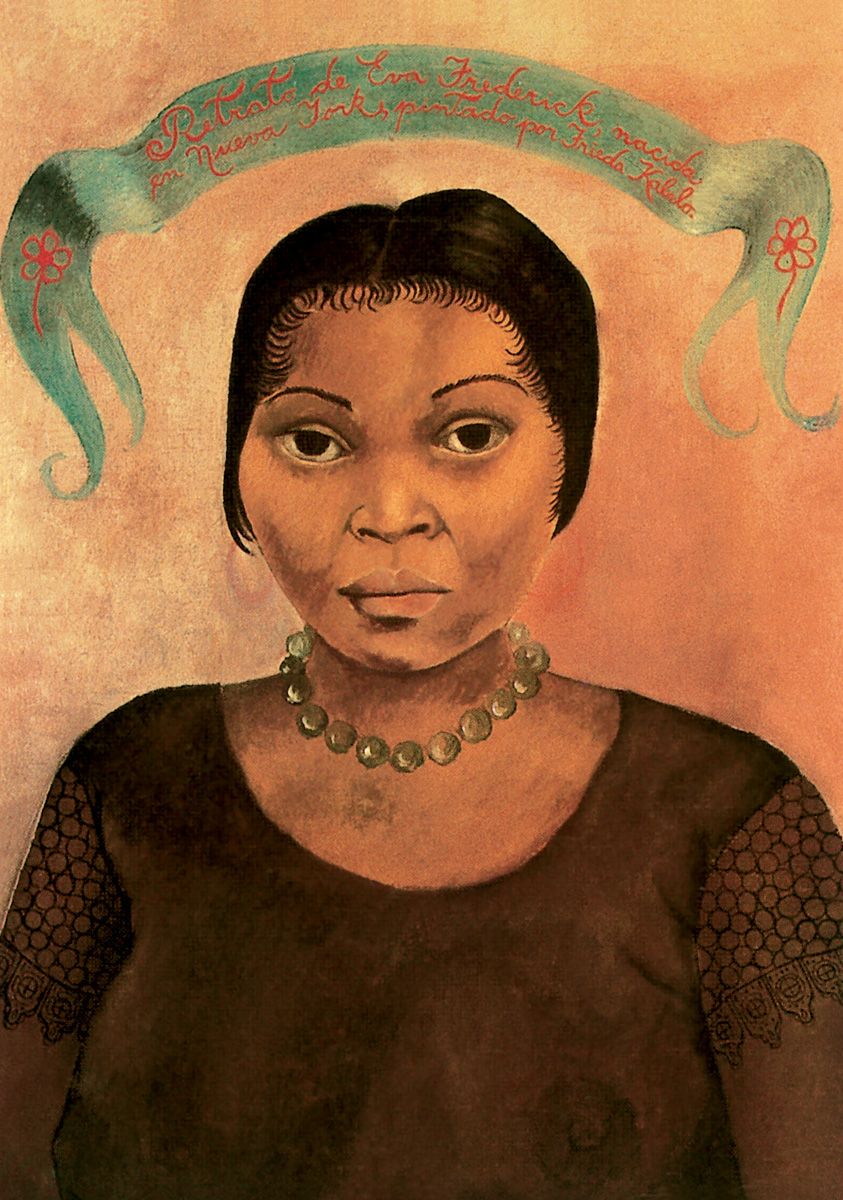
Frida Kahlo, Portrait of Eva Frederick, 1931. Oil on canvas, 63 x 46 cm. Museo Dolores Olmedo, Mexico City.
What she gives away with her open Bronzino hand, she takes back with the defiance of a survivor. This stoic, examining and unsmiling gaze is the pose that she adopted in real life.
As if to add a period to her message, across the bottom of the canvas she wrote:
“For Alex, Frida Kahlo, at the age of 17, September 1926 – Coyoacán – Heute Ist immer noch (Today is like always).”
In other words, she is saying “If you ever did love me, then today is like always and that love is still there”. Frida Kahlo consistently maintained her own demanding reality that no one, not even Diego Rivera, ever succeeded in penetrating to its steel core.
Through 1927 and 1928, Frida painted portraits of those close to her. She captured the glacial beauty of her friend, Alicia Galant.
Frida’s younger sister, Cristina, is rendered in shimmering pastel tints that surround a sharply executed and resolute face. Frida painted her toddler niece, Isolda Pinedo Kahlo as cotton soft with the child’s favourite doll lying ignored at her feet, but with roaming eyes looking for escape from the boredom of sitting.
With each painting, Frida’s confidence grew along with her technical facility.
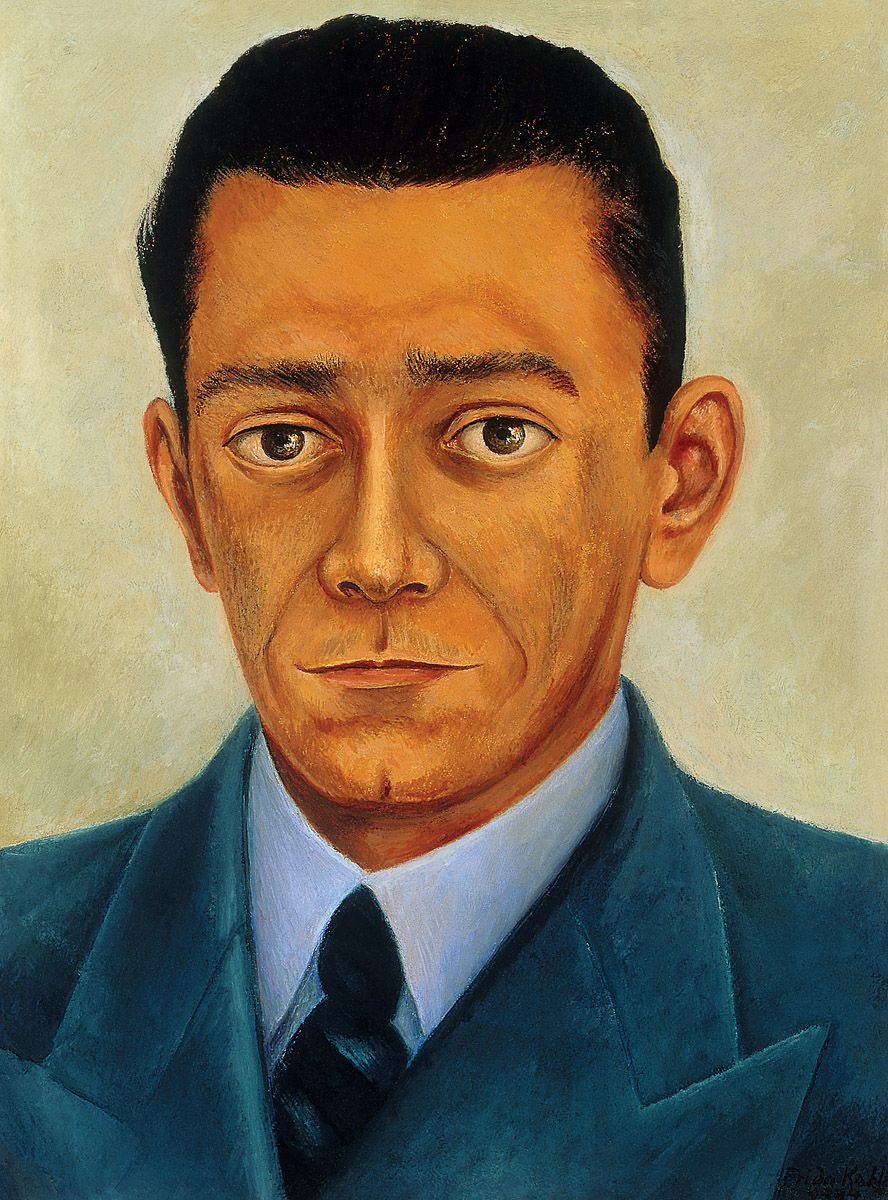
The diminished state of her relationship with Alejandro Gómez Arias is obvious in her 1928 portrait of him. He looks like a school boy in his first grown-up suit. His expression is haunted and unsure.
The boy in the painting has either missed a great opportunity and is completely unaware – or, more likely, he has dodged a passionate, all-consuming bullet and is relieved. As with almost all the men in her life, he remained a close friend, held in her orbit by the mutual fascination that first drew them together.
By 1928, Frida had recovered enough to set aside her orthopaedic corsets and escape the narrow world of her bed to walk out of La Casa Azul once again into the social and political stew that was Mexico City.
She began re-exploring the heady world of Mexican art and politics. She wasted no time in hooking up with her old comrades from the various cliques at the Preparatory School. Soon, as she drifted from one circle to another, she fell in with a collection of aspiring politicians, anarchists and Communists who gravitated around the American expatriate, Tina Modotti.
Tina was a beautiful woman who came to Mexico in 1923 to study photography with her lover, the artistically ascetic American photographer Edward Weston. When he returned to California in 1924, she remained behind to begin a short storied life as an excellent photographer in her own right and companion to an assortment of revolutionaries.
During the First World War and the early 1920s, many American intellectuals, artists, poets and writers fled the United States to Mexico and later to France in search of cheap living and political idealism. They banded together to praise or condemn each other’s works and drafted windy manifestos while participating in one long inebriated party that lasted several years, lurching from apartment to salon to saloon and back.
While most were a motley collection of exiles who skipped across the border just ahead of bankruptcy and bad debts, some genuine talents added their luster to Mexican society. John Dos Passos lived for some periods in Mexico City as did Katherine Anne Porter and poet Hart Crane.[5]
These expatriates fashioned a sentimental vision of the noble peasant toiling in the fields and promoted the Mexican view of life as fiestas y siestas interrupted by the occasional bloody peasant revolt and a scattering of political assassinations.
Into this tequila-fueled debating society stepped the formidable presence of Diego Rivera, the prodigal returned home from 14 years abroad and having been kicked out of Moscow. Despite his rude treatment at the hands of Stalinist art critics and the Russian government’s unveiled threats of harm if he did not leave, Diego embraced Communism as the world’s salvation.
Soon after his return to Mexico in 1921, he sought out pro-Mexican art movements, Mexican muralists and easel painters, photographers, and writers.
Within this deeply Mexicanistic society, Tina Modotti’s circle of expatriates and fellow travellers fit right in to the party circuit. Diego also went to work on another series of murals for the government ministry of education.
Frida drifted into this stimulating circle. She and Tina Modotti became friends. Possessing similar incendiary personalities and sensual vitality, they drank and danced deep into the hot Mexican nights at the moveable salons. In the sweltering rooms, crowded with drunken eccentrics and oblivious hangers-on, political rhetoric or denunciations of artistic merit often took on an edge.
Challenges sometimes required redress by gunplay. Gulping down a quart of tequila did not enhance marksmanship and usually, when the smoke cleared, the only casualties were the furniture, walls, streetlamps and at one particular salon, a record player. As Frida recalled her first meeting with her future husband:
“We got to know each other at a time when everybody was packing pistols; when they felt like it, they simply shot up the street lamps in Avenida Madero. Diego once shot a gramophone at one of Tina’s parties. That was when I began to be interested in him although I was also afraid of him.”[6]
So, the small and still physically frail Frida Kahlo had a chance to see old soft Panzón in a different light, gripping a smoking Colt revolver in a crowded room suddenly fallen silent.
The chubby muralist had hidden layers to him as well as a manly set of cojones. And Diego saw the same flash in the school girl who had stood eye to eye with his now ex-wife, Lupe Marín, and held her ground.
This was more than a spoiled child of the bourgeoisie who smiled back at him through the cigar smoke, punctuating her intelligent vocabulary with vulgar street slang for effect. She challenged him and Diego Rivera, ever the swordsman, never refused a challenge.
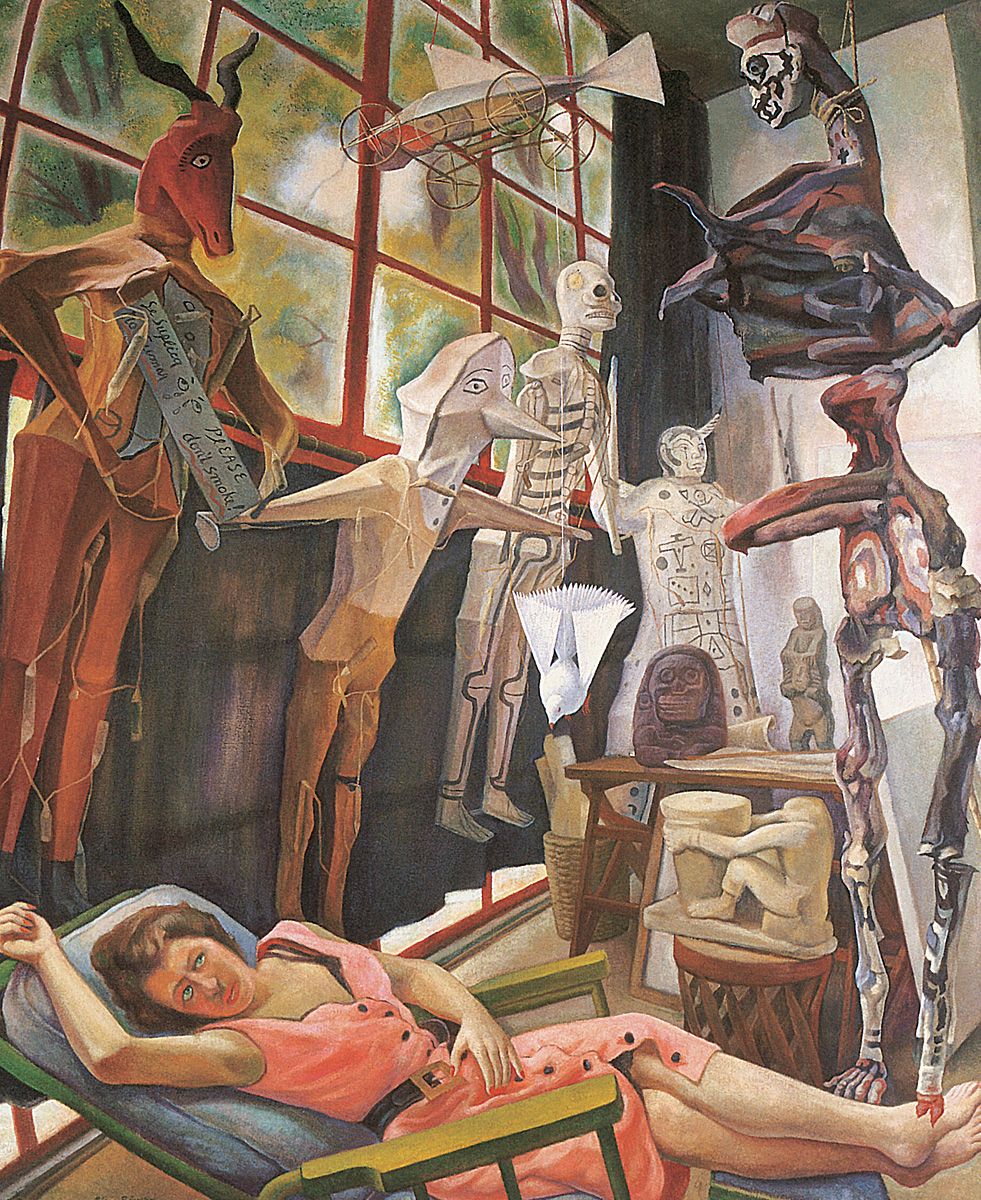
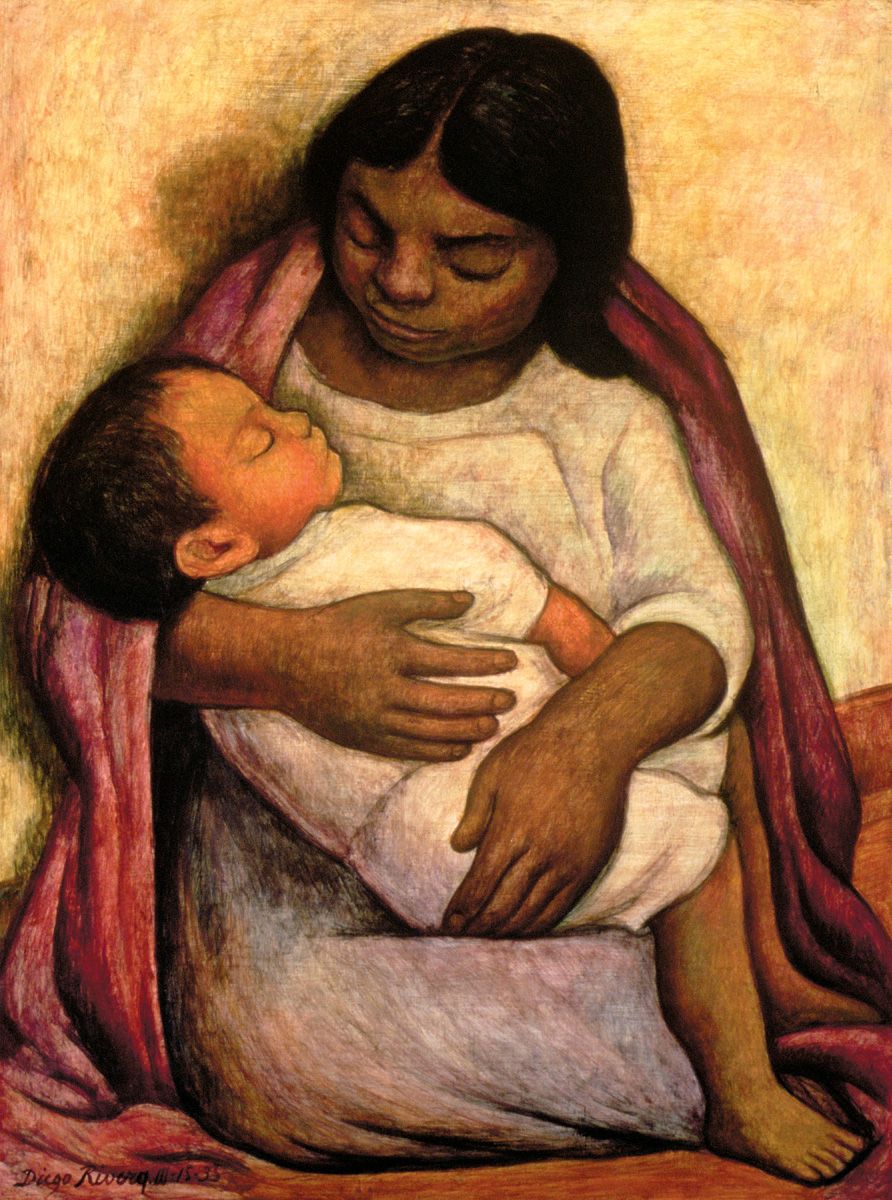
Diego Rivera, Artist’s Studio, 1954. Oil on canvas, 179 x 150 cm. Collection Acervo Patrimonial de la Secretaría de Hacienda y Crédito Público, Mexico.
The actual point of their first meeting is difficult to discover since they were both elaborate story tellers who often bent the truth to fit the moment.
There’s a charming tale that has Frida rising from her bed, tucking some of her work under her arm and hobbling with a cane to where Diego worked on the ministry of education murals. She calls to him high on the scaffolding:
“Diego, come down!”
He peers into the courtyard at this young girl wearing a blue and white European school costume, long braids and leaning on a cane. It was his curse to be easily distracted from his work so he lumbers down the rickety stairs.
“But I haven’t come here to flirt”, she says, “even though you’re a notorious ladies’ man. I just want to show you my pictures. If you find them interesting, tell me; if not, tell me anyway because then I’ll find something else to do to support my family”.
The big man with the shaggy head of hair and paint-smeared apron wrapped around his girth looks at each painting. He separates one from the other three and looks at it for a longer time.
“First of all, I like the self-portrait. That is original. The other three pictures seem to have been influenced by things you must have seen somewhere. Now, go home and paint another picture. Next Sunday I’ll come and tell you what I think of it”.
Frida finishes her tale, “He did just that and concluded that I was talented”.[7]
If this romantic story is to be believed, Diego Rivera concluded more than the depth of her talent. His original interest in the cheeky young girl, whose feisty attitude had charmed him, turned to a deeper respect, an appreciation of her as a fellow artist to whom he could relate on many different levels.
It wasn’t long before he dusted off his brown Stetson hat, shook out his sagging jacket, polished the toes of his boots on the backs of his pant legs and began showing up at La Casa Azul every Sunday.
Diego had become a courting suitor. Frida’s mother was against the match. She likened Diego to a big toad standing in the doorway. Guillermo Kahlo took Diego aside, steering him into the central courtyard.
Diego may have looked like a fat toad. He may have been twenty years her senior. He was divorced – twice – and an atheist, and a Communist to boot, but he was also a famous painter who had commissions and money and the respect of both the government and the artistic community to which Guillermo Kahlo aspired.
Guillermo leaned close. “Do you realise she’s a little devil?”
Diego nodded, “I know”.
Guillermo made a final appeal, “She is a sick person and all her life she will be sick. She is intelligent, but not pretty. Think it over if you want, and if you wish to get married, I give you my permission”.
Diego nodded again, “Gracias”.
Guillermo nodded. “All right, you’ve been warned”.[8]
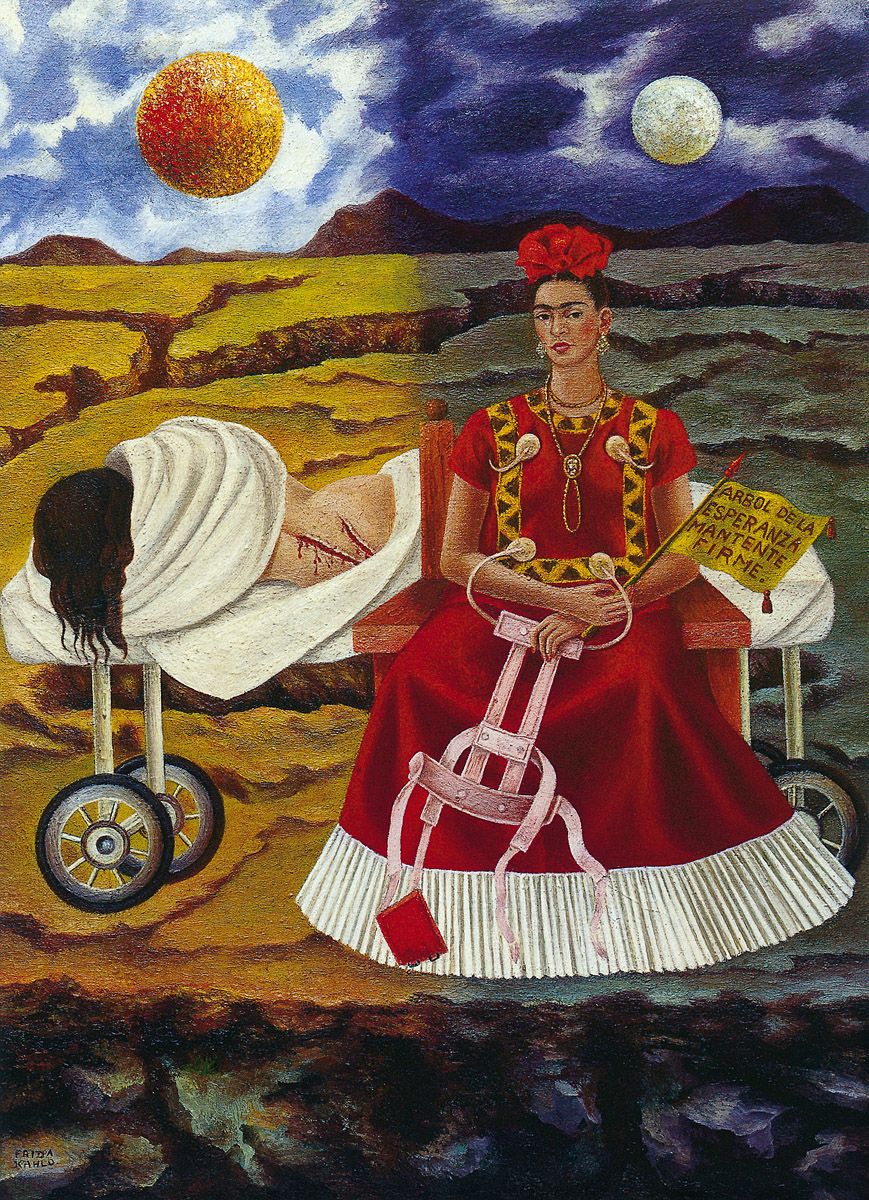
Frida Kahlo, Tree of Hope, Keep Strong, 1946. Oil on masonite, 55.9 x 40.6 cm. Isidore Ducasse Collection, France.
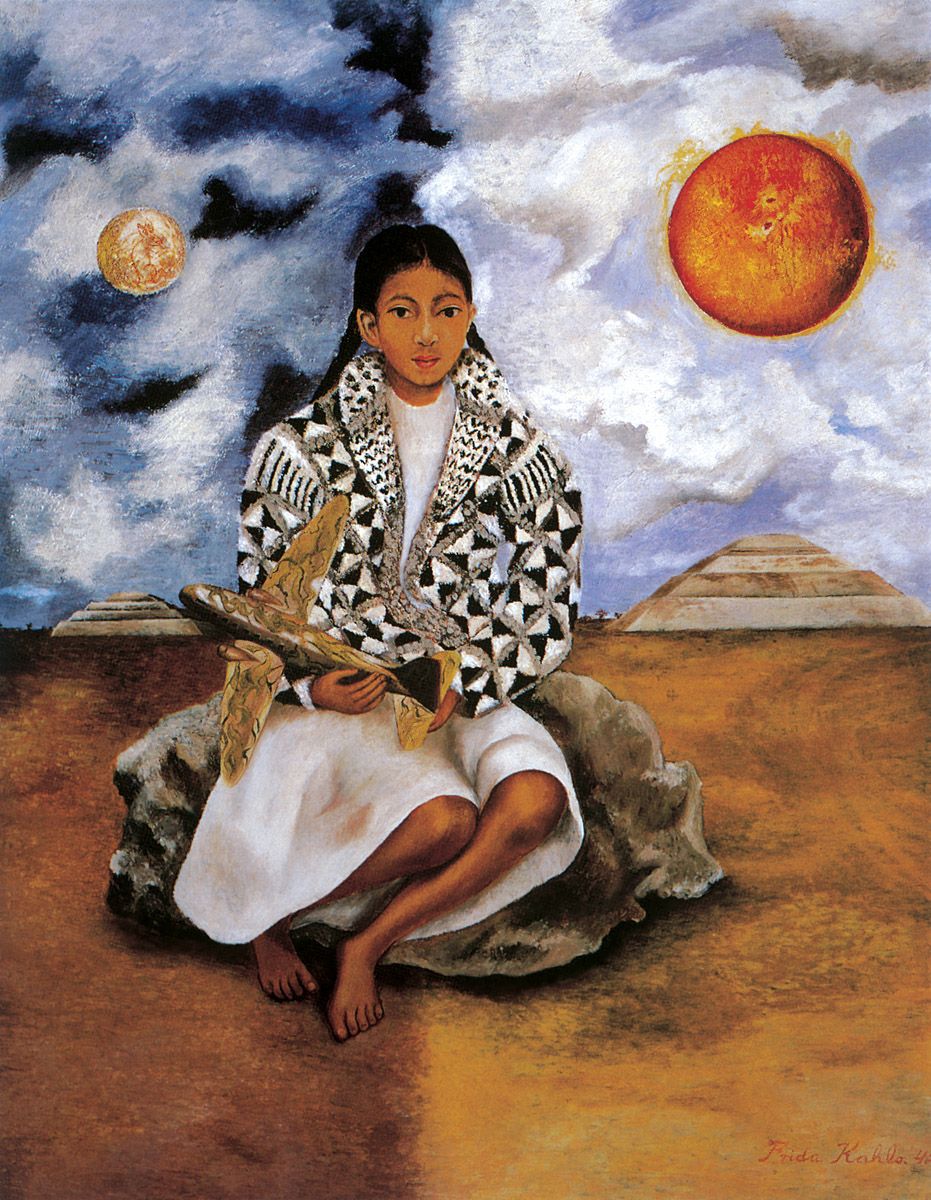
Frida Kahlo, Portrait of Lucha Maria, a girl from Tehuacán, (Sun and moon), 1942. Oil on masonite, 54.6 x 43.1 cm. Private collection.
Letter to Alejandro Gómez Arias
May 31, 1927
I’m almost finished with Chong Lee [Miguel Lira]’s portrait; I’m going to send you a photograph of it. [...] This gets worse and worse every day. I’ll have to convince myself that it is necessary, almost for sure, to be operated on. Otherwise, time goes by and suddenly you’ve wasted a hundred pesos, given away to a pair of thieves – that’s what most doctors are. The pain continues exactly the same in my bad leg and sometimes the good one hurts too; so I’m getting worse and worse, and without the least hope of getting better, because for that I need the most important thing: money. The sciatic nerve is damaged, as well as another nerve – whose name I don’t know – that branches into the genitals. I don’t know what’s wrong with two vertebrae and there’s buten other things that I can’t explain to you because I don’t understand them myself, so I don’t know what the operation will consist of, since nobody can explain it. You can imagine, from what I am telling you, the hope I have of being, if not well, at least better, by the time you arrive. I understand that it is necessary in this case to have a lot of faith, but you can’t imagine, not even for a moment, how much I suffer with this, precisely because I don’t think I’m going to recover. A doctor with some interest in me could possibly make me feel better, at least, but all these doctors who have been treating me are meanies who don’t care about me at all and who spend their time stealing. So I don’t know what to do and to despair is useless. [...] Lupe Vélez is shooting her first movie with Douglas Fairbanks, did you know that? How are the movie theatres in Germany? What other things about painting have you learned and seen? Are you going to go to Paris? How is the Rhine; German architecture? Everything.
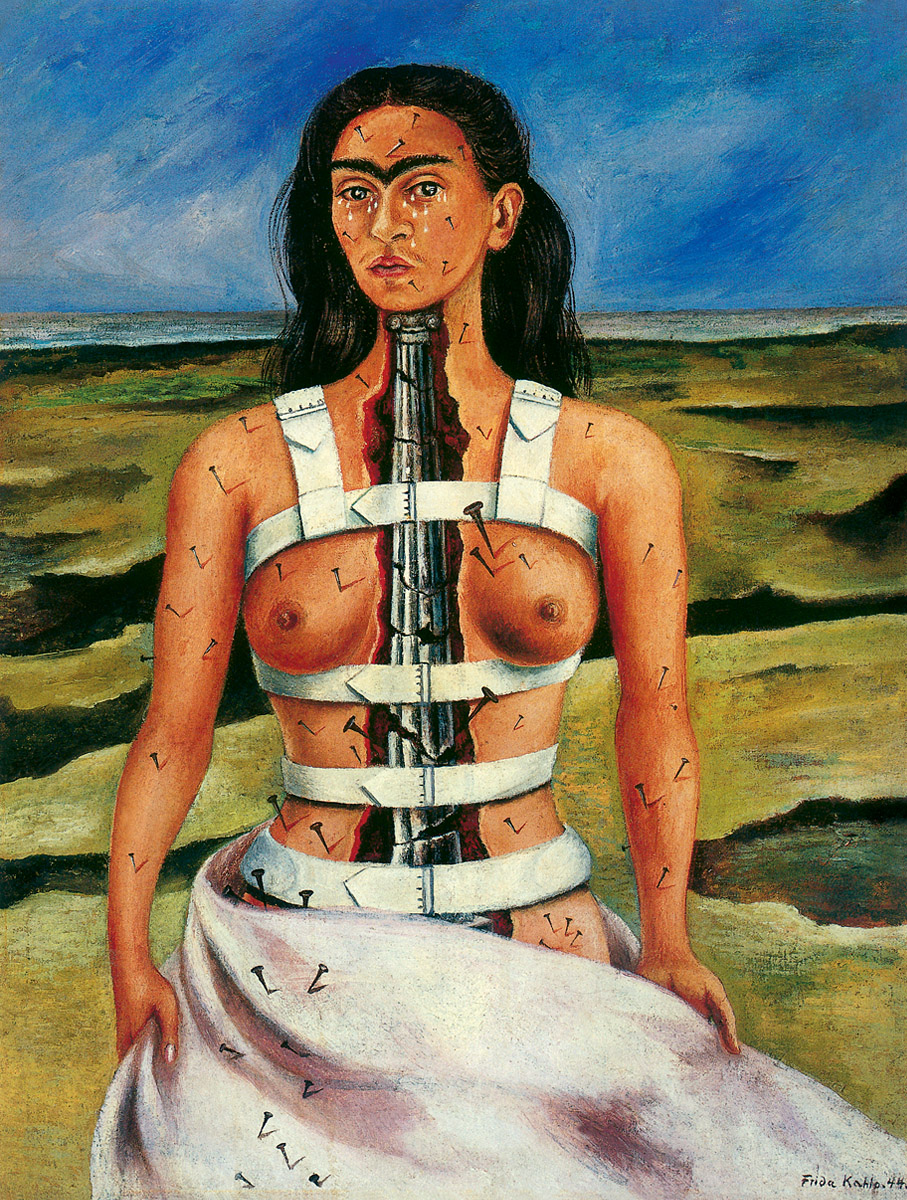
Frida Kahlo, The Broken Column, 1944. Oil on masonite, 39 x 30.5 cm. Museo Dolores Olmedo, Mexico City.
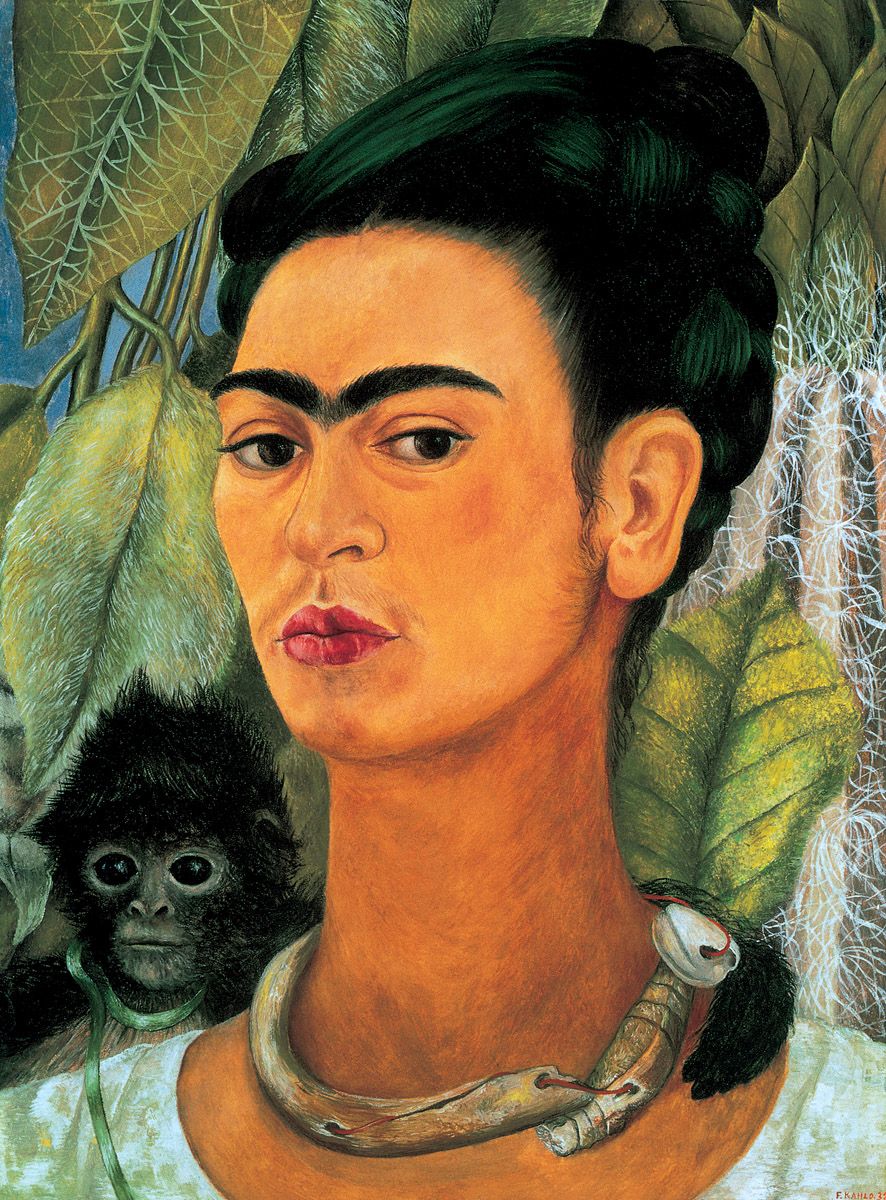
Frida Kahlo, Self-Portrait with Monkey, 1938. Oil on masonite, 49.5 x 39.4 cm. Albright-Knox Art Gallery, Buffalo (New York).
Letter to Alejandro Gómez Arias
July 23, 1927
My Alex:
I just received your letter…You tell me that you will be taking a boat to Naples and that it is almost certain that you will go to Switzerland too. Let me ask you a favour: tell your aunt that you want to come back, that you don’t want to stay there after August under any circumstances... you can’t imagine what every day, every minute without you means to me...
Cristina [her younger sister] is still very pretty, but she is very mean to me and to my mother.
I did a portrait of Lira because he asked me to, but it is so bad that I don’t understand how he can tell me that he likes it. Buten horrible. I am not sending you the photograph since my dad doesn’t have all the plates in order yet because of the move; but it’s not worth it, since it has a very corny background and he looks like a cardboard figure. I only like one detail (one angel in the background), you’ll see it. My dad also took pictures of the others, of Adnana, of Alicia [Galant] with the veil (very bad), and of the one who aimed to be Ruth Quintanilla and that Salas likes. As soon as my dad makes me more copies I will send them to you. He only made one of each, but Lira took them away, because he says he is going to publish them in a magazine that is going into circulation in August (he must have already talked to you about it, hasn’t he?). It will be named Panorama, and the contributors for the first issue will be, among others, Diego, Montenegro (as a poet), and who knows how many others. I don’t think it will be anything very good. I already tore up Rios’s portrait, because you can’t imagine how it still annoyed me. Flaquer wanted to keep the backdrop (the woman and the trees) and the portrait ended its life as Joan of Arc did. Tomorrow is Cristina’s saint’s day. The boys are going to come over and so are the two children of Mr Cabrera, the lawyer. They don’t look like him (they are very stupid) and they barely speak Spanish, because they have lived in the United States for twelve years and they only come to Mexico for vacations. The Galants will come too, la Pinocha [Esperanza Ordonez], etc... Only Chelo Navarro is not coming as she’s still in bed because of her baby girl; they say she’s very cute. This is all that is going on in my house, but none of this interests me.
Tomorrow it will be a month and a half since I got the cast, and four months since I last saw you. I wish that next month life would start and I could kiss you. Will this come true?
Your sister,
Frieda
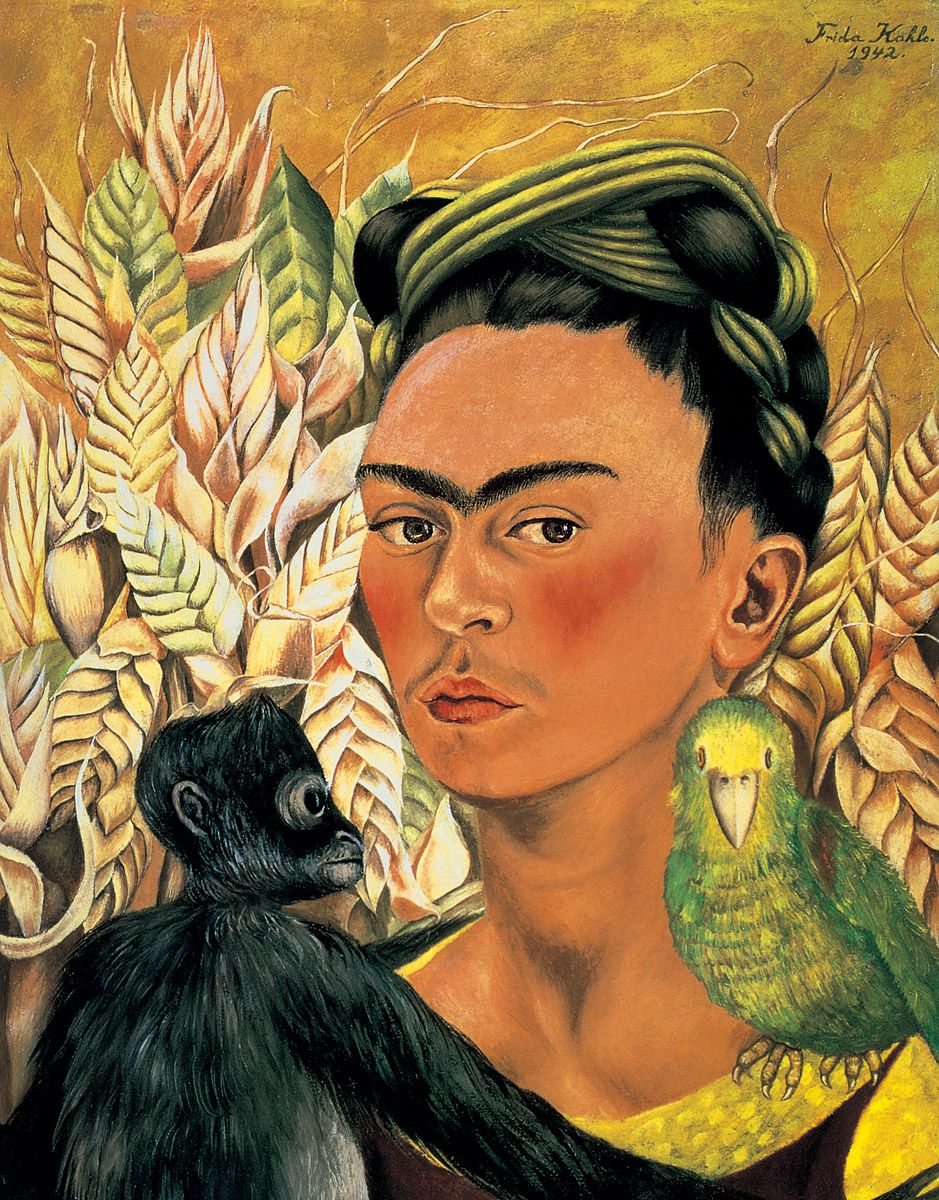
Frida Kahlo, Self-Portrait with Monkey and Parrot, 1942. Oil on masonite, 54.6 x 43.2 cm. Private collection.
Letter to Alejandro Gómez Arias
April 31 [1927], Sunday Labour Day
My Alex,
I just got your letter of the 13th, and this has been the only happy moment in all this time. Even though thinking of you always helps me to feel less sad, your letters help even more. How I wish I could explain to you, minute by minute, my suffering. Since you left, I’ve gotten worse and I cannot for a moment either console myself or forget you. Friday, they put the plaster cast on me, and since then it’s been a real martyrdom that is not comparable to anything else. I feel suffocated, my lungs and my whole back hurt terribly; I can’t even touch my leg. I can hardly walk, let alone sleep. Imagine, they hung me by just my head for two and a half hours, and then I stood on my tiptoes for more than one hour while [the cast] was dried with hot air; but when I got home, it was still completely wet.
They put it on me at the Hospital de las Damas Francesas, because at the Hospital Frances it would have been necessary to stay at least a week, as they wouldn’t do it otherwise. At the other hospital they started to put it on me at 9:15 A.M. and I was able to leave at approximately 1 P.M. They didn’t let Adriana [her sister] or anybody else in, and I was suffering horribly, all by myself. I’m going to have this martyrdom for three or four months, and if I don’t get well with that, I sincerely want to die, because I can’t stand it anymore. It’s not only the physical suffering, but also that I don’t have the least entertainment. I never leave this room, I can’t do anything, I can’t walk. I’m completely desperate and, above all, you’re not here. On top of that, I only hear bad news. My mother is still very sick, she’s had seven strokes this month, and my father is the same, and broke. There’s something to be completely desperate about, don’t you think? I lose weight every day, and nothing amuses me anymore. The only thing that makes me happy is that the boys visit me; last Thursday Chong, el Güero Garay, Salas, and Goch came, and they’re going to come back on Wednesday. Nevertheless, this makes me suffer too because you’re not with us.
Your little sister and your mum are doing well, but I’m sure they would give anything to have you here; do everything you can to come back soon. Don’t doubt, even for a moment, that I’ll be exactly the same person when you come back. And you – don’t forget me and write to me a lot. I look forward to getting your letters almost with anguish; they make me feel infinitely well.
Never stop writing to me, at least once a week; you promised. Tell me if I can write to you at the Mexican Legation in Berlin or at the same place as always. I need you so much, Alex! [water sign as signature]
Frida Kahlo, Self-Portrait wearing a Velvet Dress (detail), 1926. Oil on canvas, 12.5 x 17 cm. Museo Frida Kahlo, Mexico City.
Frida Kahlo, Portrait of Engineer Eduardo Morillo, date unknown. Oil on masonite, 39.5 x 29.5 cm. Museo Dolores Olmedo, Mexico City.
Letter to Guillermo Kablo
San Francisco, Cal. November 21, 1930
Lovely Daddy,
If you knew the pleasure getting your little letter gave me, you’d write to me every day, because you can’t imagine how happy it made me. The only thing I didn’t like is that you told me that you are still quick-tempered, but since I am just like you, I understand you very well, and I know that it is very hard to control oneself. Anyway, try as hard as you can; at least do it for mum who is so nice to you. Diego laughed really hard at what you told me about the Chinese, but he says he will take care of me so they won’t kidnap me. I am well, under [a treatment of] injections by a certain Dr. Eloesser, who is of German origin but speaks Spanish better than someone from Madrid, so I can clearly explain to him everything I feel. I’m learning a little bit of English every day, and I can at least understand the essentials, shop at stores, etc., etc…
Tell me in your reply how you are and how mum and everybody are doing. I miss you very much – you know how much I love you – but certainly in March we will be together again and we will talk a whole lot. Don’t fail to write me and feel free to let me know if you need some money. Diego sends his warmest wishes and says that he doesn’t write to you because he has so much to do.
I send you all my affection and a thousand kisses. Your daughter who adores you, Frieducha
Here is a kiss
Write to me everything you do and everything that happens to you